

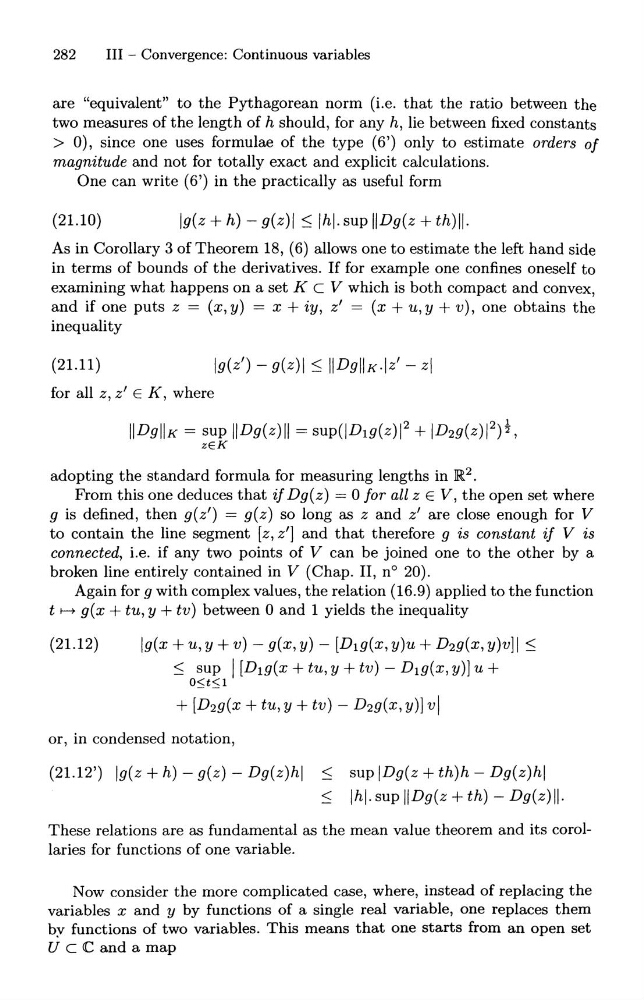
282
III - Convergence: Continuous variables
are "equivalent" to the Pythagorean norm (Le. that the ratio between the
two measures of the length of h should, for any h, lie between fixed constants
> 0), since one uses formulae of the type (6') only to estimate orders of
magnitude and not for totally exact and explicit calculations.
One can write (6') in the practically as useful form
(21.10)
Jg(z + h) - g(z)J :::; JhJ. sup IiDg(z + th)JJ.
As in Corollary 3 of Theorem 18, (6) allows one to estimate the left hand side
in terms of bounds of the derivatives. If for example one confines oneself to
examining what happens on a set K c V which is both compact and convex,
and if one puts z = (x,y) = x + iy, z' = (x + u,y + v), one obtains the
inequality
(21.11)
Jg(z') - g(z)J :::; JJDgIiK.Jz' - zJ
for all z, z' E K, where
adopting the standard formula for measuring lengths in ~.2.
From this one deduces that if Dg(z) = 0 for all z E V, the open set where
9 is defined, then g(z') = g(z) so long as z and z' are close enough for V
to contain the line segment [z, z'] and that therefore 9 is constant if V is
connected, Le. if any two points of V can be joined one to the other by a
broken line entirely contained in V (Chap. II, nO 20).
Again for 9 with complex values, the relation (16.9) applied to the function
t 1-+ g(x + tu, y + tv) between 0 and 1 yields the inequality
(21.12)
Jg(x + u, y + v) - g(x, y) - [Dlg(X, y)u + D2g(x, y)v] J :::;
:::; sup I [D1g(x + tu, y + tv) - D1g(x, y)] u +
099
+ [D2g(X + tu, y + tv) - D2g(x, y)] vi
or, in condensed notation,
(21.12') Jg(z + h) - g(z) - Dg(z)hJ < sup JDg(z + th)h - Dg(z)hJ
< JhJ. sup JJDg(z + th) - Dg(z)li·
These relations are as fundamental as the mean value theorem and its corollaries for functions of one variable.
Now consider the more complicated case, where, instead of replacing the
variables x and y by functions of a single real variable, one replaces them
by functions of two variables. This means that one starts from an open set
U C
III - Convergence: Continuous variables
are "equivalent" to the Pythagorean norm (Le. that the ratio between the
two measures of the length of h should, for any h, lie between fixed constants
> 0), since one uses formulae of the type (6') only to estimate orders of
magnitude and not for totally exact and explicit calculations.
One can write (6') in the practically as useful form
(21.10)
Jg(z + h) - g(z)J :::; JhJ. sup IiDg(z + th)JJ.
As in Corollary 3 of Theorem 18, (6) allows one to estimate the left hand side
in terms of bounds of the derivatives. If for example one confines oneself to
examining what happens on a set K c V which is both compact and convex,
and if one puts z = (x,y) = x + iy, z' = (x + u,y + v), one obtains the
inequality
(21.11)
Jg(z') - g(z)J :::; JJDgIiK.Jz' - zJ
for all z, z' E K, where
adopting the standard formula for measuring lengths in ~.2.
From this one deduces that if Dg(z) = 0 for all z E V, the open set where
9 is defined, then g(z') = g(z) so long as z and z' are close enough for V
to contain the line segment [z, z'] and that therefore 9 is constant if V is
connected, Le. if any two points of V can be joined one to the other by a
broken line entirely contained in V (Chap. II, nO 20).
Again for 9 with complex values, the relation (16.9) applied to the function
t 1-+ g(x + tu, y + tv) between 0 and 1 yields the inequality
(21.12)
Jg(x + u, y + v) - g(x, y) - [Dlg(X, y)u + D2g(x, y)v] J :::;
:::; sup I [D1g(x + tu, y + tv) - D1g(x, y)] u +
099
+ [D2g(X + tu, y + tv) - D2g(x, y)] vi
or, in condensed notation,
(21.12') Jg(z + h) - g(z) - Dg(z)hJ < sup JDg(z + th)h - Dg(z)hJ
< JhJ. sup JJDg(z + th) - Dg(z)li·
These relations are as fundamental as the mean value theorem and its corollaries for functions of one variable.
Now consider the more complicated case, where, instead of replacing the
variables x and y by functions of a single real variable, one replaces them
by functions of two variables. This means that one starts from an open set
U C