

§4. Differentiable functions
267
or
(17.3)
Since the f~ converge uniformly on K to g, they satisfy Cauchy's criterion
for uniform convergence (nO 10, Theorem 12"); then (3) shows that the fn
do so too, and therefore they converge uniformly on K.
It remains to prove that the limit f of the f n is differentiable and that
f' = g. This reduces to showing that, for all a E I,
(17.4)
1 ·
1·
fn(x) - fn(a)
1·
1· fn(x) - fn(a)
1m 1m
=lmlm
.
x-+a n-+oo
X - a
n-+oo x-+a
X - a
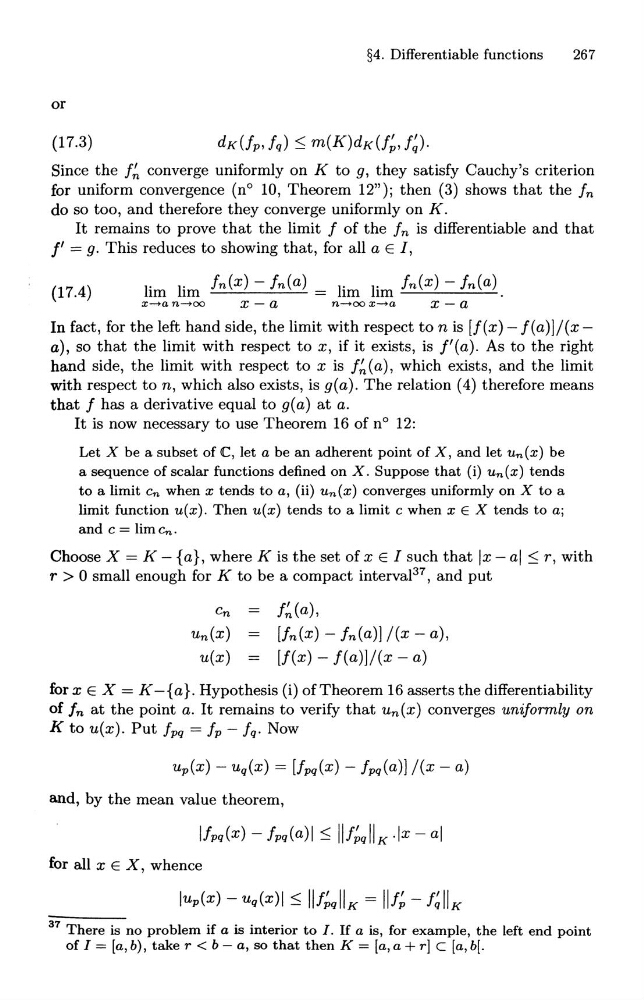
In fact, for the left hand side, the limit with respect to n is [f(x) - f(a)]j(xa), so that the limit with respect to x, if it exists, is f'(a). As to the right
hand side, the limit with respect to x is f~ (a), which exists, and the limit
with respect to n, which also exists, is g(a). The relation (4) therefore means
that f has a derivative equal to g( a) at a.
It is now necessary to use Theorem 16 of nO 12:
Let X be a subset of C, let a be an adherent point of X, and let un(x) be
a sequence of scalar functions defined on X. Suppose that (i) un(x) tends
to a limit en when x tends to a, (ii) un(x) converges uniformly on X to a
limit function u(x). Then u(x) tends to a limit c when x E X tends to aj
and c = limen.
Choose X = K - {a}, where K is the set of x E I such that Ix - al ~ r, with
r > 0 small enough for K to be a compact interva1 37 , and put
f~(a),
[fn(x) - fn(a)] I(x - a),
[f(x) - f(a)]j(x - a)
for x E X = K -{a}. Hypothesis (i) of Theorem 16 asserts the differentiability
of fn at the point a. It remains to verify that un(x) converges uniformly on
K to u(x). Put fpq = fp - fq. Now
Up(x) - uq(x) = [fpq(x) - fpq(a)] I(x - a)
and, by the mean value theorem,
for all x E X, whence
37 There is no problem if a is interior to I. If a is, for example, the left end point
of 1= [a,b), take r < b - a, so that then K = [a,a + r] c [a,b[.
267
or
(17.3)
Since the f~ converge uniformly on K to g, they satisfy Cauchy's criterion
for uniform convergence (nO 10, Theorem 12"); then (3) shows that the fn
do so too, and therefore they converge uniformly on K.
It remains to prove that the limit f of the f n is differentiable and that
f' = g. This reduces to showing that, for all a E I,
(17.4)
1 ·
1·
fn(x) - fn(a)
1·
1· fn(x) - fn(a)
1m 1m
=lmlm
.
x-+a n-+oo
X - a
n-+oo x-+a
X - a
In fact, for the left hand side, the limit with respect to n is [f(x) - f(a)]j(xa), so that the limit with respect to x, if it exists, is f'(a). As to the right
hand side, the limit with respect to x is f~ (a), which exists, and the limit
with respect to n, which also exists, is g(a). The relation (4) therefore means
that f has a derivative equal to g( a) at a.
It is now necessary to use Theorem 16 of nO 12:
Let X be a subset of C, let a be an adherent point of X, and let un(x) be
a sequence of scalar functions defined on X. Suppose that (i) un(x) tends
to a limit en when x tends to a, (ii) un(x) converges uniformly on X to a
limit function u(x). Then u(x) tends to a limit c when x E X tends to aj
and c = limen.
Choose X = K - {a}, where K is the set of x E I such that Ix - al ~ r, with
r > 0 small enough for K to be a compact interva1 37 , and put
f~(a),
[fn(x) - fn(a)] I(x - a),
[f(x) - f(a)]j(x - a)
for x E X = K -{a}. Hypothesis (i) of Theorem 16 asserts the differentiability
of fn at the point a. It remains to verify that un(x) converges uniformly on
K to u(x). Put fpq = fp - fq. Now
Up(x) - uq(x) = [fpq(x) - fpq(a)] I(x - a)
and, by the mean value theorem,
for all x E X, whence
37 There is no problem if a is interior to I. If a is, for example, the left end point
of 1= [a,b), take r < b - a, so that then K = [a,a + r] c [a,b[.