

f(a) + df(a; h)
f(a+h)
f(a)
o
fig. 14.
§4. Differentiable functions
245
a
a+h
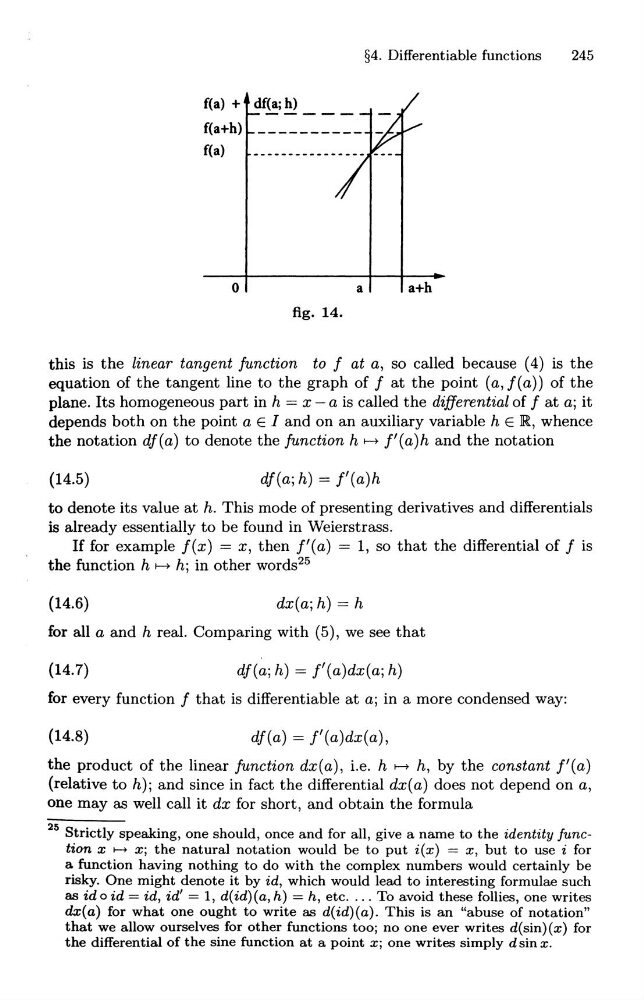
this is the linear tangent function to f at a, so called because (4) is the
equation of the tangent line to the graph of f at the point (a, f(a)) of the
plane. Its homogeneous part in h = x - a is called the differential of f at a; it
depends both on the point a E I and on an auxiliary variable hER., whence
the notation df(a) to denote the function h 1--+ f'(a)h and the notation
(14.5)
df(a; h) = f'(a)h
to denote its value at h. This mode of presenting derivatives and differentials
is already essentially to be found in Weierstrass.
If for example f(x) = x, then f'(a) = 1, so that the differential of f is
the function h 1--+ h; in other words 25
(14.6)
dx(a; h) = h
for all a and h real. Comparing with (5), we see that
(14.7)
df(a; h) = f'(a)dx(a; h)
for every function f that is differentiable at a; in a more condensed way:
(14.8)
df(a) = f'(a)dx(a),
the product of the linear function dx(a), i.e. h 1--+ h, by the constant f'(a)
(relative to h); and since in fact the differential dx(a) does not depend on a,
one may as well call it dx for short, and obtain the formula
25 Strictly speaking, one should, once and for all, give a name to the identity function x ....... x; the natural notation would be to put i(x) = x, but to use i for
a function having nothing to do with the complex numbers would certainly be
risky. One might denote it by id, which would lead to interesting formulae such
as id 0 id = id, id' = 1, d(id)(a, h) = h, etc .... To avoid these follies, one writes
dx(a) for what one ought to write as d(id)(a). This is an "abuse of notation"
that we allow ourselves for other functions too; no one ever writes d(sin)(x) for
the differential of the sine function at a point x; one writes simply dsinx.
f(a+h)
f(a)
o
fig. 14.
§4. Differentiable functions
245
a
a+h
this is the linear tangent function to f at a, so called because (4) is the
equation of the tangent line to the graph of f at the point (a, f(a)) of the
plane. Its homogeneous part in h = x - a is called the differential of f at a; it
depends both on the point a E I and on an auxiliary variable hER., whence
the notation df(a) to denote the function h 1--+ f'(a)h and the notation
(14.5)
df(a; h) = f'(a)h
to denote its value at h. This mode of presenting derivatives and differentials
is already essentially to be found in Weierstrass.
If for example f(x) = x, then f'(a) = 1, so that the differential of f is
the function h 1--+ h; in other words 25
(14.6)
dx(a; h) = h
for all a and h real. Comparing with (5), we see that
(14.7)
df(a; h) = f'(a)dx(a; h)
for every function f that is differentiable at a; in a more condensed way:
(14.8)
df(a) = f'(a)dx(a),
the product of the linear function dx(a), i.e. h 1--+ h, by the constant f'(a)
(relative to h); and since in fact the differential dx(a) does not depend on a,
one may as well call it dx for short, and obtain the formula
25 Strictly speaking, one should, once and for all, give a name to the identity function x ....... x; the natural notation would be to put i(x) = x, but to use i for
a function having nothing to do with the complex numbers would certainly be
risky. One might denote it by id, which would lead to interesting formulae such
as id 0 id = id, id' = 1, d(id)(a, h) = h, etc .... To avoid these follies, one writes
dx(a) for what one ought to write as d(id)(a). This is an "abuse of notation"
that we allow ourselves for other functions too; no one ever writes d(sin)(x) for
the differential of the sine function at a point x; one writes simply dsinx.