

230
III - Convergence: Continuous variables
exists an an E F such that d(x, an) < d + lin, so that an E K for n large;
by BW, one can extract from the sequence (an) a subsequence converging to
an a E K, and since limd(x,an ) = d it is clear that d(x,a) = d, qed, since F
contains K.
There is 110 reason for the point a to be unique in general. But there is
an important particular case where Cauchy's criterion suffices to prove the
existence and the uniqueness of a simultaneously, namely the case where the
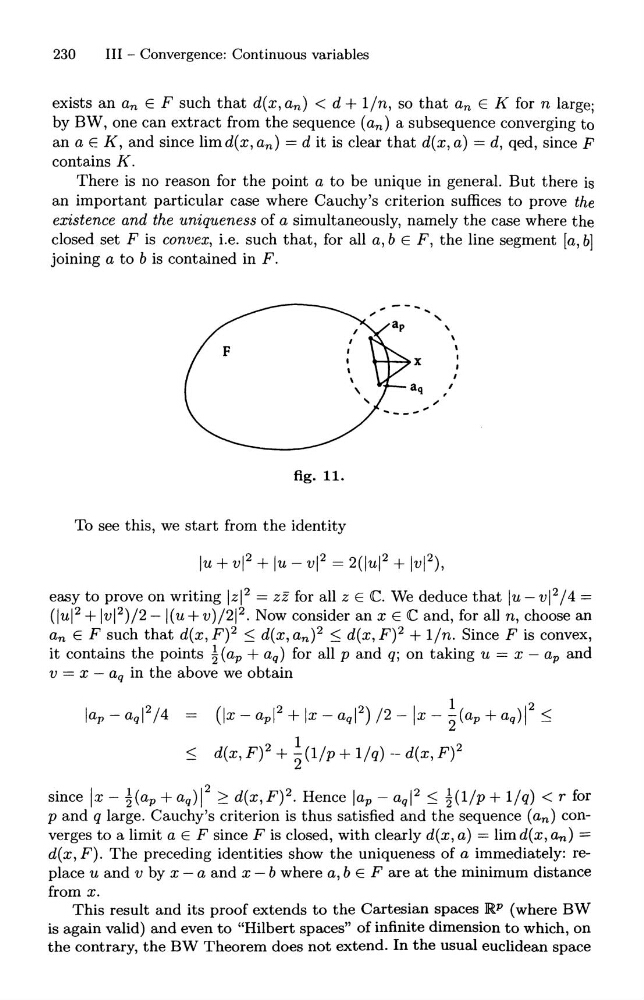
closed set F is convex, i.e. such that, for all a, b E F, the line segment [a, b]
joining a to b is contained in F.
,
fig. 11.
To see this, we start from the identity
easy to prove on writing Izl2 = zz for all z E C. We deduce that lu - vl 2 /4 =
(lul 2 + IvI 2 )/2 -I(u + v)/212. Now consider an x E C and, for all n, choose an
an E F such that d(x, F)2 :<:; d(x, an )2 :<:; d(x, F)2 + lin. Since F is convex,
it contains the points ! (ap + aq ) for all p and q; on taking u = x - ap and
v = x - aq in the above we obtain
(Ix - ap l 2 + Ix - aq l 2 ) /2 -Ix - ~(ap + aq )12 :<:;
<
1
d(x, F)2 + "2 (l/p + l/q) -- d(x, F)2
since Ix - !(ap + aq) 12 ~ d(x, F)2. Hence lap - aql 2 :<:; !(l/p + l/q) < r for
p and q large. Cauchy's criterion is thus satisfied and the sequence (an) converges to a limit a E F since F is closed, with clearly d(x, a) = limd(x, an) =
d(x, F). The preceding identities show the uniqueness of a immediately: replace u and v by x - a and x - b where a, b E F are at the minimum distance
from x.
This result and its proof extends to the Cartesian spaces IR P (where BW
is again valid) and even to "Hilbert spaces" of infinite dimension to which, on
the contrary, the BW Theorem does not extend. In the usual euclidean space
III - Convergence: Continuous variables
exists an an E F such that d(x, an) < d + lin, so that an E K for n large;
by BW, one can extract from the sequence (an) a subsequence converging to
an a E K, and since limd(x,an ) = d it is clear that d(x,a) = d, qed, since F
contains K.
There is 110 reason for the point a to be unique in general. But there is
an important particular case where Cauchy's criterion suffices to prove the
existence and the uniqueness of a simultaneously, namely the case where the
closed set F is convex, i.e. such that, for all a, b E F, the line segment [a, b]
joining a to b is contained in F.
,
fig. 11.
To see this, we start from the identity
easy to prove on writing Izl2 = zz for all z E C. We deduce that lu - vl 2 /4 =
(lul 2 + IvI 2 )/2 -I(u + v)/212. Now consider an x E C and, for all n, choose an
an E F such that d(x, F)2 :<:; d(x, an )2 :<:; d(x, F)2 + lin. Since F is convex,
it contains the points ! (ap + aq ) for all p and q; on taking u = x - ap and
v = x - aq in the above we obtain
(Ix - ap l 2 + Ix - aq l 2 ) /2 -Ix - ~(ap + aq )12 :<:;
<
1
d(x, F)2 + "2 (l/p + l/q) -- d(x, F)2
since Ix - !(ap + aq) 12 ~ d(x, F)2. Hence lap - aql 2 :<:; !(l/p + l/q) < r for
p and q large. Cauchy's criterion is thus satisfied and the sequence (an) converges to a limit a E F since F is closed, with clearly d(x, a) = limd(x, an) =
d(x, F). The preceding identities show the uniqueness of a immediately: replace u and v by x - a and x - b where a, b E F are at the minimum distance
from x.
This result and its proof extends to the Cartesian spaces IR P (where BW
is again valid) and even to "Hilbert spaces" of infinite dimension to which, on
the contrary, the BW Theorem does not extend. In the usual euclidean space