

210
III - Convergence: Continuous variables
7~'"T'~"M- ~ -"::'~~'~2- --I::":'t.'~~y_ -- -
"
, g •
' .
.
"
- -t
-
-
-
- ;- - -
- -
- - , - - -
, - - - -
I
I
I
,
,
,
,
" , :
1
,
'
,
,
1
,
I
1
,
I
I
I
I
I
,
t
,
b-27t
a
b
a+27t
b+27t
a+47t
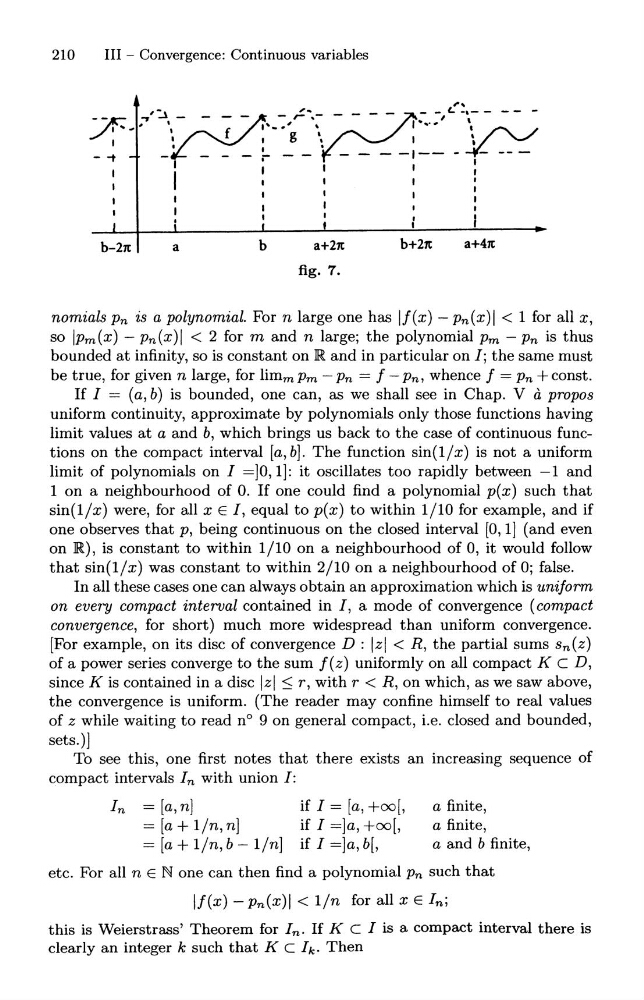
fig. 7.
nomials Pn is a polynomial. For n large one has I/(x) - Pn(x)1 < 1 for all x,
so IPm(x) - Pn(x)1 < 2 for m and n large; the polynomial Pm - Pn is thus
bounded at infinity, so is constant on IR and in particular on I; the same must
be true, for given n large, for limm Pm - Pn = 1- Pn, whence I = Pn + const.
If I = (a, b) is bounded, one can, as we shall see in Chap. V a propos
uniform continuity, approximate by polynomials only those functions having
limit values at a and b, which brings us back to the case of continuous functions on the compact interval [a, b]. The function sin(l/x) is not a uniform
limit of polynomials on I =]0,1]: it oscillates too rapidly between -1 and
1 on a neighbourhood of O. If one could find a polynomial p(x) such that
sin(l/x) were, for all x E I, equal to p(x) to within 1/10 for example, and if
one observes that P, being continuous on the closed interval [0, 1] (and even
on IR), is constant to within 1/10 on a neighbourhood of 0, it would follow
that sin(l/x) was constant to within 2/10 on a neighbourhood of 0; false.
In all these cases one can always obtain an approximation which is unilorm
on every compact interval contained in I, a mode of convergence (compact
convergence, for short) much more widespread than uniform convergence.
[For example, on its disc of convergence D : Izl < R, the partial sums sn(z)
of a power series converge to the sum I(z) uniformly on all compact KeD,
since K is contained in a disc Izl ~ r, with r < R, on which, as we saw above,
the convergence is uniform. (The reader may confine himself to real values
of z while waiting to read n° 9 on general compact, i.e. closed and bounded,
sets.)]
To see this, one first notes that there exists an increasing sequence of
compact intervals In with union I:
= [a,n]
= [a + l/n,n]
= [a + lin, b - l/n]
if I = [a, +00[,
if I =]a, +00[,
if I =]a, b[,
a finite,
a finite,
a and b finite,
etc. For all n E N one can then find a polynomial Pn such that
I/(x) - Pn(x)1 < l/n for all x E In;
this is Weierstrass' Theorem for In. If K C I is a compact interval there is
clearly an integer k such that K C h. Then
III - Convergence: Continuous variables
7~'"T'~"M- ~ -"::'~~'~2- --I::":'t.'~~y_ -- -
"
, g •
' .
.
"
- -t
-
-
-
- ;- - -
- -
- - , - - -
, - - - -
I
I
I
,
,
,
,
" , :
1
,
'
,
,
1
,
I
1
,
I
I
I
I
I
,
t
,
b-27t
a
b
a+27t
b+27t
a+47t
fig. 7.
nomials Pn is a polynomial. For n large one has I/(x) - Pn(x)1 < 1 for all x,
so IPm(x) - Pn(x)1 < 2 for m and n large; the polynomial Pm - Pn is thus
bounded at infinity, so is constant on IR and in particular on I; the same must
be true, for given n large, for limm Pm - Pn = 1- Pn, whence I = Pn + const.
If I = (a, b) is bounded, one can, as we shall see in Chap. V a propos
uniform continuity, approximate by polynomials only those functions having
limit values at a and b, which brings us back to the case of continuous functions on the compact interval [a, b]. The function sin(l/x) is not a uniform
limit of polynomials on I =]0,1]: it oscillates too rapidly between -1 and
1 on a neighbourhood of O. If one could find a polynomial p(x) such that
sin(l/x) were, for all x E I, equal to p(x) to within 1/10 for example, and if
one observes that P, being continuous on the closed interval [0, 1] (and even
on IR), is constant to within 1/10 on a neighbourhood of 0, it would follow
that sin(l/x) was constant to within 2/10 on a neighbourhood of 0; false.
In all these cases one can always obtain an approximation which is unilorm
on every compact interval contained in I, a mode of convergence (compact
convergence, for short) much more widespread than uniform convergence.
[For example, on its disc of convergence D : Izl < R, the partial sums sn(z)
of a power series converge to the sum I(z) uniformly on all compact KeD,
since K is contained in a disc Izl ~ r, with r < R, on which, as we saw above,
the convergence is uniform. (The reader may confine himself to real values
of z while waiting to read n° 9 on general compact, i.e. closed and bounded,
sets.)]
To see this, one first notes that there exists an increasing sequence of
compact intervals In with union I:
= [a,n]
= [a + l/n,n]
= [a + lin, b - l/n]
if I = [a, +00[,
if I =]a, +00[,
if I =]a, b[,
a finite,
a finite,
a and b finite,
etc. For all n E N one can then find a polynomial Pn such that
I/(x) - Pn(x)1 < l/n for all x E In;
this is Weierstrass' Theorem for In. If K C I is a compact interval there is
clearly an integer k such that K C h. Then