

208
III - Convergence: Continuous variables
x
fig. 5.
there exists N such that, for all x, PN(X).
There is a problem in permuting the logical operators "for all" and "there
exists" .
One meets this in everyday life. The two assertions
for all x E H there exists y E F such that C (x, y)
there exists y E F such that C(x, y) for all x E H
are not equivalent: even if every man had at least one partner, it would not
follow that there must be a woman belonging to all the men (or the opposite,
to remain politically correct).
fig. 6.
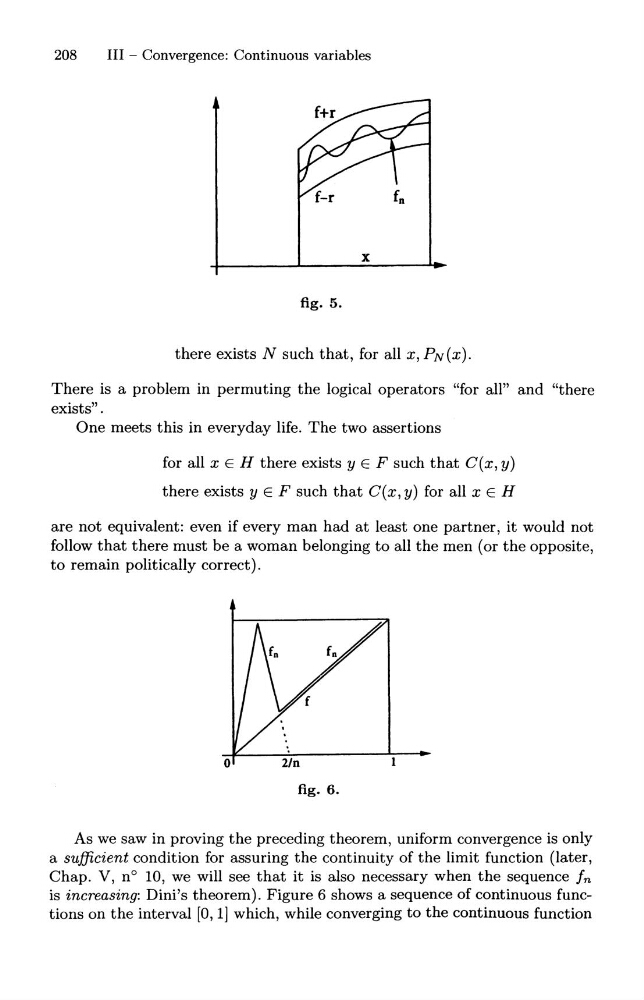
As we saw in proving the preceding theorem, uniform convergence is only
a sufficient condition for assuring the continuity of the limit function (later,
Chap. V, n° 10, we will see that it is also necessary when the sequence In
is increasing: Dini's theorem). Figure 6 shows a sequence of continuous functions on the interval [0, 1] which, while converging to the continuous function
III - Convergence: Continuous variables
x
fig. 5.
there exists N such that, for all x, PN(X).
There is a problem in permuting the logical operators "for all" and "there
exists" .
One meets this in everyday life. The two assertions
for all x E H there exists y E F such that C (x, y)
there exists y E F such that C(x, y) for all x E H
are not equivalent: even if every man had at least one partner, it would not
follow that there must be a woman belonging to all the men (or the opposite,
to remain politically correct).
fig. 6.
As we saw in proving the preceding theorem, uniform convergence is only
a sufficient condition for assuring the continuity of the limit function (later,
Chap. V, n° 10, we will see that it is also necessary when the sequence In
is increasing: Dini's theorem). Figure 6 shows a sequence of continuous functions on the interval [0, 1] which, while converging to the continuous function