

202
III - Convergence: Continuous variables
Theorem 7. Let f be a real function, defined and strictly monotone on an
interval I and let J = f(I) be the image of I under f. The following properties are then equivalent: (i) f is continuous, (ii) J is an interval. The map
g : J -? I inverse to f is then continuous and strictly monotone.
Since f is strictly monotone it is injective, so g exists and, like f, is strictly
monotone. The fact that (i) ==> (ii) has been established above. To show that
(ii) ==> (i) it suffices, by (i) ==> (ii) applied to g, to show that g is continuous.
Let b = f(a) be a point of J, with a E I. Choose an r > 0; we need only
prove that there exists an r' > 0 such that, for y E J, the relation Iy - bl < r'
implies Ig(y) - al < r. Suppose that f is increasing, for definiteness.
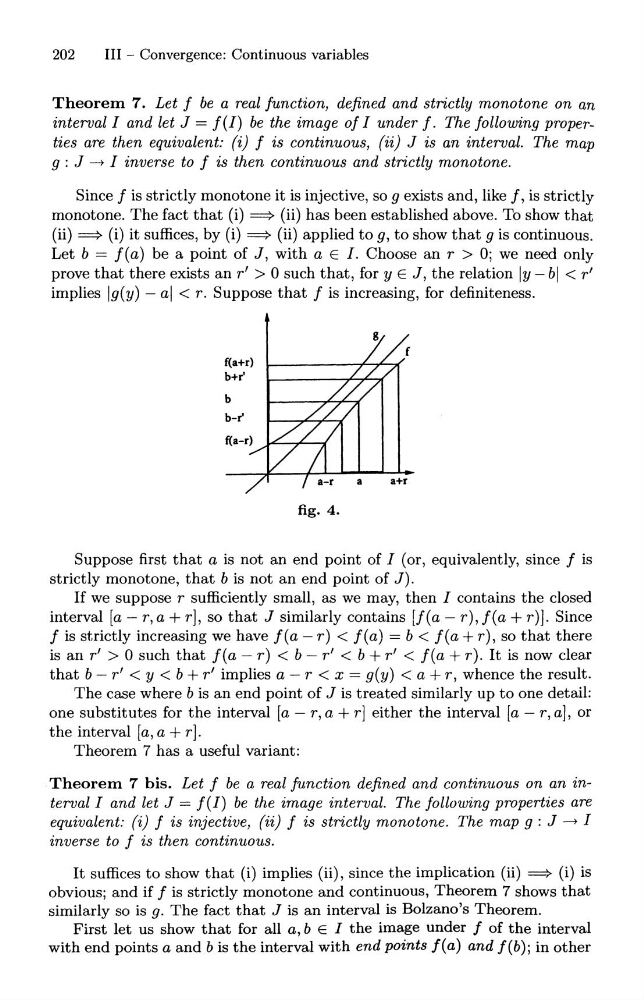
fig. 4.
Suppose first that a is not an end point of I (or, equivalently, since f is
strictly monotone, that b is not an end point of J).
If we suppose r sufficiently small, as we may, then I contains the closed
interval [a - r, a + r], so that J similarly contains [J(a - r), f(a + r)]. Since
f is strictly increasing we have f(a - r) < f(a) = b < f(a + r), so that there
is an r' > 0 such that f(a - r) < b - r' < b + r' < f(a + r). It is now clear
that b - r' < y < b + r' implies a - r < x = g(y) < a + r, whence the result.
The case where b is an end point of J is treated similarly up to one detail:
one substitutes for the interval [a - r, a + r] either the interval [a - r, a], or
the interval [a, a + r].
Theorem 7 has a useful variant:
Theorem 7 bis. Let f be a real function defined and continuous on an interval I and let J = f(I) be the image interval. The following properties are
equivalent: (i) f is injective, (ii) f is strictly monotone. The map g : J -? I
inverse to f is then continuous.
It suffices to show that (i) implies (ii), since the implication (ii) ==> (i) is
obvious; and if f is strictly monotone and continuous, Theorem 7 shows that
similarly so is g. The fact that J is an interval is Bolzano's Theorem.
First let us show that for all a, bEl the image under f of the interval
with end points a and b is the interval with end points f(a) and f(b); in other
III - Convergence: Continuous variables
Theorem 7. Let f be a real function, defined and strictly monotone on an
interval I and let J = f(I) be the image of I under f. The following properties are then equivalent: (i) f is continuous, (ii) J is an interval. The map
g : J -? I inverse to f is then continuous and strictly monotone.
Since f is strictly monotone it is injective, so g exists and, like f, is strictly
monotone. The fact that (i) ==> (ii) has been established above. To show that
(ii) ==> (i) it suffices, by (i) ==> (ii) applied to g, to show that g is continuous.
Let b = f(a) be a point of J, with a E I. Choose an r > 0; we need only
prove that there exists an r' > 0 such that, for y E J, the relation Iy - bl < r'
implies Ig(y) - al < r. Suppose that f is increasing, for definiteness.
fig. 4.
Suppose first that a is not an end point of I (or, equivalently, since f is
strictly monotone, that b is not an end point of J).
If we suppose r sufficiently small, as we may, then I contains the closed
interval [a - r, a + r], so that J similarly contains [J(a - r), f(a + r)]. Since
f is strictly increasing we have f(a - r) < f(a) = b < f(a + r), so that there
is an r' > 0 such that f(a - r) < b - r' < b + r' < f(a + r). It is now clear
that b - r' < y < b + r' implies a - r < x = g(y) < a + r, whence the result.
The case where b is an end point of J is treated similarly up to one detail:
one substitutes for the interval [a - r, a + r] either the interval [a - r, a], or
the interval [a, a + r].
Theorem 7 has a useful variant:
Theorem 7 bis. Let f be a real function defined and continuous on an interval I and let J = f(I) be the image interval. The following properties are
equivalent: (i) f is injective, (ii) f is strictly monotone. The map g : J -? I
inverse to f is then continuous.
It suffices to show that (i) implies (ii), since the implication (ii) ==> (i) is
obvious; and if f is strictly monotone and continuous, Theorem 7 shows that
similarly so is g. The fact that J is an interval is Bolzano's Theorem.
First let us show that for all a, bEl the image under f of the interval
with end points a and b is the interval with end points f(a) and f(b); in other