

§l. The intermediate value theorem
199
(3.2")
f(c + 0) = lim f(x).
X~C,X>C
The numbers f(c - 0) and f(c+ 0) are called the limits from the left and
from the right of f at the point c. These limits always exist if f is monotone,
even if it is not defined at the point c itself (as in the case X = Q: c can be
an irrational number). They exist also when f is defined and continuous at
the point c, and in fact it is clear that the equalities
f(c - 0) = f(c) = f(c + 0)
characterise the continuity of f at the point c.
If f is monotone one has f(x) ~ f(y) for x < c < y if f is increasing, and
f(x) ~ f(y) if f is decreasing; so, in the first case,
f(c-O) ~ f(c+O),
with the reversed inequality in the second. Now, for all y > c, the number
f(y) majorises f(x) for any x < c; so it majorises the least upper bound
f(c - 0) of f(x); but then f(c - 0) minorises f(y) for any y > c, so also
minorises the greatest lower bound f(c + 0) of these f(y). If, furthermore, f
is defined at the point c (the case where X is an interval for example), the
relation x < c < y implies f(x) ~ f(c) ~ f(y), whence one concludes, by the
same argument, that
f(c - 0) ~ f(c) ~ f(c + 0).
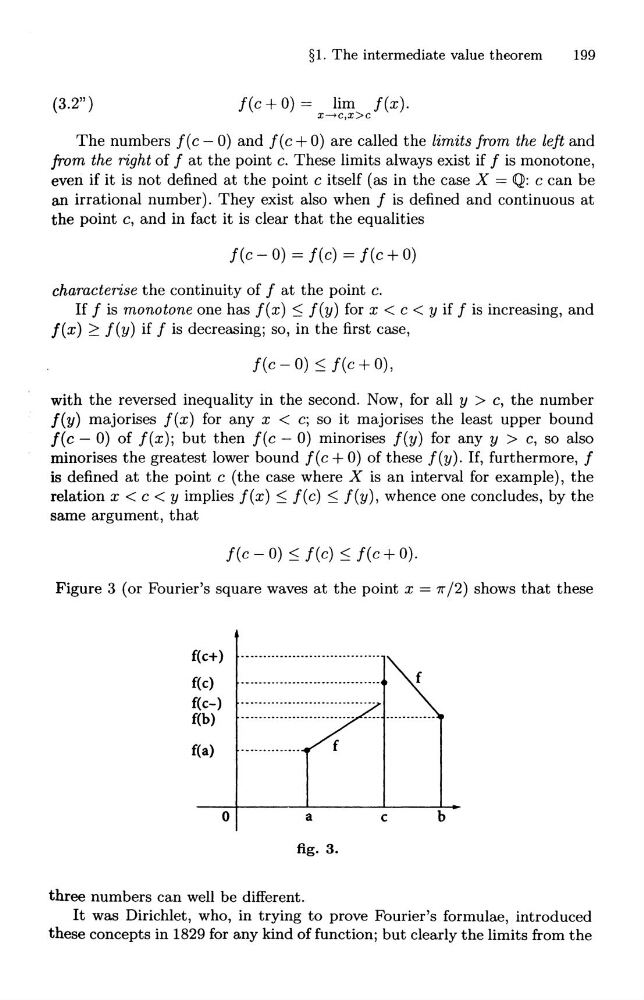
Figure 3 (or Fourier's square waves at the point x = 7r/2) shows that these
f(c+)
f(c)
f(c-)
f(b)
f(a)
............. .
o
a
fig. 3.
three numbers can well be different.
c
b
It was Dirichlet, who, in trying to prove Fourier's formulae, introduced
these concepts in 1829 for any kind of function; but clearly the limits from the
199
(3.2")
f(c + 0) = lim f(x).
X~C,X>C
The numbers f(c - 0) and f(c+ 0) are called the limits from the left and
from the right of f at the point c. These limits always exist if f is monotone,
even if it is not defined at the point c itself (as in the case X = Q: c can be
an irrational number). They exist also when f is defined and continuous at
the point c, and in fact it is clear that the equalities
f(c - 0) = f(c) = f(c + 0)
characterise the continuity of f at the point c.
If f is monotone one has f(x) ~ f(y) for x < c < y if f is increasing, and
f(x) ~ f(y) if f is decreasing; so, in the first case,
f(c-O) ~ f(c+O),
with the reversed inequality in the second. Now, for all y > c, the number
f(y) majorises f(x) for any x < c; so it majorises the least upper bound
f(c - 0) of f(x); but then f(c - 0) minorises f(y) for any y > c, so also
minorises the greatest lower bound f(c + 0) of these f(y). If, furthermore, f
is defined at the point c (the case where X is an interval for example), the
relation x < c < y implies f(x) ~ f(c) ~ f(y), whence one concludes, by the
same argument, that
f(c - 0) ~ f(c) ~ f(c + 0).
Figure 3 (or Fourier's square waves at the point x = 7r/2) shows that these
f(c+)
f(c)
f(c-)
f(b)
f(a)
............. .
o
a
fig. 3.
three numbers can well be different.
c
b
It was Dirichlet, who, in trying to prove Fourier's formulae, introduced
these concepts in 1829 for any kind of function; but clearly the limits from the