

196
III - Convergence: Continuous variables
(2.3)
log [exp(x)] = x for all x E R
Since the functions log and exp are injective we can also write (3) in the form
(2.3')
exp(logy) = y for all y E JR, y > O.
We shall go over all this in detail in Chap. IV.
Most of the functions that one meets - or that the Founders met - at the
start of analysis are continuous and even much more, because they are given
by "formulae" which are quasi-algebraic or originate from geometry, mechanics or physics, or from power series, etc. This explains why the very concept
of continuity was not isolated explicitly before Bolzano and Cauchy, around
1820. Furthermore, one has no desire to traumatise the innocent neophyte
with horrors he has never yet seen.
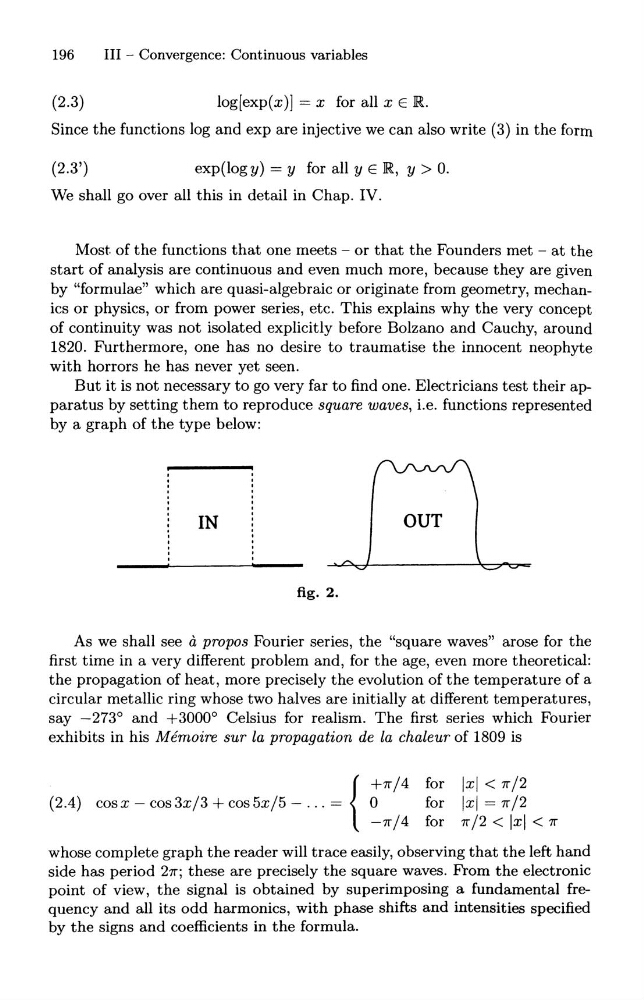
But it is not necessary to go very far to find one. Electricians test their apparatus by setting them to reproduce square waves, i.e. functions represented
by a graph of the type below:
IN
OUT
fig. 2.
As we shall see Ii propos Fourier series, the "square waves" arose for the
first time in a very different problem and, for the age, even more theoretical:
the propagation of heat, more precisely the evolution of the temperature of a
circular metallic ring whose two halves are initially at different temperatures,
say -273° and +3000° Celsius for realism. The first series which Fourier
exhibits in his Memoire sur la propagation de la chaleur of 1809 is
{
+11"/4 for Ixl < ' 11"/2
(2.4) cos x - cos3x/3 + cos5x/5 - ... = 0
for Ixl = ' 11"/2
-'11"/4 for '11"/2 < Ixl <'11"
whose complete graph the reader will trace easily, observing that the left hand
side has period 2' 11"; these are precisely the square waves. From the electronic
point of view, the signal is obtained by superimposing a fundamental frequency and all its odd harmonics, with phase shifts and intensities specified
by the signs and coefficients in the formula.
III - Convergence: Continuous variables
(2.3)
log [exp(x)] = x for all x E R
Since the functions log and exp are injective we can also write (3) in the form
(2.3')
exp(logy) = y for all y E JR, y > O.
We shall go over all this in detail in Chap. IV.
Most of the functions that one meets - or that the Founders met - at the
start of analysis are continuous and even much more, because they are given
by "formulae" which are quasi-algebraic or originate from geometry, mechanics or physics, or from power series, etc. This explains why the very concept
of continuity was not isolated explicitly before Bolzano and Cauchy, around
1820. Furthermore, one has no desire to traumatise the innocent neophyte
with horrors he has never yet seen.
But it is not necessary to go very far to find one. Electricians test their apparatus by setting them to reproduce square waves, i.e. functions represented
by a graph of the type below:
IN
OUT
fig. 2.
As we shall see Ii propos Fourier series, the "square waves" arose for the
first time in a very different problem and, for the age, even more theoretical:
the propagation of heat, more precisely the evolution of the temperature of a
circular metallic ring whose two halves are initially at different temperatures,
say -273° and +3000° Celsius for realism. The first series which Fourier
exhibits in his Memoire sur la propagation de la chaleur of 1809 is
{
+11"/4 for Ixl < ' 11"/2
(2.4) cos x - cos3x/3 + cos5x/5 - ... = 0
for Ixl = ' 11"/2
-'11"/4 for '11"/2 < Ixl <'11"
whose complete graph the reader will trace easily, observing that the left hand
side has period 2' 11"; these are precisely the square waves. From the electronic
point of view, the signal is obtained by superimposing a fundamental frequency and all its odd harmonics, with phase shifts and intensities specified
by the signs and coefficients in the formula.