

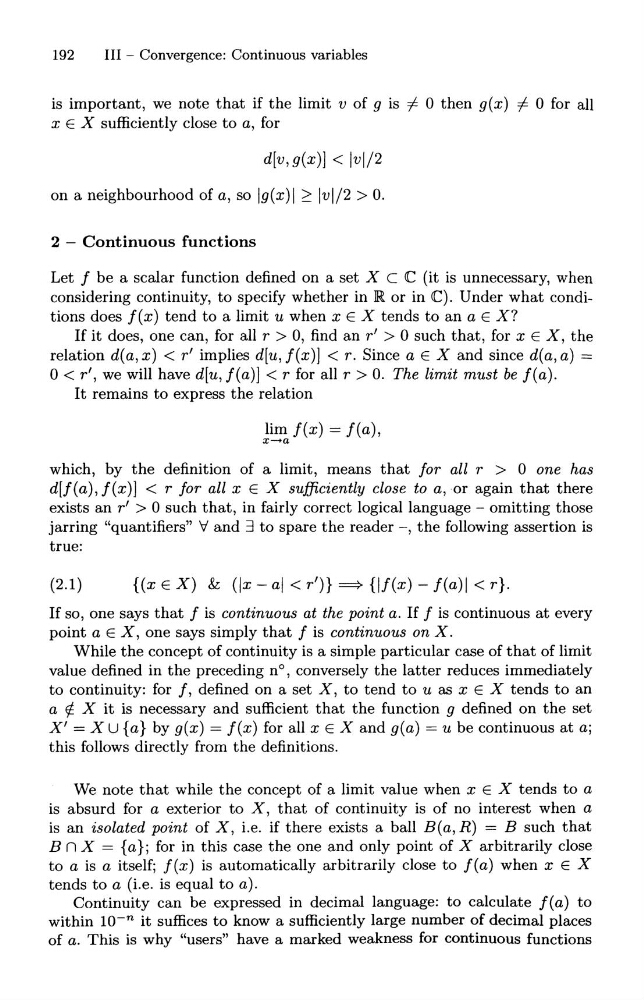
192
III - Convergence: Continuous variables
is important, we note that if the limit v of 9 is -=I 0 then g(x) -=I 0 for all
x E X sufficiently close to a, for
d[v,g(x)] < Ivl/2
on a neighbourhood of a, so Ig(x)1 ~ Ivl/2 > o.
2 - Continuous functions
Let f be a scalar function defined on a set X C C (it is unnecessary, when
considering continuity, to specify whether in R. or in C). Under what conditions does f(x) tend to a limit u when x E X tends to an a E X?
If it does, one can, for all r > 0, find an r' > 0 such that, for x EX, the
relation d(a, x) < r' implies d[u, f(x)] < r. Since a E X and since d(a, a) =
0< r', we will have d[u, f(a)] < r for all r > o. The limit must be f(a).
It remains to express the relation
lim f(x) = f(a),
x-+a
which, by the definition of a limit, means that for all r > 0 one has
d[f(a), f(x)] < r for all x E X sufficiently close to a, or again that there
exists an r' > 0 such that, in fairly correct logical language - omitting those
jarring "quantifiers" V and :3 to spare the reader -, the following assertion is
true:
(2.1)
{(x E X) & (Ix - al < r')} ===} {If(x) - f(a)1 < r}.
If so, one says that f is continuous at the point a. If f is continuous at every
point a EX, one says simply that f is continuous on X.
While the concept of continuity is a simple particular case of that of limit
value defined in the preceding nO, conversely the latter reduces immediately
to continuity: for f, defined on a set X, to tend to u as x E X tends to an
a ¢. X it is necessary and sufficient that the function 9 defined on the set
X' = X U {a} by g(x) = f(x) for all x E X and g(a) = u be continuous at aj
this follows directly from the definitions.
We note that while the concept of a limit value when x E X tends to a
is absurd for a exterior to X, that of continuity is of no interest when a
is an isolated point of X, i.e. if there exists a ball B (a, R) = B such that
B n X = {a}j for in this case the one and only point of X arbitrarily close
to a is a itselfj f(x) is automatically arbitrarily close to f(a) when x E X
tends to a (i.e. is equal to a).
Continuity can be expressed in decimal language: to calculate f(a) to
within lO-n it suffices to know a sufficiently large number of decimal places
of a. This is why "users" have a marked weakness for continuous functions
III - Convergence: Continuous variables
is important, we note that if the limit v of 9 is -=I 0 then g(x) -=I 0 for all
x E X sufficiently close to a, for
d[v,g(x)] < Ivl/2
on a neighbourhood of a, so Ig(x)1 ~ Ivl/2 > o.
2 - Continuous functions
Let f be a scalar function defined on a set X C C (it is unnecessary, when
considering continuity, to specify whether in R. or in C). Under what conditions does f(x) tend to a limit u when x E X tends to an a E X?
If it does, one can, for all r > 0, find an r' > 0 such that, for x EX, the
relation d(a, x) < r' implies d[u, f(x)] < r. Since a E X and since d(a, a) =
0< r', we will have d[u, f(a)] < r for all r > o. The limit must be f(a).
It remains to express the relation
lim f(x) = f(a),
x-+a
which, by the definition of a limit, means that for all r > 0 one has
d[f(a), f(x)] < r for all x E X sufficiently close to a, or again that there
exists an r' > 0 such that, in fairly correct logical language - omitting those
jarring "quantifiers" V and :3 to spare the reader -, the following assertion is
true:
(2.1)
{(x E X) & (Ix - al < r')} ===} {If(x) - f(a)1 < r}.
If so, one says that f is continuous at the point a. If f is continuous at every
point a EX, one says simply that f is continuous on X.
While the concept of continuity is a simple particular case of that of limit
value defined in the preceding nO, conversely the latter reduces immediately
to continuity: for f, defined on a set X, to tend to u as x E X tends to an
a ¢. X it is necessary and sufficient that the function 9 defined on the set
X' = X U {a} by g(x) = f(x) for all x E X and g(a) = u be continuous at aj
this follows directly from the definitions.
We note that while the concept of a limit value when x E X tends to a
is absurd for a exterior to X, that of continuity is of no interest when a
is an isolated point of X, i.e. if there exists a ball B (a, R) = B such that
B n X = {a}j for in this case the one and only point of X arbitrarily close
to a is a itselfj f(x) is automatically arbitrarily close to f(a) when x E X
tends to a (i.e. is equal to a).
Continuity can be expressed in decimal language: to calculate f(a) to
within lO-n it suffices to know a sufficiently large number of decimal places
of a. This is why "users" have a marked weakness for continuous functions