

§l. The intermediate value theorem
189
is outside X but is not exterior to it, neither in IR nor in C; in this example,
the points of IR (resp. q exterior to I are those which satisfy x < 0, or x > 1,
with strict inequalities (resp. these same points together with the non-real
points). For an arbitrary interval I the points of IR (or of q exterior to I are
those which do not belong to the closed interval having the same end points
as I. In C, the points exterior to a ball with centre a and of radius Rare
those which satisfy the strict inequality Iz - al > R.
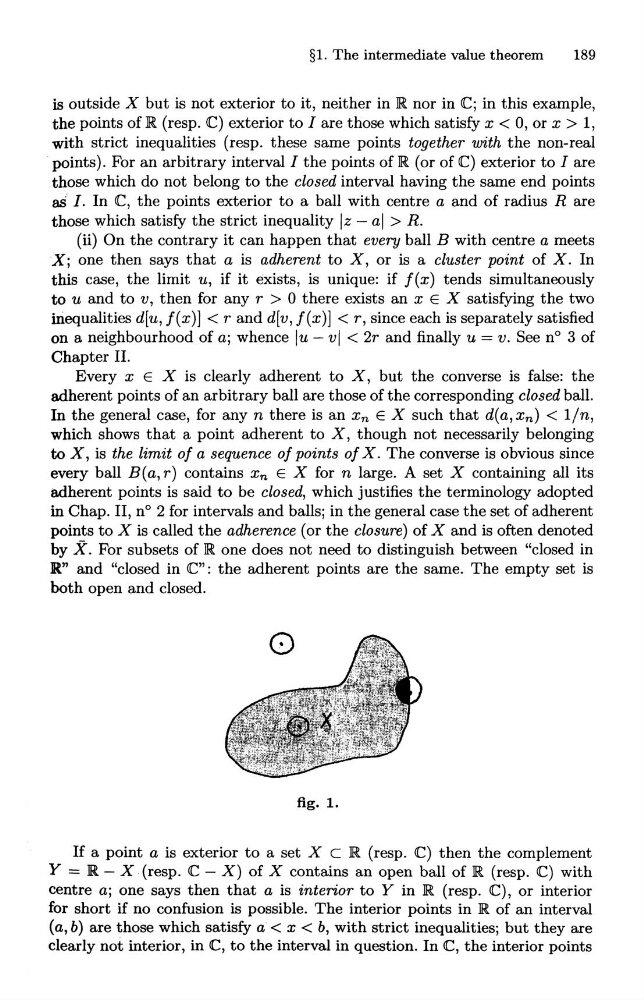
(ii) On the contrary it can happen that every ball B with centre a meets
X; one then says that a is adherent to X, or is a cluster point of X. In
this case, the limit u, if it exists, is unique: if f(x) tends simultaneously
to u and to v, then for any r > 0 there exists an x E X satisfying the two
iriequalities d[u, f(x») < rand d[v, f(x») < r, since each is separately satisfied
on a neighbourhood of a; whence lu - vi < 2r and finally u = v. See nO 3 of
Chapter II.
Every x E X is clearly adherent to X, but the converse is false: the
adherent points of an arbitrary ball are those of the corresponding closed ball.
In the general case, for any n there is an Xn E X such that d(a,xn ) < lin,
which shows that a point adherent to X, though not necessarily belonging
to X, is the limit of a sequence of points of X. The converse is obvious since
every ball B(a, r) contains Xn E X for n large. A set X containing all its
bdherent points is said to be closed, which justifies the terminology adopted
in Chap. II, n° 2 for intervals and balls; in the general case the set of adherent
points to X is called the adherence (or the closure) of X and is often denoted
by X. For subsets of IR one does not need to distinguish between "closed in
R" and "closed in C": the adherent points are the same. The empty set is
both open and closed.
fig. 1.
If a point a is exterior to a set X C R (resp. C) then the complement
Y = R - X (resp. C - X) of X contains an open ball of IR (resp. q with
centre a; one says then that a is interior to Y in IR (resp. C), or interior
for short if no confusion is possible. The interior points in R of an interval
(a, b) are those which satisfy a < x < b, with strict inequalities; but they are
clearly not interior, in C, to the interval in question. In C, the interior points
189
is outside X but is not exterior to it, neither in IR nor in C; in this example,
the points of IR (resp. q exterior to I are those which satisfy x < 0, or x > 1,
with strict inequalities (resp. these same points together with the non-real
points). For an arbitrary interval I the points of IR (or of q exterior to I are
those which do not belong to the closed interval having the same end points
as I. In C, the points exterior to a ball with centre a and of radius Rare
those which satisfy the strict inequality Iz - al > R.
(ii) On the contrary it can happen that every ball B with centre a meets
X; one then says that a is adherent to X, or is a cluster point of X. In
this case, the limit u, if it exists, is unique: if f(x) tends simultaneously
to u and to v, then for any r > 0 there exists an x E X satisfying the two
iriequalities d[u, f(x») < rand d[v, f(x») < r, since each is separately satisfied
on a neighbourhood of a; whence lu - vi < 2r and finally u = v. See nO 3 of
Chapter II.
Every x E X is clearly adherent to X, but the converse is false: the
adherent points of an arbitrary ball are those of the corresponding closed ball.
In the general case, for any n there is an Xn E X such that d(a,xn ) < lin,
which shows that a point adherent to X, though not necessarily belonging
to X, is the limit of a sequence of points of X. The converse is obvious since
every ball B(a, r) contains Xn E X for n large. A set X containing all its
bdherent points is said to be closed, which justifies the terminology adopted
in Chap. II, n° 2 for intervals and balls; in the general case the set of adherent
points to X is called the adherence (or the closure) of X and is often denoted
by X. For subsets of IR one does not need to distinguish between "closed in
R" and "closed in C": the adherent points are the same. The empty set is
both open and closed.
fig. 1.
If a point a is exterior to a set X C R (resp. C) then the complement
Y = R - X (resp. C - X) of X contains an open ball of IR (resp. q with
centre a; one says then that a is interior to Y in IR (resp. C), or interior
for short if no confusion is possible. The interior points in R of an interval
(a, b) are those which satisfy a < x < b, with strict inequalities; but they are
clearly not interior, in C, to the interval in question. In C, the interior points