

§3. First concepts of analytic functions
185
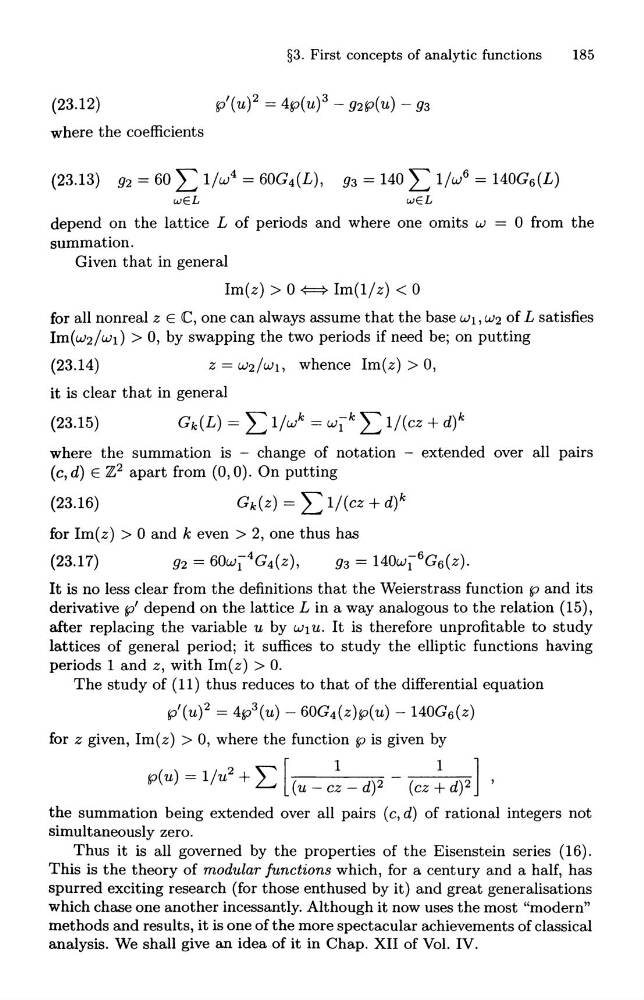
(23.12)
where the coefficients
(23.13) g2 = 60 L 1/w 4 = 60G4 (L), g3 = 140 L 1/w 6 = 140G6 (L)
wEL
wEL
depend on the lattice L of periods and where one omits W = 0 from the
summation.
Given that in general
Im(z) > 0 {=} Im(l/z) < 0
for all nonreal z E C, one can always assume that the base WI, W2 of L satisfies
Im(w2/wI) > 0, by swapping the two periods if need be; on putting
(23.14)
z = W2/WI, whence Im(z) > 0,
it is clear that in general
(23.15)
where the summation is - change of notation - extended over all pairs
(c, d) E 'Z} apart from (0,0). On putting
(23.16)
Gk(Z) = L l/(cz + d)k
for Im(z) > 0 and k even> 2, one thus has
(23.17)
g2 = 60w 1 4 G4 (z),
g3 = 140w 1 6 G6 (z).
It is no less clear from the definitions that the Weierstrass function 80 and its
derivative 80' depend on the lattice L in a way analogous to the relation (15),
after replacing the variable u by WI u. It is therefore unprofitable to study
lattices of general period; it suffices to study the elliptic functions having
periods 1 and z, with Im(z) > o.
The study of (11) thus reduces to that of the differential equation
p'(u)2 = 4p3(u) - 60G4 (z)p(u) - 140G6 (z)
for z given, Im(z) > 0, where the function 80 is given by
p(u) = 1/u 2 + L [(U _ c~ _ d)2 - (cz! d)2] ,
the summation being extended over all pairs (c, d) of rational integers not
simultaneously zero.
Thus it is all governed by the properties of the Eisenstein series (16).
This is the theory of modular functions which, for a century and a half, has
spurred exciting research (for those enthused by it) and great generalisations
which chase one another incessantly. Although it now uses the most "modern"
methods and results, it is one of the more spectacular achievements of classical
analysis. We shall give an idea of it in Chap. XII of Vol. IV.
185
(23.12)
where the coefficients
(23.13) g2 = 60 L 1/w 4 = 60G4 (L), g3 = 140 L 1/w 6 = 140G6 (L)
wEL
wEL
depend on the lattice L of periods and where one omits W = 0 from the
summation.
Given that in general
Im(z) > 0 {=} Im(l/z) < 0
for all nonreal z E C, one can always assume that the base WI, W2 of L satisfies
Im(w2/wI) > 0, by swapping the two periods if need be; on putting
(23.14)
z = W2/WI, whence Im(z) > 0,
it is clear that in general
(23.15)
where the summation is - change of notation - extended over all pairs
(c, d) E 'Z} apart from (0,0). On putting
(23.16)
Gk(Z) = L l/(cz + d)k
for Im(z) > 0 and k even> 2, one thus has
(23.17)
g2 = 60w 1 4 G4 (z),
g3 = 140w 1 6 G6 (z).
It is no less clear from the definitions that the Weierstrass function 80 and its
derivative 80' depend on the lattice L in a way analogous to the relation (15),
after replacing the variable u by WI u. It is therefore unprofitable to study
lattices of general period; it suffices to study the elliptic functions having
periods 1 and z, with Im(z) > o.
The study of (11) thus reduces to that of the differential equation
p'(u)2 = 4p3(u) - 60G4 (z)p(u) - 140G6 (z)
for z given, Im(z) > 0, where the function 80 is given by
p(u) = 1/u 2 + L [(U _ c~ _ d)2 - (cz! d)2] ,
the summation being extended over all pairs (c, d) of rational integers not
simultaneously zero.
Thus it is all governed by the properties of the Eisenstein series (16).
This is the theory of modular functions which, for a century and a half, has
spurred exciting research (for those enthused by it) and great generalisations
which chase one another incessantly. Although it now uses the most "modern"
methods and results, it is one of the more spectacular achievements of classical
analysis. We shall give an idea of it in Chap. XII of Vol. IV.