

182
II - Convergence: Discrete variables
is thus majorised in modulus by
where M < +00 does not depend on w. It remains to remark that the series
E Iwl- 3 converges, as we established earlier. The periodicity of the function
is less obvious than in the case of the functions (1); we shall obtain it below,
although a direct argument would be possible.
One may note that in view of the general associativity theorem (sum over
n then over w), this argument actually proves the unconditional convergence
of the sum
(23.6)
2: 2:(n + 1)w- 2 (u/w)n.
Iwl>Rn>O
We can then permute the E that appear in (6); in the disc lui < R,
the function p( u ) is then the sum of the function 1/ u 2 , of the functions
1/(u - w)2 - 1/w 2 for the finite number of w such that Iwl ::; R, and finally
of a power series in u converging in lui < R. The function p is thus, in the
disc considered, the sum of a power series and of a finite number of analytic
functions each having a double pole in a period of modulus < R. Since R is
arbitrary, the function p is analytic apart from at the points of the lattice of
periods.
One can in particular, in the above, choose
R = inflwl,
the inf being taken over the nonzero periods, so that R is the radius of
the largest open disc with centre 0 not containing any nonzero period. The
sum (6) is then extended over all the nonzero periods, so that, in the disc
considered, one has
(23.7)
p(u) = 1/u 2 + 2: (n + 1)w- 2 (u/w)n.
w,eO,n>O
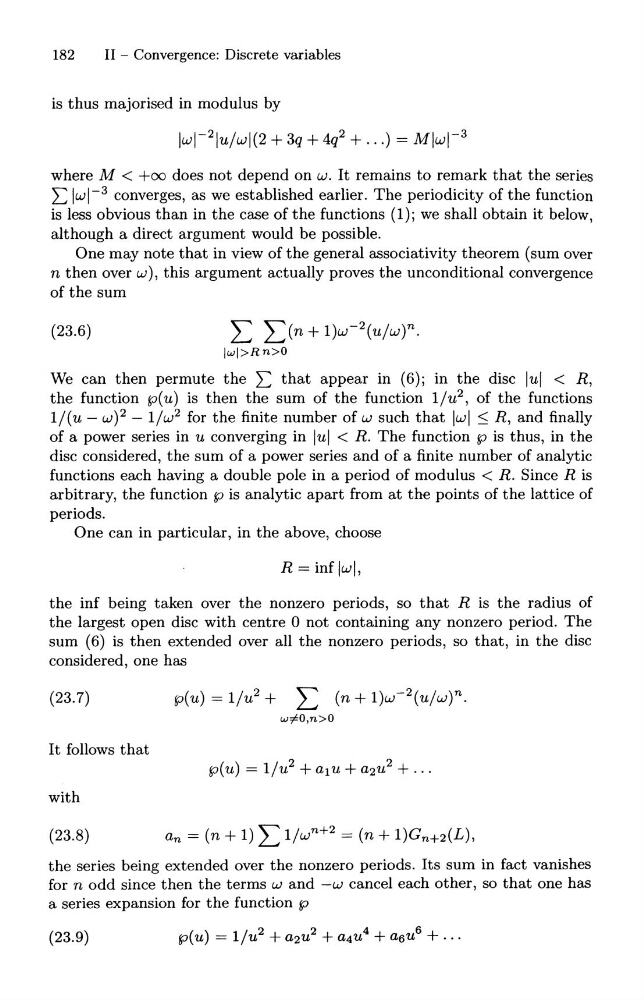
It follows that
with
(23.8)
an = (n + 1) L 1/w n + 2 = (n + 1)Gn+2(L),
the series being extended over the nonzero periods. Its sum in fact vanishes
for n odd since then the terms wand -w cancel each other, so that one has
a series expansion for the function p
(23.9)
II - Convergence: Discrete variables
is thus majorised in modulus by
where M < +00 does not depend on w. It remains to remark that the series
E Iwl- 3 converges, as we established earlier. The periodicity of the function
is less obvious than in the case of the functions (1); we shall obtain it below,
although a direct argument would be possible.
One may note that in view of the general associativity theorem (sum over
n then over w), this argument actually proves the unconditional convergence
of the sum
(23.6)
2: 2:(n + 1)w- 2 (u/w)n.
Iwl>Rn>O
We can then permute the E that appear in (6); in the disc lui < R,
the function p( u ) is then the sum of the function 1/ u 2 , of the functions
1/(u - w)2 - 1/w 2 for the finite number of w such that Iwl ::; R, and finally
of a power series in u converging in lui < R. The function p is thus, in the
disc considered, the sum of a power series and of a finite number of analytic
functions each having a double pole in a period of modulus < R. Since R is
arbitrary, the function p is analytic apart from at the points of the lattice of
periods.
One can in particular, in the above, choose
R = inflwl,
the inf being taken over the nonzero periods, so that R is the radius of
the largest open disc with centre 0 not containing any nonzero period. The
sum (6) is then extended over all the nonzero periods, so that, in the disc
considered, one has
(23.7)
p(u) = 1/u 2 + 2: (n + 1)w- 2 (u/w)n.
w,eO,n>O
It follows that
with
(23.8)
an = (n + 1) L 1/w n + 2 = (n + 1)Gn+2(L),
the series being extended over the nonzero periods. Its sum in fact vanishes
for n odd since then the terms wand -w cancel each other, so that one has
a series expansion for the function p
(23.9)