

§3. First concepts of analytic functions
177
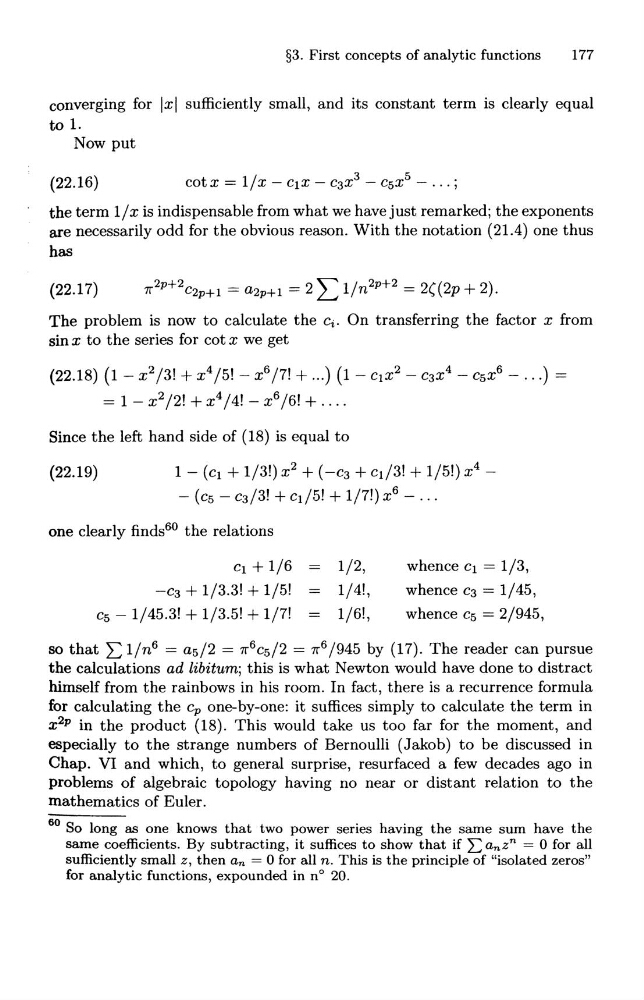
converging for Ixl sufficiently small, and its constant term is clearly equal
to 1.
Now put
(22.16)
the term 1/ x is indispensable from what we have just remarked; the exponents
are necessarily odd for the obvious reason. With the notation (21.4) one thus
has
(22.17)
The problem is now to calculate the Ci. On transferring the factor x from
sin x to the series for cot x we get
(22.18) (1 - x 2 /3! + x 4 /5! - x 6 /7! + ... ) (1 - CIX 2 - C3X4 - C5X 6 - ••• ) =
= 1 - x 2 /2! + x4 /4! - x 6 /6! + ... .
Since the left hand side of (18) is equal to
(22.19)
1 - (Cl + 1/3!) x 2 + (-C3 + cd3! + 1/5!) x4 -
- (C5 - C3/3! + cd5! + 1/7!) x 6 - •.•
one clearly finds 60 the relations
Cl + 1/6
-C3 + 1/3.3! + 1/5!
C5 - 1/45.3! + 1/3.5! + 1/7!
1/2,
1/4!,
1/6!,
whence Cl = 1/3,
whence C3 = 1/45,
whence C5 = 2/945,
so that E 1/n 6 = a5/2 = rr6c5/2 = rr 6 /945 by (17). The reader can pursue
the calculations ad libitum; this is what Newton would have done to distract
himself from the rainbows in his room. In fact, there is a recurrence formula
for calculating the Cp one-by-one: it suffices simply to calculate the term in
X2p in the product (18). This would take us too far for the moment, and
especially to the strange numbers of Bernoulli (Jakob) to be discussed in
Chap. VI and which, to general surprise, resurfaced a few decades ago in
problems of algebraic topology having no near or distant relation to the
mathematics of Euler.
60 So long as one knows that two power series having the same sum have the
same coefficients. By subtracting, it suffices to show that if L anz n = 0 for all
sufficiently small z, then an = 0 for all n. This is the principle of "isolated zeros"
for analytic functions, expounded in nO 20.
177
converging for Ixl sufficiently small, and its constant term is clearly equal
to 1.
Now put
(22.16)
the term 1/ x is indispensable from what we have just remarked; the exponents
are necessarily odd for the obvious reason. With the notation (21.4) one thus
has
(22.17)
The problem is now to calculate the Ci. On transferring the factor x from
sin x to the series for cot x we get
(22.18) (1 - x 2 /3! + x 4 /5! - x 6 /7! + ... ) (1 - CIX 2 - C3X4 - C5X 6 - ••• ) =
= 1 - x 2 /2! + x4 /4! - x 6 /6! + ... .
Since the left hand side of (18) is equal to
(22.19)
1 - (Cl + 1/3!) x 2 + (-C3 + cd3! + 1/5!) x4 -
- (C5 - C3/3! + cd5! + 1/7!) x 6 - •.•
one clearly finds 60 the relations
Cl + 1/6
-C3 + 1/3.3! + 1/5!
C5 - 1/45.3! + 1/3.5! + 1/7!
1/2,
1/4!,
1/6!,
whence Cl = 1/3,
whence C3 = 1/45,
whence C5 = 2/945,
so that E 1/n 6 = a5/2 = rr6c5/2 = rr 6 /945 by (17). The reader can pursue
the calculations ad libitum; this is what Newton would have done to distract
himself from the rainbows in his room. In fact, there is a recurrence formula
for calculating the Cp one-by-one: it suffices simply to calculate the term in
X2p in the product (18). This would take us too far for the moment, and
especially to the strange numbers of Bernoulli (Jakob) to be discussed in
Chap. VI and which, to general surprise, resurfaced a few decades ago in
problems of algebraic topology having no near or distant relation to the
mathematics of Euler.
60 So long as one knows that two power series having the same sum have the
same coefficients. By subtracting, it suffices to show that if L anz n = 0 for all
sufficiently small z, then an = 0 for all n. This is the principle of "isolated zeros"
for analytic functions, expounded in nO 20.