

§3. First concepts of analytic functions
159
disc with centre z(t). The set E is not empty: it contains a since z(O) = a.
Let u ~ 1 be the least upper bound of E; we need to show that u E E and
that u = 1.
First note that if E contains atE I, it also contains all t' E I sufficiently
close to t: if indeed f vanishes On an open disc D with centre z(t), one has
clearly (continuity) z(t') ED for t' close to t and consequently f vanishes on
every open disc with centre z(t') contained in D.
If on the other hand atE I is the limit of a sequence of points tn E E,
then again one has tEE, since in the opposite case the tn would be distinct
from t and this would contradict the principle of isolated zeros established at
the end of the preceding nO. [We have just shown that E is simultaneously
open and closed in I.J
Let us now return to the least upper bound u of E. This is the limit of
points of E, so u E E. Every tEl sufficiently close to u therefore also belongs
to E. If we had u < 1, we would then have at> u in E, impossible since
u = sup(E). Thus u = 1, and since z(u) = b the function f vanishes On a
neighbourhood of b in C, qed.
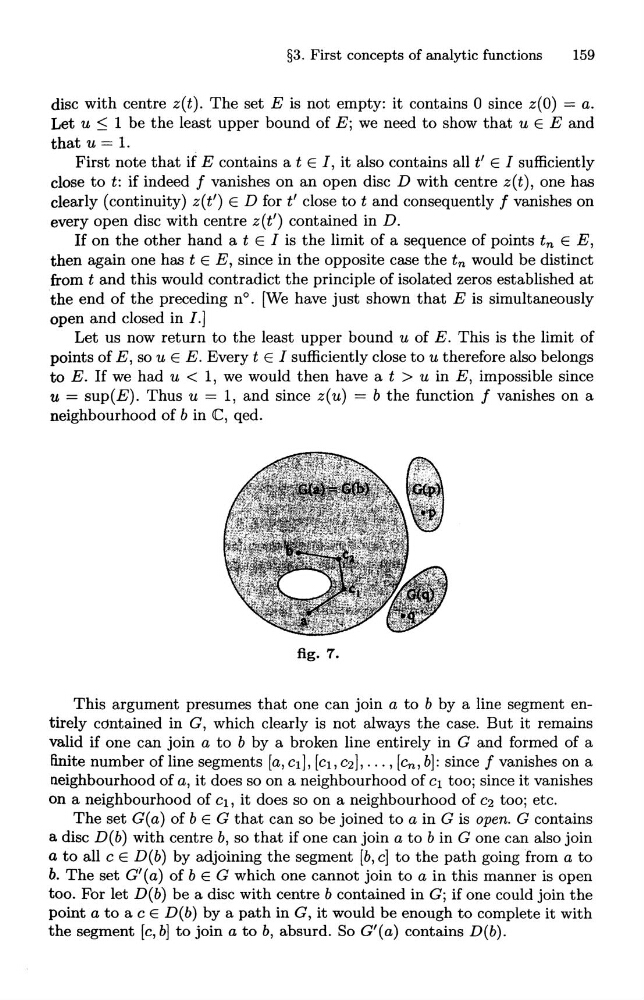
fig. 7.
This argument presumes that one can join a to b by a line segment entirely ccJntained in G, which clearly is not always the case. But it remains
valid if one can join a to b by a broken line entirely in G and formed of a
finite number of line segments [a, Cll, [Cb C2l, ... , [en, bJ: since f vanishes on a
neighbourhood of a, it does so on a neighbourhood of Cl too; since it vanishes
On a neighbourhood of Cl, it does so on a neighbourhood of C2 too; etc.
The set G(a) of bEG that can so be joined to a in G is open. G contains
a disc D(b) with centre b, so that if one can join a to b in G one can also join
a to all C E D(b) by adjoining the segment [b, cJ to the path going from a to
b. The set G'(a) of bEG which one cannot join to a in this manner is open
too. For let D(b) be a disc with centre b contained in G; if one could join the
point a to acE D(b) by a path in G, it would be enough to complete it with
the segment [c, b) to join a to b, absurd. So G'(a) contains D(b).
159
disc with centre z(t). The set E is not empty: it contains a since z(O) = a.
Let u ~ 1 be the least upper bound of E; we need to show that u E E and
that u = 1.
First note that if E contains atE I, it also contains all t' E I sufficiently
close to t: if indeed f vanishes On an open disc D with centre z(t), one has
clearly (continuity) z(t') ED for t' close to t and consequently f vanishes on
every open disc with centre z(t') contained in D.
If on the other hand atE I is the limit of a sequence of points tn E E,
then again one has tEE, since in the opposite case the tn would be distinct
from t and this would contradict the principle of isolated zeros established at
the end of the preceding nO. [We have just shown that E is simultaneously
open and closed in I.J
Let us now return to the least upper bound u of E. This is the limit of
points of E, so u E E. Every tEl sufficiently close to u therefore also belongs
to E. If we had u < 1, we would then have at> u in E, impossible since
u = sup(E). Thus u = 1, and since z(u) = b the function f vanishes On a
neighbourhood of b in C, qed.
fig. 7.
This argument presumes that one can join a to b by a line segment entirely ccJntained in G, which clearly is not always the case. But it remains
valid if one can join a to b by a broken line entirely in G and formed of a
finite number of line segments [a, Cll, [Cb C2l, ... , [en, bJ: since f vanishes on a
neighbourhood of a, it does so on a neighbourhood of Cl too; since it vanishes
On a neighbourhood of Cl, it does so on a neighbourhood of C2 too; etc.
The set G(a) of bEG that can so be joined to a in G is open. G contains
a disc D(b) with centre b, so that if one can join a to b in G one can also join
a to all C E D(b) by adjoining the segment [b, cJ to the path going from a to
b. The set G'(a) of bEG which one cannot join to a in this manner is open
too. For let D(b) be a disc with centre b contained in G; if one could join the
point a to acE D(b) by a path in G, it would be enough to complete it with
the segment [c, b) to join a to b, absurd. So G'(a) contains D(b).