

§3. First concepts of analytic functions
157
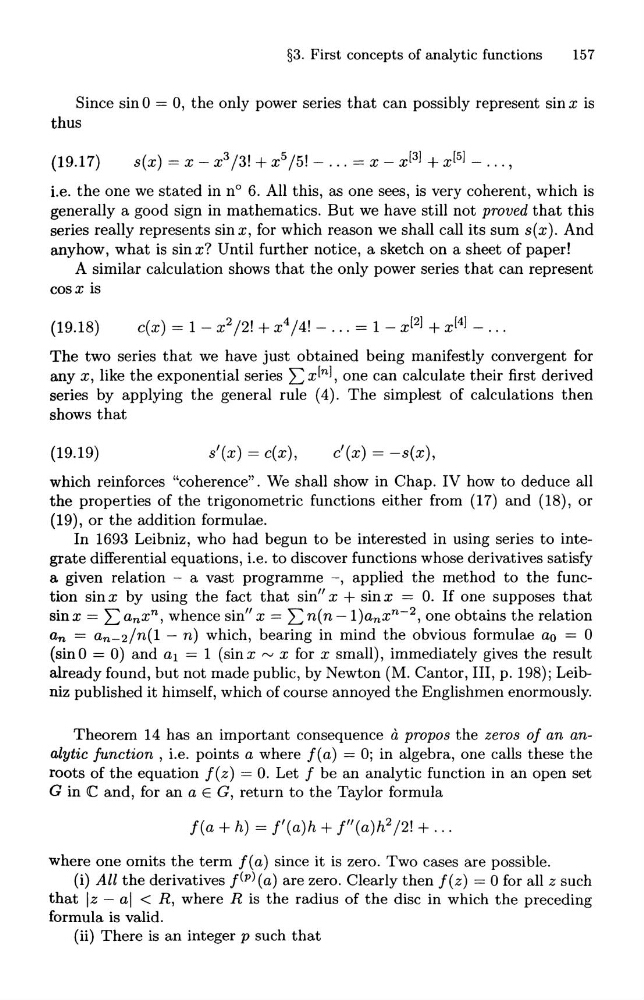
Since sin 0 = 0, the only power series that can possibly represent sin x is
thus
(19.17)
( ) -
3/3'
5/5'
_
[3J
[5J
sx -x-x .+x .- ... -x-x +x - ... ,
Le. the one we stated in n° 6. All this, as one sees, is very coherent, which is
generally a good sign in mathematics. But we have still not proved that this
series really represents sinx, for which reason we shall call its sum sex). And
anyhow, what is sin x? Until further notice, a sketch on a sheet of paper!
A similar calculation shows that the only power series that can represent
cos x is
(19.18)
c(x) = 1 - x 2 /2! + x 4 /4! - ... = 1 - x[2J + X[4J - ...
The two series that we have just obtained being manifestly convergent for
any x, like the exponential series Ex[nJ, one can calculate their first derived
series by applying the general rule (4). The simplest of calculations then
shows that
(19.19)
s'(x) = c(x),
c'(x) = -sex),
which reinforces "coherence". We shall show in Chap. IV how to deduce all
the properties of the trigonometric functions either from (17) and (18), or
(19), or the addition formulae.
In 1693 Leibniz, who had begun to be interested in using series to integrate differential equations, i.e. to discover functions whose derivatives satisfy
a given relation - a vast programme -, applied the method to the function sin x by using the fact that sin" x + sin x = o. If one supposes that
sin x = E anx n , whence sin" x = E n( n - 1 )anX n - 2 , one obtains the relation
an = an_2/n(l - n) which, bearing in mind the obvious formulae ao = 0
(sinO = 0) and al = 1 (sin x rv x for x small), immediately gives the result
already found, but not made public, by Newton (M. Cantor, III, p. 198); Leibniz published it himself, which of course annoyed the Englishmen enormously.
Theorem 14 has an important consequence a propos the zeros of an analytic function, Le. points a where f(a) = 0; in algebra, one calls these the
roots of the equation fez) = O. Let f be an analytic function in an open set
Gin C and, for an a E G, return to the Taylor formula
f(a + h) = f'(a)h + j"(a)h2/2! + ...
where one omits the term f(a) since it is zero. Two cases are possible.
(i) All the derivatives f Cp ) (a) are zero. Clearly then fez) = 0 for all z such
that Iz - al < R, where R is the radius of the disc in which the preceding
formula is valid.
(ii) There is an integer p such that
157
Since sin 0 = 0, the only power series that can possibly represent sin x is
thus
(19.17)
( ) -
3/3'
5/5'
_
[3J
[5J
sx -x-x .+x .- ... -x-x +x - ... ,
Le. the one we stated in n° 6. All this, as one sees, is very coherent, which is
generally a good sign in mathematics. But we have still not proved that this
series really represents sinx, for which reason we shall call its sum sex). And
anyhow, what is sin x? Until further notice, a sketch on a sheet of paper!
A similar calculation shows that the only power series that can represent
cos x is
(19.18)
c(x) = 1 - x 2 /2! + x 4 /4! - ... = 1 - x[2J + X[4J - ...
The two series that we have just obtained being manifestly convergent for
any x, like the exponential series Ex[nJ, one can calculate their first derived
series by applying the general rule (4). The simplest of calculations then
shows that
(19.19)
s'(x) = c(x),
c'(x) = -sex),
which reinforces "coherence". We shall show in Chap. IV how to deduce all
the properties of the trigonometric functions either from (17) and (18), or
(19), or the addition formulae.
In 1693 Leibniz, who had begun to be interested in using series to integrate differential equations, i.e. to discover functions whose derivatives satisfy
a given relation - a vast programme -, applied the method to the function sin x by using the fact that sin" x + sin x = o. If one supposes that
sin x = E anx n , whence sin" x = E n( n - 1 )anX n - 2 , one obtains the relation
an = an_2/n(l - n) which, bearing in mind the obvious formulae ao = 0
(sinO = 0) and al = 1 (sin x rv x for x small), immediately gives the result
already found, but not made public, by Newton (M. Cantor, III, p. 198); Leibniz published it himself, which of course annoyed the Englishmen enormously.
Theorem 14 has an important consequence a propos the zeros of an analytic function, Le. points a where f(a) = 0; in algebra, one calls these the
roots of the equation fez) = O. Let f be an analytic function in an open set
Gin C and, for an a E G, return to the Taylor formula
f(a + h) = f'(a)h + j"(a)h2/2! + ...
where one omits the term f(a) since it is zero. Two cases are possible.
(i) All the derivatives f Cp ) (a) are zero. Clearly then fez) = 0 for all z such
that Iz - al < R, where R is the radius of the disc in which the preceding
formula is valid.
(ii) There is an integer p such that