

150
II - Convergence: Discrete variables
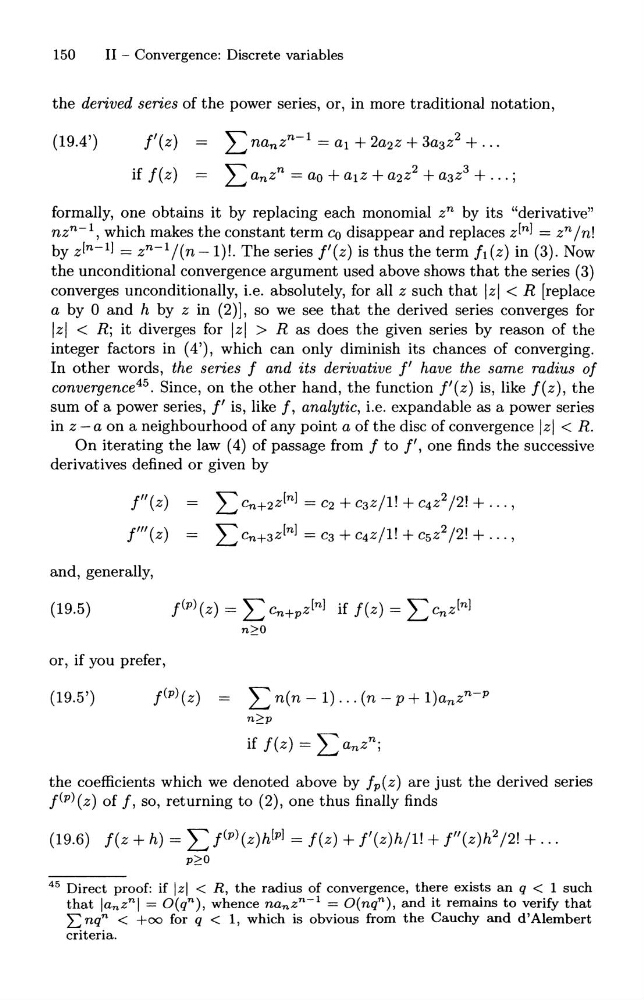
the derived series of the power series, or, in more traditional notation,
(19.4')
I'(z)
if I(z)
L nanz n - 1 = al + 2a2z + 3a3z2 + .. .
LanZ n = ao + alZ + a2z2 + a3z3 + ... ;
formally, one obtains it by replacing each monomial zn by its "derivative"
nzn-l, which makes the constant term Co disappear and replaces z[n] = zn In!
by z[n-l] = zn-l /(n -I)!. The series f'(z) is thus the term h(z) in (3). Now
the unconditional convergence argument used above shows that the series (3)
converges unconditionally, i.e. absolutely, for all z such that Izl < R [replace
a by 0 and h by z in (2)], so we see that the derived series converges for
Izl < R; it diverges for Izl > R as does the given series by reason of the
integer factors in (4'), which can only diminish its chances of converging.
In other words, the series I and its derivative f' have the same radius of
convergence 45 . Since, on the other hand, the function I'(z) is, like I(z), the
sum of a power series, f' is, like I, analytic, i.e. expandable as a power series
in z - a on a neighbourhood of any point a of the disc of convergence Izl < R.
On iterating the law (4) of passage from I to I', one finds the successive
derivatives defined or given by
J"(z)
J"'(z)
and, generally,
(19.5)
or, if you prefer,
(19.5')
L Cn+2 Z [n] = C2 + C3 z / 1! + C4 z2 / 2! + ... ,
L Cn+3z [n] = C3 + c4 z / 1! + C5 z2 / 2! + ... ,
I(p)(z) = L Cn+pz[n] if I(z) = L:CnZ[n]
n~O
L n(n - 1) ... (n - p + l)an z n - p
n~p
the coefficients which we denoted above by Ip(z) are just the derived series
I(p)(z) of I, so, returning to (2), one thus finally finds
(19.6) I(z + h) = L I(p) (z)h[p] = I(z) + J'(z)h/1! + J"(z)h 2 /2! + ...
p~O
45 Direct proof: if Izl < R, the radius of convergence, there exists an q < 1 such
that lanznl = O(qn), whence nanZ n - 1 = O(nqn), and it remains to verify that
Enqn < +00 for q < I, which is obvious from the Cauchy and d'Alembert
criteria.
II - Convergence: Discrete variables
the derived series of the power series, or, in more traditional notation,
(19.4')
I'(z)
if I(z)
L nanz n - 1 = al + 2a2z + 3a3z2 + .. .
LanZ n = ao + alZ + a2z2 + a3z3 + ... ;
formally, one obtains it by replacing each monomial zn by its "derivative"
nzn-l, which makes the constant term Co disappear and replaces z[n] = zn In!
by z[n-l] = zn-l /(n -I)!. The series f'(z) is thus the term h(z) in (3). Now
the unconditional convergence argument used above shows that the series (3)
converges unconditionally, i.e. absolutely, for all z such that Izl < R [replace
a by 0 and h by z in (2)], so we see that the derived series converges for
Izl < R; it diverges for Izl > R as does the given series by reason of the
integer factors in (4'), which can only diminish its chances of converging.
In other words, the series I and its derivative f' have the same radius of
convergence 45 . Since, on the other hand, the function I'(z) is, like I(z), the
sum of a power series, f' is, like I, analytic, i.e. expandable as a power series
in z - a on a neighbourhood of any point a of the disc of convergence Izl < R.
On iterating the law (4) of passage from I to I', one finds the successive
derivatives defined or given by
J"(z)
J"'(z)
and, generally,
(19.5)
or, if you prefer,
(19.5')
L Cn+2 Z [n] = C2 + C3 z / 1! + C4 z2 / 2! + ... ,
L Cn+3z [n] = C3 + c4 z / 1! + C5 z2 / 2! + ... ,
I(p)(z) = L Cn+pz[n] if I(z) = L:CnZ[n]
n~O
L n(n - 1) ... (n - p + l)an z n - p
n~p
the coefficients which we denoted above by Ip(z) are just the derived series
I(p)(z) of I, so, returning to (2), one thus finally finds
(19.6) I(z + h) = L I(p) (z)h[p] = I(z) + J'(z)h/1! + J"(z)h 2 /2! + ...
p~O
45 Direct proof: if Izl < R, the radius of convergence, there exists an q < 1 such
that lanznl = O(qn), whence nanZ n - 1 = O(nqn), and it remains to verify that
Enqn < +00 for q < I, which is obvious from the Cauchy and d'Alembert
criteria.