

146
II - Convergence: Discrete variables
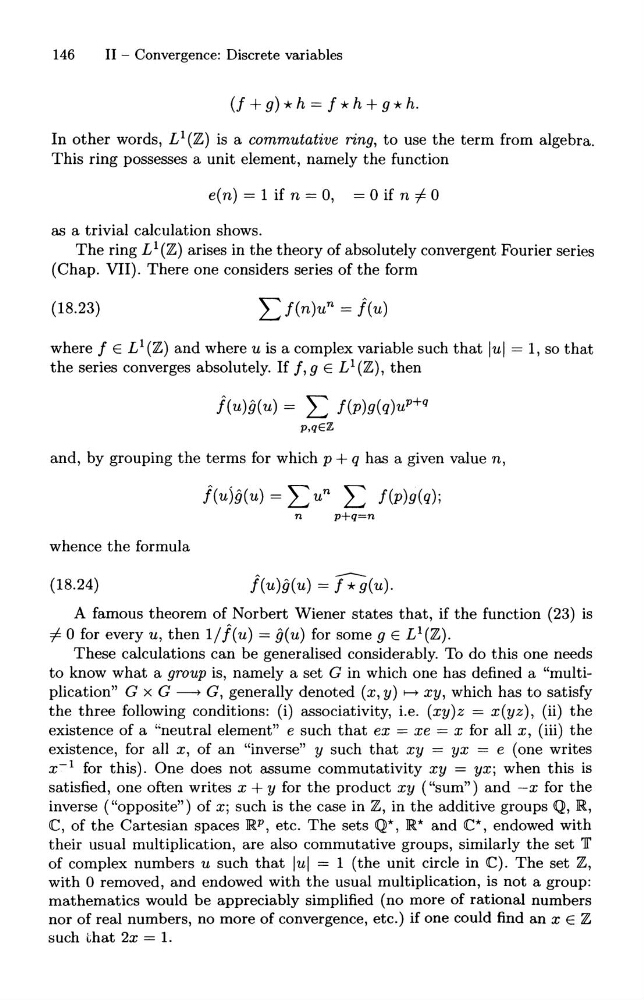
In other words, Ll(Z) is a commutative ring, to use the term from algebra.
This ring possesses a unit element, namely the function
e(n) = 1 if n = 0, = 0 if n =F 0
as a trivial calculation shows.
The ring Ll (Z) arises in the theory of absolutely convergent Fourier series
(Chap. VII). There one considers series of the form
(18.23)
L f(n)u n = j(u)
where f E Ll(Z) and where u is a complex variable such that lui = 1, so that
the series converges absolutely. If f, 9 E Ll (Z), then
j(u)g(u) = L f(p)g(q)u p + q
p,qEZ
and, by grouping the terms for which p + q has a given value n,
j(u)g(u) = L un L f(p)g(q)j
n
p+q=n
whence the formula
(18.24)
j(u)g(u) = j.;g(u).
A famous theorem of Norbert Wiener states that, if the function (23) is
=F 0 for every u, then l/j(u) = g(u) for some 9 E Ll(Z).
These calculations can be generalised considerably. To do this one needs
to know what a group is, namely a set G in which one has defined a "multiplication" G x G --+ G, generally denoted (x, y) 1-+ xy, which has to satisfy
the three following conditions: (i) associativity, i.e. (xy)z = x(yz), (ii) the
existence of a "neutral element" e such that ex = xe = x for all x, (iii) the
existence, for all x, of an "inverse" y such that xy = yx = e (one writes
X-I for this). One does not assume commutativity xy = yXj when this is
satisfied, one often writes x + y for the product xy ("sum") and -x for the
inverse ("opposite") of Xj such is the case in Z, in the additive groups (11, JR.,
C, of the Cartesian spaces JR.P, etc. The sets (11*, JR.* and C*, endowed with
their usual multiplication, are also commutative groups, similarly the set 11'
of complex numbers u such that lui = 1 (the unit circle in C). The set Z,
with 0 removed, and endowed with the usual multiplication, is not a group:
mathematics would be appreciably simplified (no more of rational numbers
nor of real numbers, no more of convergence, etc.) if one could find an x E Z
such that 2x = 1.
II - Convergence: Discrete variables
In other words, Ll(Z) is a commutative ring, to use the term from algebra.
This ring possesses a unit element, namely the function
e(n) = 1 if n = 0, = 0 if n =F 0
as a trivial calculation shows.
The ring Ll (Z) arises in the theory of absolutely convergent Fourier series
(Chap. VII). There one considers series of the form
(18.23)
L f(n)u n = j(u)
where f E Ll(Z) and where u is a complex variable such that lui = 1, so that
the series converges absolutely. If f, 9 E Ll (Z), then
j(u)g(u) = L f(p)g(q)u p + q
p,qEZ
and, by grouping the terms for which p + q has a given value n,
j(u)g(u) = L un L f(p)g(q)j
n
p+q=n
whence the formula
(18.24)
j(u)g(u) = j.;g(u).
A famous theorem of Norbert Wiener states that, if the function (23) is
=F 0 for every u, then l/j(u) = g(u) for some 9 E Ll(Z).
These calculations can be generalised considerably. To do this one needs
to know what a group is, namely a set G in which one has defined a "multiplication" G x G --+ G, generally denoted (x, y) 1-+ xy, which has to satisfy
the three following conditions: (i) associativity, i.e. (xy)z = x(yz), (ii) the
existence of a "neutral element" e such that ex = xe = x for all x, (iii) the
existence, for all x, of an "inverse" y such that xy = yx = e (one writes
X-I for this). One does not assume commutativity xy = yXj when this is
satisfied, one often writes x + y for the product xy ("sum") and -x for the
inverse ("opposite") of Xj such is the case in Z, in the additive groups (11, JR.,
C, of the Cartesian spaces JR.P, etc. The sets (11*, JR.* and C*, endowed with
their usual multiplication, are also commutative groups, similarly the set 11'
of complex numbers u such that lui = 1 (the unit circle in C). The set Z,
with 0 removed, and endowed with the usual multiplication, is not a group:
mathematics would be appreciably simplified (no more of rational numbers
nor of real numbers, no more of convergence, etc.) if one could find an x E Z
such that 2x = 1.