

§2. Absolutely convergent series
125
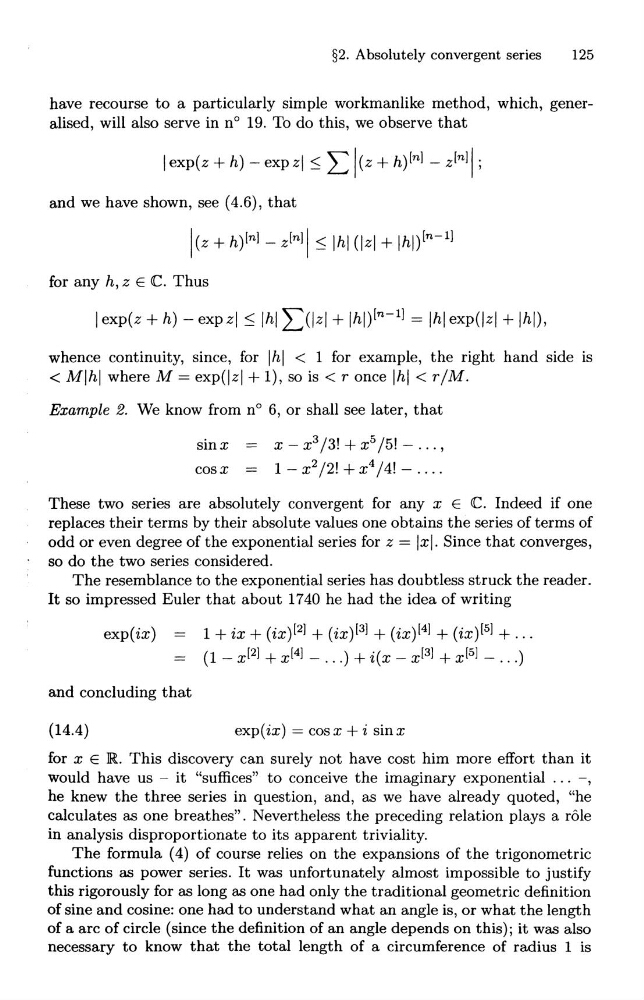
have recourse to a particularly simple workmanlike method, which, generalised, will also serve in nO 19. To do this, we observe that
I exp(z + h) - expzl :::; L I(z + h)[n] - z[n]1 ;
and we have shown, see (4.6), that
for any h, z E Co Thus
I exp(z + h) - exp zl :::; Ihl L(lzl + Ihl)[n-l] = Ihl exp{lzl + Ihl),
whence continuity, since, for Ihl < 1 for example, the right hand side is
< Mlhl where M = exp(lzl + 1), so is < r once Ihl < riM.
Example 2. We know from nO 6, or shall see later, that
sin x
x - x 3 /3! + x 5 /5! - ... ,
cos x
l-x 2 /2!+x 4 /4!- .. ..
These two series are absolutely convergent for any x E Co Indeed if one
replaces their terms by their absolute values one obtains the series of terms of
odd or even degree of the exponential series for z = Ixl. Since that converges,
so do the two series considered.
The resemblance to the exponential series has doubtless struck the reader.
It so impressed Euler that about 1740 he had the idea of writing
exp(ix)
1 + ix + (iX)[2] + (ix)[3] + (iX)[4] + (iX)[5] + .. .
(1 - x[2] + x[4] - ... ) + i(x - X[3] + X[5] - ... )
and concluding that
(14.4)
exp(ix) = cos x + i sin x
for x E R This discovery can surely not have cost him more effort than it
would have us - it "suffices" to conceive the imaginary exponential ... -,
he knew the three series in question, and, as we have already quoted, "he
calculates as one breathes". Nevertheless the preceding relation plays a role
in analysis disproportionate to its apparent triviality.
The formula (4) of course relies on the expansions of the trigonometric
functions as power series. It was unfortunately almost impossible to justify
this rigorously for as long as one had only the traditional geometric definition
of sine and cosine: one had to understand what an angle is, or what the length
of a arc of circle (since the definition of an angle depends on this); it was also
necessary to know that the total length of a circumference of radius 1 is
125
have recourse to a particularly simple workmanlike method, which, generalised, will also serve in nO 19. To do this, we observe that
I exp(z + h) - expzl :::; L I(z + h)[n] - z[n]1 ;
and we have shown, see (4.6), that
for any h, z E Co Thus
I exp(z + h) - exp zl :::; Ihl L(lzl + Ihl)[n-l] = Ihl exp{lzl + Ihl),
whence continuity, since, for Ihl < 1 for example, the right hand side is
< Mlhl where M = exp(lzl + 1), so is < r once Ihl < riM.
Example 2. We know from nO 6, or shall see later, that
sin x
x - x 3 /3! + x 5 /5! - ... ,
cos x
l-x 2 /2!+x 4 /4!- .. ..
These two series are absolutely convergent for any x E Co Indeed if one
replaces their terms by their absolute values one obtains the series of terms of
odd or even degree of the exponential series for z = Ixl. Since that converges,
so do the two series considered.
The resemblance to the exponential series has doubtless struck the reader.
It so impressed Euler that about 1740 he had the idea of writing
exp(ix)
1 + ix + (iX)[2] + (ix)[3] + (iX)[4] + (iX)[5] + .. .
(1 - x[2] + x[4] - ... ) + i(x - X[3] + X[5] - ... )
and concluding that
(14.4)
exp(ix) = cos x + i sin x
for x E R This discovery can surely not have cost him more effort than it
would have us - it "suffices" to conceive the imaginary exponential ... -,
he knew the three series in question, and, as we have already quoted, "he
calculates as one breathes". Nevertheless the preceding relation plays a role
in analysis disproportionate to its apparent triviality.
The formula (4) of course relies on the expansions of the trigonometric
functions as power series. It was unfortunately almost impossible to justify
this rigorously for as long as one had only the traditional geometric definition
of sine and cosine: one had to understand what an angle is, or what the length
of a arc of circle (since the definition of an angle depends on this); it was also
necessary to know that the total length of a circumference of radius 1 is