

§2. Absolutely convergent series
117
we have just seen that we do not change the convergence or the divergence of
a series with positive terms by performing arbitrary regroupings of its terms.
Theorem 5. The series L link converges for k > 1 and diverges for k :-:; 1.
For k = 1, this is the harmonic series, already investigated. For k < 1,
one has n k < n, thus link> lin, whence all the more divergent. For k > 1,
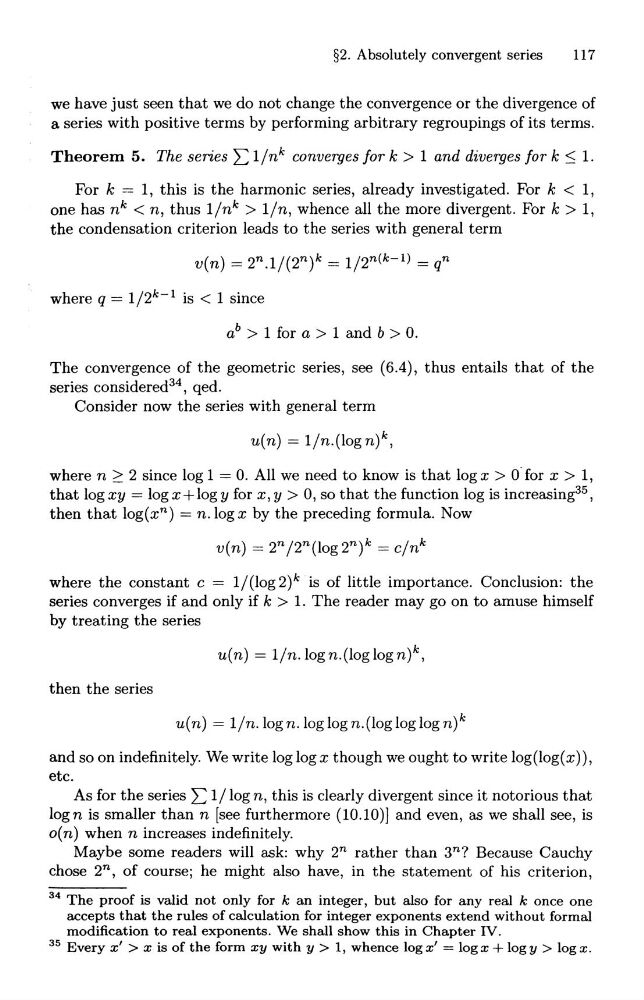
the condensation criterion leads to the series with general term
where q = 1/2k-1 is < 1 since
a b > 1 for a > 1 and b > o.
The convergence of the geometric series, see (6.4), thus entails that of the
series considered 34 , qed.
Consider now the series with general term
u(n) = 1/n.(logn)k,
where n ~ 2 since log 1 = o. All we need to know is that log x> O· for x > 1,
that log xy = log x + log y for x, y > 0, so that the function log is increasing 35 ,
then that log(xn) = n.log x by the preceding formula. Now
v(n) = 2 n 12n(log 2n)k = cln k
where the constant c = 11 (log 2)k is of little importance. Conclusion: the
series converges if and only if k > 1. The reader may go on to amuse himself
by treating the series
u(n) = I/n.logn.(loglogn)\
then the series
u(n) = lin. logn. log log n.(log log log n)k
and so on indefinitely. We write log log x though we ought to write log(log(x)),
etc.
As for the series L 1 I log n, this is clearly divergent since it notorious that
logn is smaller than n [see furthermore (1O.1O)J and even, as we shall see, is
o( n) when n increases indefinitely.
Maybe some readers will ask: why 2 n rather than 3 n ? Because Cauchy
chose 2n, of course; he might also have, in the statement of his criterion,
34 The proof is valid not only for k an integer, but also for any real k once one
accepts that the rules of calculation for integer exponents extend without formal
modification to real exponents. We shall show this in Chapter IV.
35 Every x' > x is of the form xy with y > 1, whence log x' = log x + log y > log x.
117
we have just seen that we do not change the convergence or the divergence of
a series with positive terms by performing arbitrary regroupings of its terms.
Theorem 5. The series L link converges for k > 1 and diverges for k :-:; 1.
For k = 1, this is the harmonic series, already investigated. For k < 1,
one has n k < n, thus link> lin, whence all the more divergent. For k > 1,
the condensation criterion leads to the series with general term
where q = 1/2k-1 is < 1 since
a b > 1 for a > 1 and b > o.
The convergence of the geometric series, see (6.4), thus entails that of the
series considered 34 , qed.
Consider now the series with general term
u(n) = 1/n.(logn)k,
where n ~ 2 since log 1 = o. All we need to know is that log x> O· for x > 1,
that log xy = log x + log y for x, y > 0, so that the function log is increasing 35 ,
then that log(xn) = n.log x by the preceding formula. Now
v(n) = 2 n 12n(log 2n)k = cln k
where the constant c = 11 (log 2)k is of little importance. Conclusion: the
series converges if and only if k > 1. The reader may go on to amuse himself
by treating the series
u(n) = I/n.logn.(loglogn)\
then the series
u(n) = lin. logn. log log n.(log log log n)k
and so on indefinitely. We write log log x though we ought to write log(log(x)),
etc.
As for the series L 1 I log n, this is clearly divergent since it notorious that
logn is smaller than n [see furthermore (1O.1O)J and even, as we shall see, is
o( n) when n increases indefinitely.
Maybe some readers will ask: why 2 n rather than 3 n ? Because Cauchy
chose 2n, of course; he might also have, in the statement of his criterion,
34 The proof is valid not only for k an integer, but also for any real k once one
accepts that the rules of calculation for integer exponents extend without formal
modification to real exponents. We shall show this in Chapter IV.
35 Every x' > x is of the form xy with y > 1, whence log x' = log x + log y > log x.