

§2. Absolutely convergent series
109
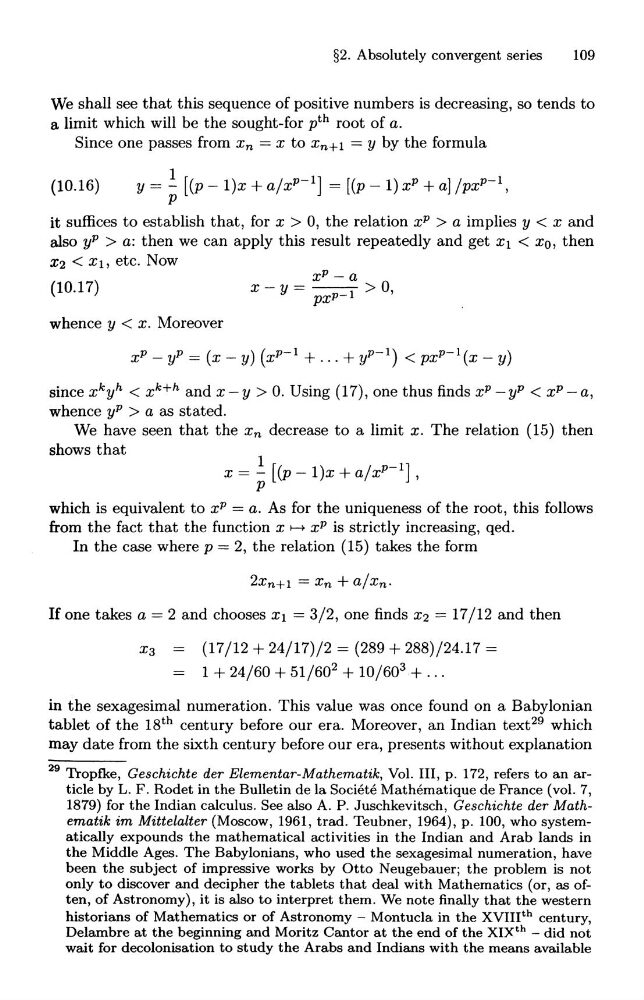
We shall see that this sequence of positive numbers is decreasing, so tends to
a limit which will be the sought-for pth root of a.
Since one passes from Xn = x to XnH = Y by the formula
(10.16)
1
y = - [(p - l)x + a/xV-I] = [(p - 1) XV + a] /px v - l ,
p
it suffices to establish that, for x > 0, the relation XV > a implies y < x and
also yV > a: then we can apply this result repeatedly and get Xl < Xo, then
X2 < Xl, etc. Now
(10.17)
xV-a
x-y= - - - >0,
pxv- l
whence y < x. Moreover
since xkyh < X k + h and X - Y > O. Using (17), one thus finds XV - yV < XV - a,
whence yV > a as stated.
We have seen that the Xn decrease to a limit x. The relation (15) then
shows that
1
X = - [(p - l)x + a/xV-I] ,
p
which is equivalent to XV = a. As for the uniqueness of the root, this follows
from the fact that the function x f--+ XV is strictly increasing, qed.
In the case where p = 2, the relation (15) takes the form
If one takes a = 2 and chooses Xl = 3/2, one finds X2 = 17/12 and then
X3
(17/12 + 24/17)/2 = (289 + 288)/24.17 =
1 + 24/60 + 51/60 2 + 10/60 3 + ...
in the sexagesimal numeration. This value was once found on a Babylonian
tablet of the 18 th century before our era. Moreover, an Indian text 29 which
may date from the sixth century before our era, presents without explanation
29 Tropike, Geschichte der Elementar-Mathematik, Vol. III, p. 172, refers to an article by L. F. Rodet in the Bulletin de la Societe Mathematique de France (vol. 7,
1879) for the Indian calculus. See also A. P. Juschkevitsch, Geschichte der Mathematik im Mittelalter (Moscow, 1961, trad. Teubner, 1964), p. 100, who systematically expounds the mathematical activities in the Indian and Arab lands in
the Middle Ages. The Babylonians, who used the sexagesimal numeration, have
been the subject of impressive works by Otto Neugebauer; the problem is not
only to discover and decipher the tablets that deal with Mathematics (or, as often, of Astronomy), it is also to interpret them. We note finally that the western
historians of Mathematics or of Astronomy - Montucla in the XVIII th century,
Delambre at the beginning and Moritz Cantor at the end of the XIX th - did not
wait for decolonisation to study the Arabs and Indians with the means available
109
We shall see that this sequence of positive numbers is decreasing, so tends to
a limit which will be the sought-for pth root of a.
Since one passes from Xn = x to XnH = Y by the formula
(10.16)
1
y = - [(p - l)x + a/xV-I] = [(p - 1) XV + a] /px v - l ,
p
it suffices to establish that, for x > 0, the relation XV > a implies y < x and
also yV > a: then we can apply this result repeatedly and get Xl < Xo, then
X2 < Xl, etc. Now
(10.17)
xV-a
x-y= - - - >0,
pxv- l
whence y < x. Moreover
since xkyh < X k + h and X - Y > O. Using (17), one thus finds XV - yV < XV - a,
whence yV > a as stated.
We have seen that the Xn decrease to a limit x. The relation (15) then
shows that
1
X = - [(p - l)x + a/xV-I] ,
p
which is equivalent to XV = a. As for the uniqueness of the root, this follows
from the fact that the function x f--+ XV is strictly increasing, qed.
In the case where p = 2, the relation (15) takes the form
If one takes a = 2 and chooses Xl = 3/2, one finds X2 = 17/12 and then
X3
(17/12 + 24/17)/2 = (289 + 288)/24.17 =
1 + 24/60 + 51/60 2 + 10/60 3 + ...
in the sexagesimal numeration. This value was once found on a Babylonian
tablet of the 18 th century before our era. Moreover, an Indian text 29 which
may date from the sixth century before our era, presents without explanation
29 Tropike, Geschichte der Elementar-Mathematik, Vol. III, p. 172, refers to an article by L. F. Rodet in the Bulletin de la Societe Mathematique de France (vol. 7,
1879) for the Indian calculus. See also A. P. Juschkevitsch, Geschichte der Mathematik im Mittelalter (Moscow, 1961, trad. Teubner, 1964), p. 100, who systematically expounds the mathematical activities in the Indian and Arab lands in
the Middle Ages. The Babylonians, who used the sexagesimal numeration, have
been the subject of impressive works by Otto Neugebauer; the problem is not
only to discover and decipher the tablets that deal with Mathematics (or, as often, of Astronomy), it is also to interpret them. We note finally that the western
historians of Mathematics or of Astronomy - Montucla in the XVIII th century,
Delambre at the beginning and Moritz Cantor at the end of the XIX th - did not
wait for decolonisation to study the Arabs and Indians with the means available