

104
II - Convergence: Discrete variables
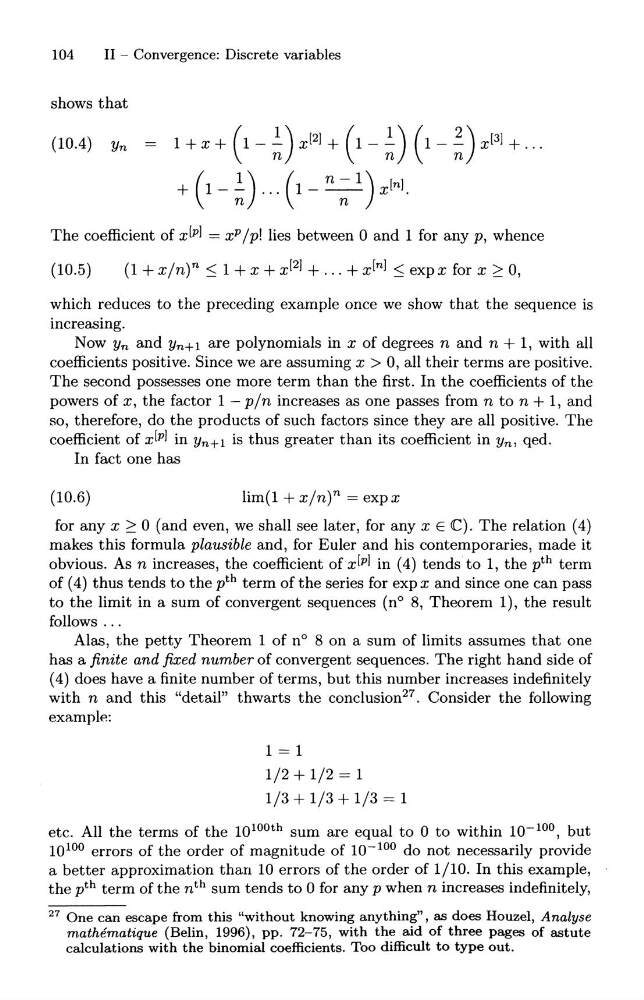
shows that
(10.4) Yn
1 + x + (1 - ~) X[2] + (1 - ~) (1 - ~) x[3] + ...
+ (1 _ ~) ... (1 _ n : 1 ) x[n].
The coefficient of x[p] = x P /p! lies between 0 and 1 for any p, whence
(10.5)
(1 + x/n)n ~ 1 + x + x[2] + ... + x[n] ~ expx for x:::: 0,
which reduces to the preceding example once we show that the sequence is
increasing.
Now Yn and Yn+1 are polynomials in x of degrees n and n + 1, with all
coefficients positive. Since we are assuming x > 0, all their terms are positive.
The second possesses one more term than the first. In the coefficients of the
powers of x, the factor 1 - pin increases as one passes from n to n + 1, and
so, therefore, do the products of such factors since they are all positive. The
coefficient of x[p] in Yn+1 is thus greater than its coefficient in Yn, qed.
In fact one has
(10.6)
lim(1 + x/n)n = expx
for any x:::: 0 (and even, we shall see later, for any x E C). The relation (4)
makes this formula plausible and, for Euler and his contemporaries, made it
obvious. As n increases, the coefficient of x[p] in (4) tends to 1, the pth term
of (4) thus tends to the pth term of the series for exp x and since one can pass
to the limit in a sum of convergent sequences (nO 8, Theorem 1), the result
follows ...
Alas, the petty Theorem 1 of nO 8 on a sum of limits assumes that one
has a finite and fixed number of convergent sequences. The right hand side of
(4) does have a finite number of terms, but this number increases indefinitely
with n and this "detail" thwarts the conclusion 27 • Consider the following
examplp.:
1 = 1
1/2 + 1/2 = 1
1/3 + 1/3 + 1/3 = 1
etc. All the terms of the 10 100th sum are equal to 0 to within 10- 100 , but
10100 errors of the order of magnitude of 10- 100 do not necessarily provide
a better approximation than 10 errors of the order of 1/10. In this example,
the pth term of the nth sum tends to 0 for any p when n increases indefinitely,
27 One can escape from this "without knowing anything" , as does Houzel, Analyse
matMmatique (Belin, 1996), pp. 72-75, with the aid of three pages of astute
calculations with the binomial coefficients. Too difficult to type out.
II - Convergence: Discrete variables
shows that
(10.4) Yn
1 + x + (1 - ~) X[2] + (1 - ~) (1 - ~) x[3] + ...
+ (1 _ ~) ... (1 _ n : 1 ) x[n].
The coefficient of x[p] = x P /p! lies between 0 and 1 for any p, whence
(10.5)
(1 + x/n)n ~ 1 + x + x[2] + ... + x[n] ~ expx for x:::: 0,
which reduces to the preceding example once we show that the sequence is
increasing.
Now Yn and Yn+1 are polynomials in x of degrees n and n + 1, with all
coefficients positive. Since we are assuming x > 0, all their terms are positive.
The second possesses one more term than the first. In the coefficients of the
powers of x, the factor 1 - pin increases as one passes from n to n + 1, and
so, therefore, do the products of such factors since they are all positive. The
coefficient of x[p] in Yn+1 is thus greater than its coefficient in Yn, qed.
In fact one has
(10.6)
lim(1 + x/n)n = expx
for any x:::: 0 (and even, we shall see later, for any x E C). The relation (4)
makes this formula plausible and, for Euler and his contemporaries, made it
obvious. As n increases, the coefficient of x[p] in (4) tends to 1, the pth term
of (4) thus tends to the pth term of the series for exp x and since one can pass
to the limit in a sum of convergent sequences (nO 8, Theorem 1), the result
follows ...
Alas, the petty Theorem 1 of nO 8 on a sum of limits assumes that one
has a finite and fixed number of convergent sequences. The right hand side of
(4) does have a finite number of terms, but this number increases indefinitely
with n and this "detail" thwarts the conclusion 27 • Consider the following
examplp.:
1 = 1
1/2 + 1/2 = 1
1/3 + 1/3 + 1/3 = 1
etc. All the terms of the 10 100th sum are equal to 0 to within 10- 100 , but
10100 errors of the order of magnitude of 10- 100 do not necessarily provide
a better approximation than 10 errors of the order of 1/10. In this example,
the pth term of the nth sum tends to 0 for any p when n increases indefinitely,
27 One can escape from this "without knowing anything" , as does Houzel, Analyse
matMmatique (Belin, 1996), pp. 72-75, with the aid of three pages of astute
calculations with the binomial coefficients. Too difficult to type out.