

Hg Contamnation from New World Gold & Silver Mine Tailings
79
and tailings in North Carolina also showed concentrations below 20 ~lg 1- 1
(Callaham et a1. 1994).
Tiimpling et a1. (1995), working in creek waters draining tailings in central
Brazil, found that volatile Hgo is typically less than 5% of the total dissolved Hg
content in water. Easily reducible Hg corresponds to 20 to 50%, and the other
fractions in dissolved form are refractory compounds.
Lacerda et a1. (1991a) studied Hg dynamics in a creek draining a contaminated
tailing deposit during a storm in the Po cone mining site, central Brazil.
Significant changes in Hg concentrations in water and suspended particles, as
well as in major physicochemical parameters in creek water draining the tailings,
occurred during the storm event. The water became progressively more acidic,
with pH dropping from 6.8 to 5.1. Redox potential also increased due to the entry
of rainwater supersaturated in oxygen, average Eh became more oxidizing,
increasing from 280 to 430 m V 10 min after the start of the storm. The content of
suspended particles also showed a dramatic increase, reaching values up to ten
times higher than during dry conditions, increasing from 6 mg 1- 1 to 66 mg 1- 1.
These changes occurred just a few minutes after the onset of rain. Mercury
concentrations III suspended particles increased from <0.02 pg g - I to
0.61 ~lg g - I .
The results obtained show the capacity of rain to erode fine particles, enriched
with Hg, from the tailings, suggesting that erosion, followed by Hg transport
associated with suspended particles, is the main pathway of Hg contamination of
the tailings drainage. Prokopovich (1984) found a significant relationship
between Hg content and the clay fraction in old California tailings. The fact
that dissolved Hg concentrations remained constant during the storm suggests
that only small amounts of Hg, if any, are remobilized into solution and that Hg
concentration in water is independent of mercury content in sediments (Andrade
180
160
140
120
:;; 100
I:D
cil 80
.s
Cl
60
z
40
20
0
0.5
1
4
5
10
15
20
25
30
Distance from tailings (km)
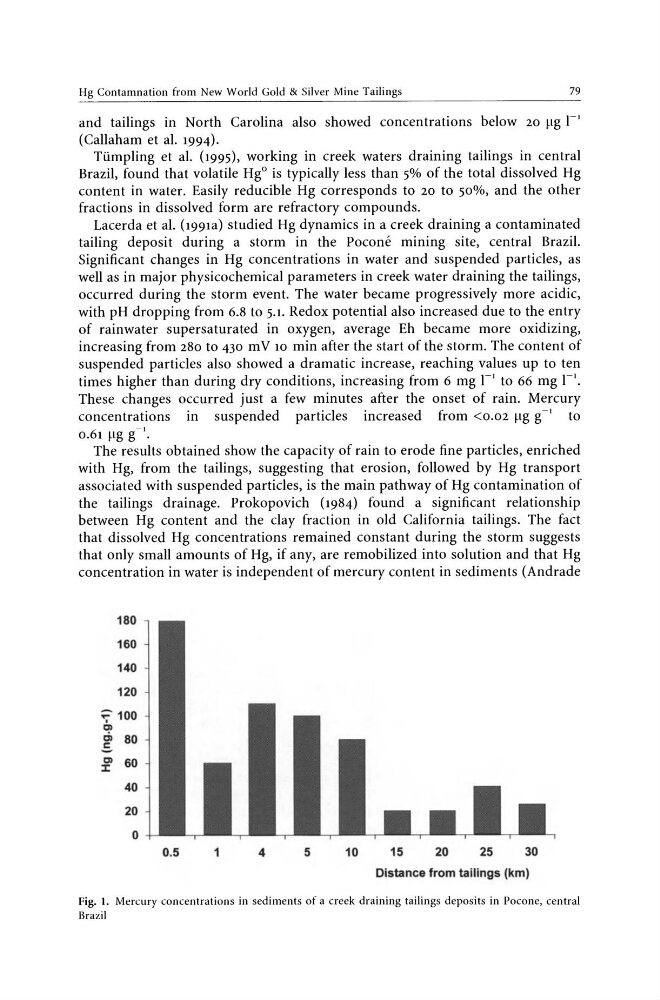
Fig. 1. Mercury concentrations in sediments of a creek draining tailings deposits in Pocone, central
Brazil
79
and tailings in North Carolina also showed concentrations below 20 ~lg 1- 1
(Callaham et a1. 1994).
Tiimpling et a1. (1995), working in creek waters draining tailings in central
Brazil, found that volatile Hgo is typically less than 5% of the total dissolved Hg
content in water. Easily reducible Hg corresponds to 20 to 50%, and the other
fractions in dissolved form are refractory compounds.
Lacerda et a1. (1991a) studied Hg dynamics in a creek draining a contaminated
tailing deposit during a storm in the Po cone mining site, central Brazil.
Significant changes in Hg concentrations in water and suspended particles, as
well as in major physicochemical parameters in creek water draining the tailings,
occurred during the storm event. The water became progressively more acidic,
with pH dropping from 6.8 to 5.1. Redox potential also increased due to the entry
of rainwater supersaturated in oxygen, average Eh became more oxidizing,
increasing from 280 to 430 m V 10 min after the start of the storm. The content of
suspended particles also showed a dramatic increase, reaching values up to ten
times higher than during dry conditions, increasing from 6 mg 1- 1 to 66 mg 1- 1.
These changes occurred just a few minutes after the onset of rain. Mercury
concentrations III suspended particles increased from <0.02 pg g - I to
0.61 ~lg g - I .
The results obtained show the capacity of rain to erode fine particles, enriched
with Hg, from the tailings, suggesting that erosion, followed by Hg transport
associated with suspended particles, is the main pathway of Hg contamination of
the tailings drainage. Prokopovich (1984) found a significant relationship
between Hg content and the clay fraction in old California tailings. The fact
that dissolved Hg concentrations remained constant during the storm suggests
that only small amounts of Hg, if any, are remobilized into solution and that Hg
concentration in water is independent of mercury content in sediments (Andrade
180
160
140
120
:;; 100
I:D
cil 80
.s
Cl
60
z
40
20
0
0.5
1
4
5
10
15
20
25
30
Distance from tailings (km)
Fig. 1. Mercury concentrations in sediments of a creek draining tailings deposits in Pocone, central
Brazil