

Mercury Mines in Europe
69
5
General Remarks
Of the three most important mining districts in Europe, only the one in Almaden
(Spain) is still active with a discontinuous mercury production and much lower
than in the past. In Idrija (Slovenia) and Mt. Amiata (Italy) extraction and
smelting activity practically ceased many years ago, but their effects due to
mercury environmental contamination are still visible today.
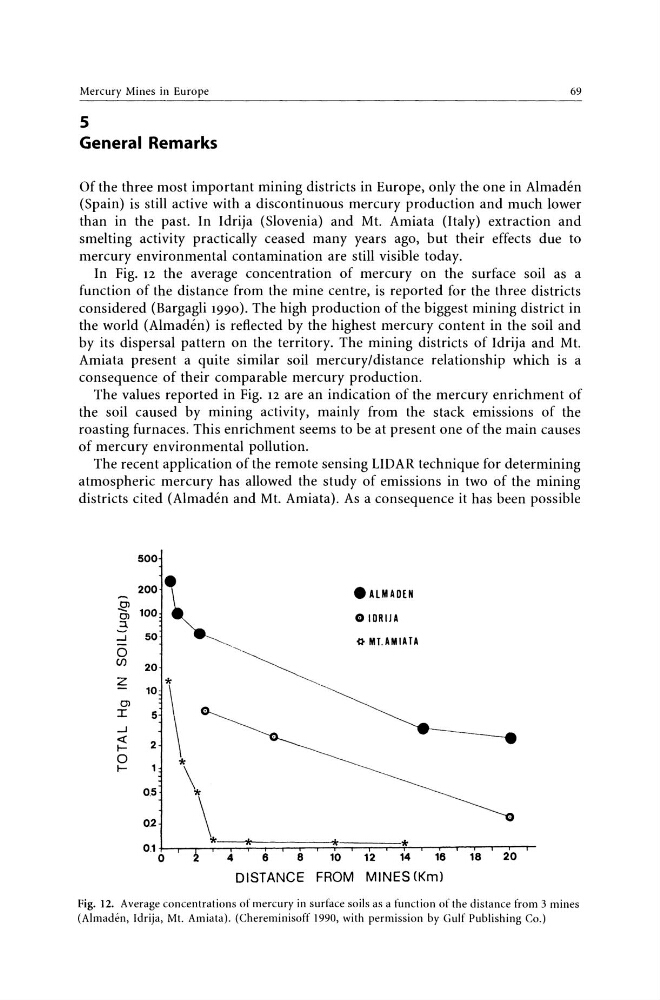
In Fig. 12 the average concentration of mercury on the surface soil as a
function of the distance from the mine centre, is reported for the three districts
considered (Bargagli 1990). The high production of the biggest mining district in
the world (Almaden) is reflected by the highest mercury content in the soil and
by its dispersal pattern on the territory. The mining districts of Idrija and Mt.
Amiata present a quite similar soil mercury/distance relationship which is a
consequence of their comparable mercury production.
The values reported in Fig. 12 are an indication of the mercury enrichment of
the soil caused by mining activity, mainly from the stack emissions of the
roasting furnaces. This enrichment seems to be at present one of the main causes
of mercury environmental pollution.
The recent application of the remote sensing LIDAR technique for determining
atmospheric mercury has allowed the study of emissions in two of the mining
districts cited (Almaden and Mt. Amiata). As a consequence it has been possible
500
200
~,
• ALMADEN
.l2' 100
01
G IDRIJA
.3
-I
50
o MT.AMIATA
a
~
en 20
z
*
10
\
01
:r: 5
-I
c::(
2
Ia
*
I\
0.5
\
02
0.1
*
*
*
0
4
8
8
10
12
14
16
18
20
DISTANCE FROM MINES(Kml
Fig. 12. Average concentrations of mercury in surface soils as a function of the distance from 3 mines
(Almaden, Idrija, Mt. Amiata), (Chereminisoff 1990, with permission by Gulf Publishing Co.)
69
5
General Remarks
Of the three most important mining districts in Europe, only the one in Almaden
(Spain) is still active with a discontinuous mercury production and much lower
than in the past. In Idrija (Slovenia) and Mt. Amiata (Italy) extraction and
smelting activity practically ceased many years ago, but their effects due to
mercury environmental contamination are still visible today.
In Fig. 12 the average concentration of mercury on the surface soil as a
function of the distance from the mine centre, is reported for the three districts
considered (Bargagli 1990). The high production of the biggest mining district in
the world (Almaden) is reflected by the highest mercury content in the soil and
by its dispersal pattern on the territory. The mining districts of Idrija and Mt.
Amiata present a quite similar soil mercury/distance relationship which is a
consequence of their comparable mercury production.
The values reported in Fig. 12 are an indication of the mercury enrichment of
the soil caused by mining activity, mainly from the stack emissions of the
roasting furnaces. This enrichment seems to be at present one of the main causes
of mercury environmental pollution.
The recent application of the remote sensing LIDAR technique for determining
atmospheric mercury has allowed the study of emissions in two of the mining
districts cited (Almaden and Mt. Amiata). As a consequence it has been possible
500
200
~,
• ALMADEN
.l2' 100
01
G IDRIJA
.3
-I
50
o MT.AMIATA
a
~
en 20
z
*
10
\
01
:r: 5
-I
c::(
2
Ia
*
I\
0.5
\
02
0.1
*
*
*
0
4
8
8
10
12
14
16
18
20
DISTANCE FROM MINES(Kml
Fig. 12. Average concentrations of mercury in surface soils as a function of the distance from 3 mines
(Almaden, Idrija, Mt. Amiata), (Chereminisoff 1990, with permission by Gulf Publishing Co.)