

Mercury Mines in Europe
,I r
\
(
!
JJ~'m i
Q 2 0
0 1 5-45
0 ° '1- 12
O OI-OJ
0 - 005
55
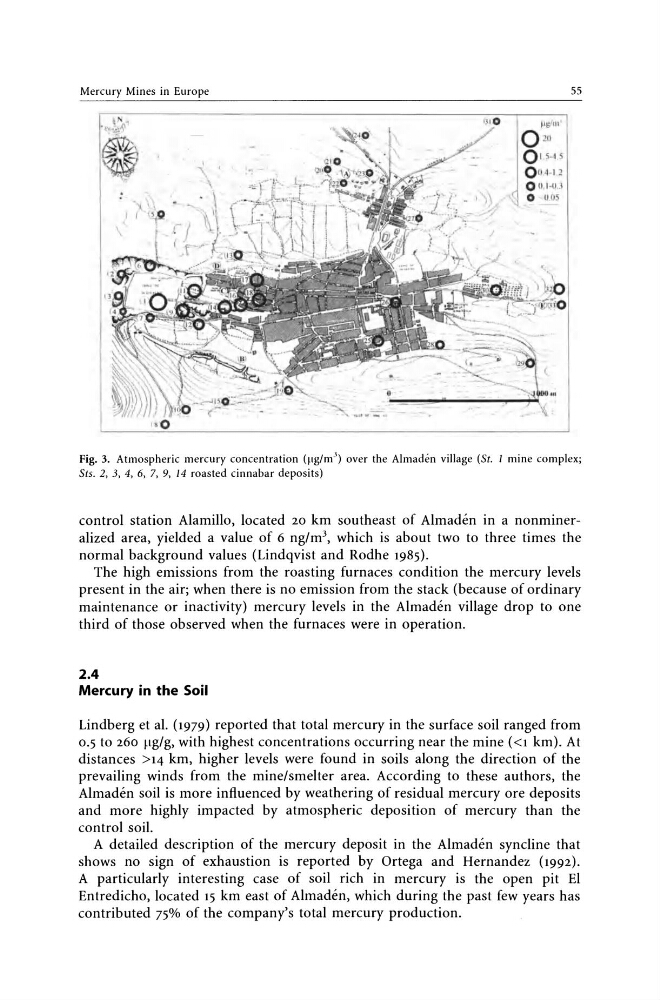
Fig. 3. Atmospheric mercury concentration (Ilg/m.! ) over the Almaden village (SI. I mine complex;
SIs. 2, 3, 4, 6, 7, 9, 14 roasted cinnabar deposits)
control station Alamillo, located 20 km southeast of Almaden in a nonmineralized area, yielded a value of 6 ng/m3, which is about two to three times the
normal background values (Lindqvist and Rodhe 1985).
The high emissions from the roasting furnaces condition the mercury levels
present in the air; when there is no emission from the stack (because of ordinary
maintenance or inactivity) mercury levels in the Almaden village drop to one
third of those observed when the furnaces were in operation.
2.4
Mercury in the Soil
Lindberg et at. (1979) reported that total mercury in the surface soil ranged from
0.5 to 260 pg/g, with highest concentrations occurring near the mine «1 km). At
distances >14 km, higher levels were found in soils along the direction of the
prevailing winds from the mine/smelter area. According to these authors, the
Almaden soil is more influenced by weathering of residual mercury ore deposits
and more highly impacted by atmospheric deposition of mercury than the
control soil.
A detailed description of the mercury deposit in the Almaden syncline that
shows no sign of exhaustion is reported by Ortega and Hernandez (1992).
A particularly interesting case of soil rich in mercury is the open pit EI
Entredicho, located 15 km east of Almaden, which during the past few years has
contributed 75% of the company's total mercury production.
,I r
\
(
!
JJ~'m i
Q 2 0
0 1 5-45
0 ° '1- 12
O OI-OJ
0 - 005
55
Fig. 3. Atmospheric mercury concentration (Ilg/m.! ) over the Almaden village (SI. I mine complex;
SIs. 2, 3, 4, 6, 7, 9, 14 roasted cinnabar deposits)
control station Alamillo, located 20 km southeast of Almaden in a nonmineralized area, yielded a value of 6 ng/m3, which is about two to three times the
normal background values (Lindqvist and Rodhe 1985).
The high emissions from the roasting furnaces condition the mercury levels
present in the air; when there is no emission from the stack (because of ordinary
maintenance or inactivity) mercury levels in the Almaden village drop to one
third of those observed when the furnaces were in operation.
2.4
Mercury in the Soil
Lindberg et at. (1979) reported that total mercury in the surface soil ranged from
0.5 to 260 pg/g, with highest concentrations occurring near the mine «1 km). At
distances >14 km, higher levels were found in soils along the direction of the
prevailing winds from the mine/smelter area. According to these authors, the
Almaden soil is more influenced by weathering of residual mercury ore deposits
and more highly impacted by atmospheric deposition of mercury than the
control soil.
A detailed description of the mercury deposit in the Almaden syncline that
shows no sign of exhaustion is reported by Ortega and Hernandez (1992).
A particularly interesting case of soil rich in mercury is the open pit EI
Entredicho, located 15 km east of Almaden, which during the past few years has
contributed 75% of the company's total mercury production.