

494
K.S. Patel et al.
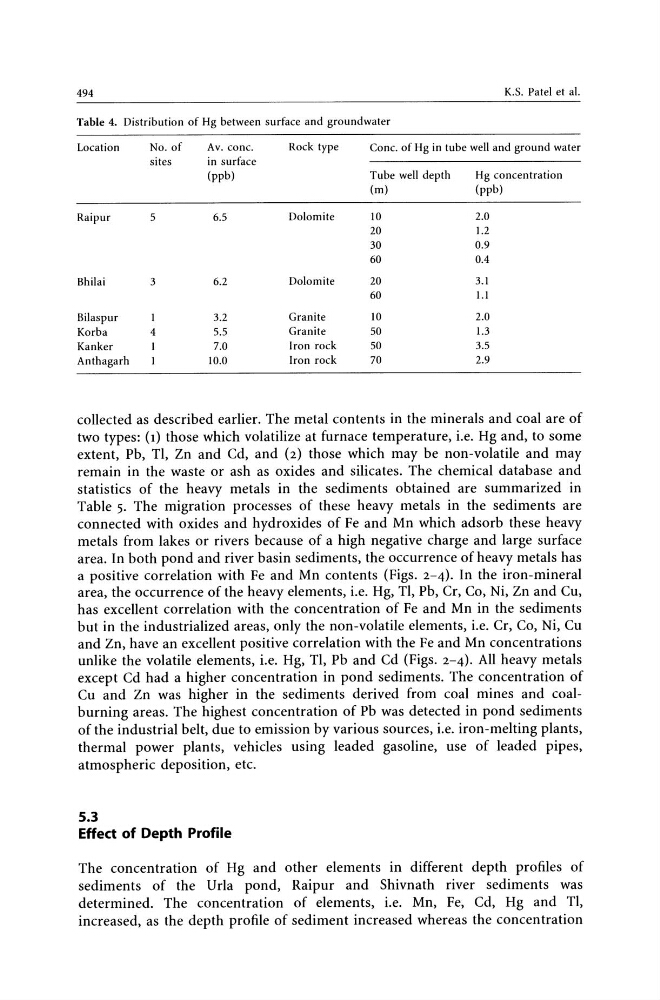
Table 4. Distribution of Hg between surface and groundwater
Location
No. of
Av. cone.
Rock type
Cone. of Hg in tube well and ground water
sites
in surface
(ppb)
Tube well depth
Hg concentration
(m)
(ppb)
Raipur
5
6.5
Dolomite
10
2.0
20
1.2
30
0.9
60
0.4
Bhilai
3
6.2
Dolomite
20
3.1
60
1.1
Bilaspur
3.2
Granite
10
2.0
Korba
4
5.5
Granite
50
1.3
Kanker
7.0
Iron rock
50
3.5
Anthagarh
10.0
Iron rock
70
2.9
collected as described earlier. The metal contents in the minerals and coal are of
two types: (1) those which volatilize at furnace temperature, i.e. Hg and, to some
extent, Pb, TI, Zn and Cd, and (2) those which may be non-volatile and may
remain in the waste or ash as oxides and silicates. The chemical database and
statistics of the heavy metals in the sediments obtained are summarized in
Table 5. The migration processes of these heavy metals in the sediments are
connected with oxides and hydroxides of Fe and Mn which adsorb these heavy
metals from lakes or rivers because of a high negative charge and large surface
area. In both pond and river basin sediments, the occurrence of heavy metals has
a positive correlation with Fe and Mn contents (Figs. 2-4). In the iron-mineral
area, the occurrence of the heavy elements, i.e. Hg, Tl, Pb, Cr, Co, Ni, Zn and Cu,
has excellent correlation with the concentration of Fe and Mn in the sediments
but in the industrialized areas, only the non-volatile elements, i.e. Cr, Co, Ni, Cu
and Zn, have an excellent positive correlation with the Fe and Mn concentrations
unlike the volatile elements, i.e. Hg, TI, Pb and Cd (Figs. 2-4). All heavy metals
except Cd had a higher concentration in pond sediments. The concentration of
Cu and Zn was higher in the sediments derived from coal mines and coalburning areas. The highest concentration of Pb was detected in pond sediments
of the industrial belt, due to emission by various sources, i.e. iron-melting plants,
thermal power plants, vehicles using leaded gasoline, use of leaded pipes,
atmospheric deposition, etc.
5.3
Effect of Depth Profile
The concentration of Hg and other elements in different depth profiles of
sediments of the Urla pond, Raipur and Shivnath river sediments was
determined. The concentration of elements, i.e. Mn, Fe, Cd, Hg and TJ,
increased, as the depth profile of sediment increased whereas the concentration
K.S. Patel et al.
Table 4. Distribution of Hg between surface and groundwater
Location
No. of
Av. cone.
Rock type
Cone. of Hg in tube well and ground water
sites
in surface
(ppb)
Tube well depth
Hg concentration
(m)
(ppb)
Raipur
5
6.5
Dolomite
10
2.0
20
1.2
30
0.9
60
0.4
Bhilai
3
6.2
Dolomite
20
3.1
60
1.1
Bilaspur
3.2
Granite
10
2.0
Korba
4
5.5
Granite
50
1.3
Kanker
7.0
Iron rock
50
3.5
Anthagarh
10.0
Iron rock
70
2.9
collected as described earlier. The metal contents in the minerals and coal are of
two types: (1) those which volatilize at furnace temperature, i.e. Hg and, to some
extent, Pb, TI, Zn and Cd, and (2) those which may be non-volatile and may
remain in the waste or ash as oxides and silicates. The chemical database and
statistics of the heavy metals in the sediments obtained are summarized in
Table 5. The migration processes of these heavy metals in the sediments are
connected with oxides and hydroxides of Fe and Mn which adsorb these heavy
metals from lakes or rivers because of a high negative charge and large surface
area. In both pond and river basin sediments, the occurrence of heavy metals has
a positive correlation with Fe and Mn contents (Figs. 2-4). In the iron-mineral
area, the occurrence of the heavy elements, i.e. Hg, Tl, Pb, Cr, Co, Ni, Zn and Cu,
has excellent correlation with the concentration of Fe and Mn in the sediments
but in the industrialized areas, only the non-volatile elements, i.e. Cr, Co, Ni, Cu
and Zn, have an excellent positive correlation with the Fe and Mn concentrations
unlike the volatile elements, i.e. Hg, TI, Pb and Cd (Figs. 2-4). All heavy metals
except Cd had a higher concentration in pond sediments. The concentration of
Cu and Zn was higher in the sediments derived from coal mines and coalburning areas. The highest concentration of Pb was detected in pond sediments
of the industrial belt, due to emission by various sources, i.e. iron-melting plants,
thermal power plants, vehicles using leaded gasoline, use of leaded pipes,
atmospheric deposition, etc.
5.3
Effect of Depth Profile
The concentration of Hg and other elements in different depth profiles of
sediments of the Urla pond, Raipur and Shivnath river sediments was
determined. The concentration of elements, i.e. Mn, Fe, Cd, Hg and TJ,
increased, as the depth profile of sediment increased whereas the concentration