

488
K.S. Patel et al.
mineral belt of central India, has been investigated to understand their
concentration level, chemical forms, dispersion and sources.
2
Materials and Methods
2.1
Equipment
A GBC model 932 Atomic Absorption Spectrophotometer (AAS) equipped with
GF-3000 graphite furnace and a model 3000 HG cold vapour accessory was used
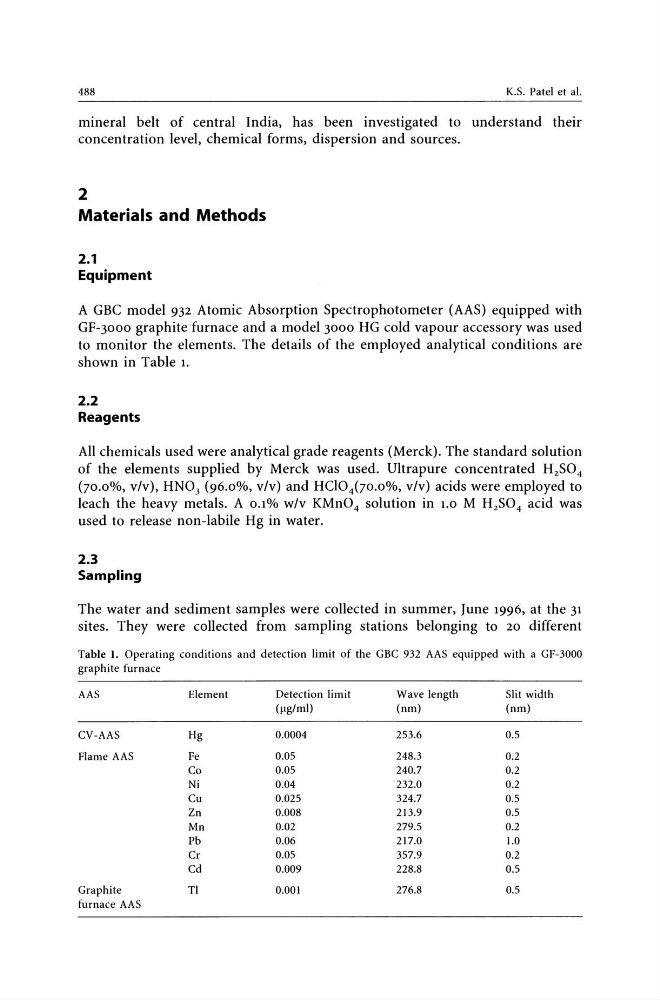
to monitor the elements. The details of the employed analytical conditions are
shown in Table 1.
2.2
Reagents
All chemicals used were analytical grade reagents (Merck). The standard solution
of the elements supplied by Merck was used. Ultrapure concentrated H2S0 4
(70.0%, v/v), HN0 3 (96.0%, v/v) and HCIOi70.0%, v/v) acids were employed to
leach the heavy metals. A 0.1% w/v KMn0 4 solution in 1.0 M H2 S0 4 acid was
used to release non-labile Hg in water.
2.3
Sampling
The water and sediment samples were collected in summer, June 1996, at the 31
sites. They were collected from sampling stations belonging to 20 different
Table 1. Operating conditions and detection limit of the GBC 932 AAS equipped with a GF-3000
graphite furnace
AAS
Element
Detection limit
Wave length
Slit width
(flg/ml)
(nm)
(nm)
CV-AAS
Hg
0.0004
253.6
0.5
Flame AAS
Fe
0.05
248.3
0.2
Co
0.05
240.7
0.2
Ni
0.04
232.0
0.2
Cu
0.025
324.7
0.5
Zn
0.008
213.9
0.5
Mn
0.02
279.5
0.2
Pb
0.06
217.0
1.0
Cr
0.05
357.9
0.2
Cd
0.009
228.8
0.5
Graphite
TI
0.001
276.8
0.5
furnace AAS
K.S. Patel et al.
mineral belt of central India, has been investigated to understand their
concentration level, chemical forms, dispersion and sources.
2
Materials and Methods
2.1
Equipment
A GBC model 932 Atomic Absorption Spectrophotometer (AAS) equipped with
GF-3000 graphite furnace and a model 3000 HG cold vapour accessory was used
to monitor the elements. The details of the employed analytical conditions are
shown in Table 1.
2.2
Reagents
All chemicals used were analytical grade reagents (Merck). The standard solution
of the elements supplied by Merck was used. Ultrapure concentrated H2S0 4
(70.0%, v/v), HN0 3 (96.0%, v/v) and HCIOi70.0%, v/v) acids were employed to
leach the heavy metals. A 0.1% w/v KMn0 4 solution in 1.0 M H2 S0 4 acid was
used to release non-labile Hg in water.
2.3
Sampling
The water and sediment samples were collected in summer, June 1996, at the 31
sites. They were collected from sampling stations belonging to 20 different
Table 1. Operating conditions and detection limit of the GBC 932 AAS equipped with a GF-3000
graphite furnace
AAS
Element
Detection limit
Wave length
Slit width
(flg/ml)
(nm)
(nm)
CV-AAS
Hg
0.0004
253.6
0.5
Flame AAS
Fe
0.05
248.3
0.2
Co
0.05
240.7
0.2
Ni
0.04
232.0
0.2
Cu
0.025
324.7
0.5
Zn
0.008
213.9
0.5
Mn
0.02
279.5
0.2
Pb
0.06
217.0
1.0
Cr
0.05
357.9
0.2
Cd
0.009
228.8
0.5
Graphite
TI
0.001
276.8
0.5
furnace AAS