

472
G.E. Glass et al.
tube with a stainless steel knife. This process was repeated for the entire length of
the core sample. Notable characteristics regarding odor, color, texture, and
layering of the sediments were noted and recorded. Subsamples were transported
by cooler and kept at 4 °C until analyzed.
Water depths at each sampling site were determined by lowering a weight
attached to a cord with calibrated length gradations. Values were recorded to the
nearest centimeter.
The Lake Superior sediment core was kept in a plastic core tube at room
temperature, split laterally, and subsampled (just prior to analysis) at l-cm
widths every 5 cm using a stainless steel spatula. Portions for analysis were kept
refrigerated in individual ziploc plastic bags until analyzed.
The width of each subsample determines the resolution of the resulting
measurement. Too great a width of subsamples could obscure a possible elevated
mercury concentration layer by dilution with sediments from nonelevated years.
Too narrow a subsample (and limited analyses resources) would leave too much
of the core underrepresented by analyses. We chose a l-cm subsampling width
because it offered sufficient resolution to resolve possible high deposition
episodes while giving reasonable coverage of the entire sediment core.
2.2.3
Sediment Dating
During the preliminary 1992 sediment survey of the three lower reservoirs,
replicate cores were taken for dating analyses. Those cores were sectioned in the
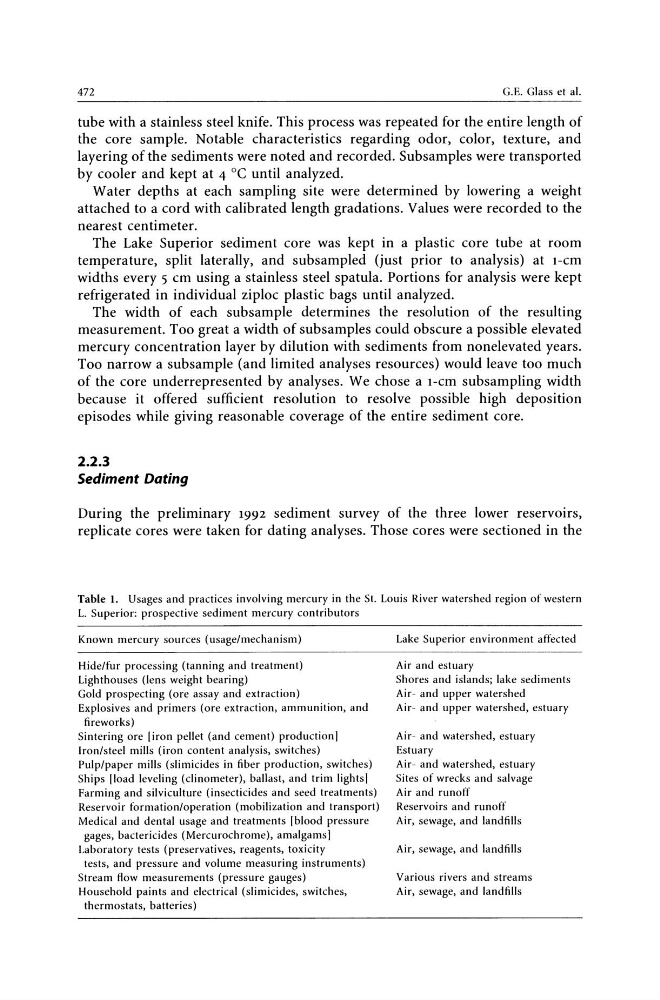
Table l. Usages and practices involving mercury in the St. Louis River watershed region of western
L. Superior: prospective sediment mercury contributors
Known mercury sources (usage/mechanism)
Hide/fur processing (tanning and treatment)
Lighthouses (lens weight bearing)
Gold prospecting (ore assay and extraction)
Explosives and primers (ore extraction, ammunition, and
fireworks)
Sintering ore [iron pellet (and cement) production]
Iron/steel mills (iron content analysis, switches)
Pulp/paper mills (slimicides in fiber production, switches)
Ships [load leveling (clinometer), ballast, and trim lights]
Farming and silviculture (insecticides and seed treatments)
Reservoir formation/operation (mobilization and transport)
Medical and dental usage and treatments [blood pressure
gages, bactericides (Mercurochrome), amalgams]
Laboratory tests (preservatives, reagents, toxicity
tests, and pressure and volume measuring instruments)
Stream flow measurements (pressure gauges)
Household paints and electrical (slimicides, switches,
thermostats, batteries)
Lake Superior environment affected
Air and estuary
Shores and islands; lake sediments
Air- and upper watershed
Air- and upper watershed, estuary
Air- and watershed, estuary
Estuary
Air- and watershed, estuary
Sites of wrecks and salvage
Air and runoff
Reservoirs and runoff
Air, sewage, and landfills
Air, sewage, and landfills
Various rivers and streams
Air, sewage, and landfills
G.E. Glass et al.
tube with a stainless steel knife. This process was repeated for the entire length of
the core sample. Notable characteristics regarding odor, color, texture, and
layering of the sediments were noted and recorded. Subsamples were transported
by cooler and kept at 4 °C until analyzed.
Water depths at each sampling site were determined by lowering a weight
attached to a cord with calibrated length gradations. Values were recorded to the
nearest centimeter.
The Lake Superior sediment core was kept in a plastic core tube at room
temperature, split laterally, and subsampled (just prior to analysis) at l-cm
widths every 5 cm using a stainless steel spatula. Portions for analysis were kept
refrigerated in individual ziploc plastic bags until analyzed.
The width of each subsample determines the resolution of the resulting
measurement. Too great a width of subsamples could obscure a possible elevated
mercury concentration layer by dilution with sediments from nonelevated years.
Too narrow a subsample (and limited analyses resources) would leave too much
of the core underrepresented by analyses. We chose a l-cm subsampling width
because it offered sufficient resolution to resolve possible high deposition
episodes while giving reasonable coverage of the entire sediment core.
2.2.3
Sediment Dating
During the preliminary 1992 sediment survey of the three lower reservoirs,
replicate cores were taken for dating analyses. Those cores were sectioned in the
Table l. Usages and practices involving mercury in the St. Louis River watershed region of western
L. Superior: prospective sediment mercury contributors
Known mercury sources (usage/mechanism)
Hide/fur processing (tanning and treatment)
Lighthouses (lens weight bearing)
Gold prospecting (ore assay and extraction)
Explosives and primers (ore extraction, ammunition, and
fireworks)
Sintering ore [iron pellet (and cement) production]
Iron/steel mills (iron content analysis, switches)
Pulp/paper mills (slimicides in fiber production, switches)
Ships [load leveling (clinometer), ballast, and trim lights]
Farming and silviculture (insecticides and seed treatments)
Reservoir formation/operation (mobilization and transport)
Medical and dental usage and treatments [blood pressure
gages, bactericides (Mercurochrome), amalgams]
Laboratory tests (preservatives, reagents, toxicity
tests, and pressure and volume measuring instruments)
Stream flow measurements (pressure gauges)
Household paints and electrical (slimicides, switches,
thermostats, batteries)
Lake Superior environment affected
Air and estuary
Shores and islands; lake sediments
Air- and upper watershed
Air- and upper watershed, estuary
Air- and watershed, estuary
Estuary
Air- and watershed, estuary
Sites of wrecks and salvage
Air and runoff
Reservoirs and runoff
Air, sewage, and landfills
Air, sewage, and landfills
Various rivers and streams
Air, sewage, and landfills