

Electroleaching: a Mobile Cleanup Process for Mercury Contaminated Materials
~ o
c:
-e>.
()
90
~ 60
·13
~
C
~
5 30
()
o measured data
- - cp = 9.8 + 90 exp(-c/1.6)
o
OLL--~~~~--~~~-L--~--L-~--~~
o
3
6
9
12
15
HOCI concentration c / (mmol/L)
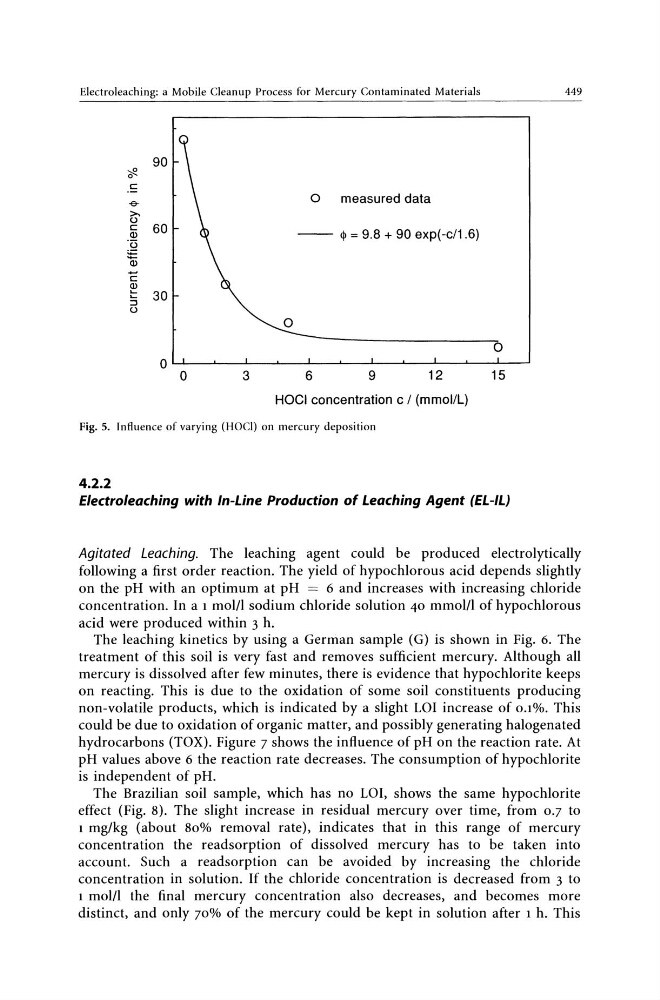
Fig. 5. Influence of varying (HOCI) on mercury deposition
4.2.2
Electroleaching with In-Line Production of Leaching Agent (EL-IL)
449
Agitated Leaching. The leaching agent could be produced electrolytically
following a first order reaction. The yield of hypochlorous acid depends slightly
on the pH with an optimum at pH = 6 and increases with increasing chloride
concentration. In a 1 molll sodium chloride solution 40 mmolll of hypochlorous
acid were produced within 3 h.
The leaching kinetics by using a German sample (G) is shown in Fig. 6. The
treatment of this soil is very fast and removes sufficient mercury. Although all
mercury is dissolved after few minutes, there is evidence that hypochlorite keeps
on reacting. This is due to the oxidation of some soil constituents producing
non-volatile products, which is indicated by a slight LOI increase of 0.1%. This
could be due to oxidation of organic matter, and possibly generating halogenated
hydrocarbons (TOX). Figure 7 shows the influence of pH on the reaction rate. At
pH values above 6 the reaction rate decreases. The consumption of hypochlorite
is independent of pH.
The Brazilian soil sample, which has no LOI, shows the same hypochlorite
effect (Fig. 8). The slight increase in residual mercury over time, from 0.7 to
1 mg/kg (about 80% removal rate), indicates that in this range of mercury
concentration the readsorption of dissolved mercury has to be taken into
account. Such a readsorption can be avoided by increasing the chloride
concentration in solution. If the chloride concentration is decreased from 3 to
1 molll the final mercury concentration also decreases, and becomes more
distinct, and only 70% of the mercury could be kept in solution after 1 h. This
~ o
c:
-e>.
()
90
~ 60
·13
~
C
~
5 30
()
o measured data
- - cp = 9.8 + 90 exp(-c/1.6)
o
OLL--~~~~--~~~-L--~--L-~--~~
o
3
6
9
12
15
HOCI concentration c / (mmol/L)
Fig. 5. Influence of varying (HOCI) on mercury deposition
4.2.2
Electroleaching with In-Line Production of Leaching Agent (EL-IL)
449
Agitated Leaching. The leaching agent could be produced electrolytically
following a first order reaction. The yield of hypochlorous acid depends slightly
on the pH with an optimum at pH = 6 and increases with increasing chloride
concentration. In a 1 molll sodium chloride solution 40 mmolll of hypochlorous
acid were produced within 3 h.
The leaching kinetics by using a German sample (G) is shown in Fig. 6. The
treatment of this soil is very fast and removes sufficient mercury. Although all
mercury is dissolved after few minutes, there is evidence that hypochlorite keeps
on reacting. This is due to the oxidation of some soil constituents producing
non-volatile products, which is indicated by a slight LOI increase of 0.1%. This
could be due to oxidation of organic matter, and possibly generating halogenated
hydrocarbons (TOX). Figure 7 shows the influence of pH on the reaction rate. At
pH values above 6 the reaction rate decreases. The consumption of hypochlorite
is independent of pH.
The Brazilian soil sample, which has no LOI, shows the same hypochlorite
effect (Fig. 8). The slight increase in residual mercury over time, from 0.7 to
1 mg/kg (about 80% removal rate), indicates that in this range of mercury
concentration the readsorption of dissolved mercury has to be taken into
account. Such a readsorption can be avoided by increasing the chloride
concentration in solution. If the chloride concentration is decreased from 3 to
1 molll the final mercury concentration also decreases, and becomes more
distinct, and only 70% of the mercury could be kept in solution after 1 h. This