

Electroleaching: a Mobile Cleanup Process for Mercury Contaminated Materials
447
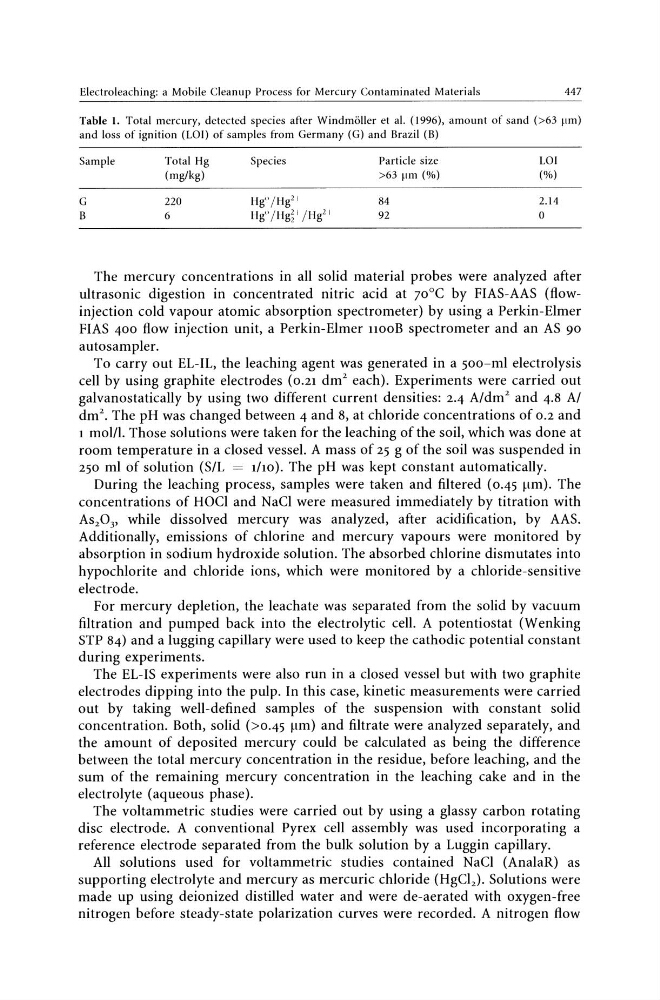
Table l. Total mercury, detected species after Windmiiller et al. (1996), amount of sand (>63 ~Lm)
and loss of ignition (LOI) of samples from Germany (G) and Brazil (B)
Sample
Total Hg
Species
Particle size
LO!
(mg/kg)
>63 pm (%)
(%)
G
220
Hg"/Hg21
84
2.14
B
6
Hg" /Hg~ I /Hg' I
92
0
The mercury concentrations in all solid material probes were analyzed after
ultrasonic digestion in concentrated nitric acid at 70 D C by FIAS-AAS (flowinjection cold vapour atomic absorption spectrometer) by using a Perkin-Elmer
FIAS 400 flow injection unit, a Perkin-Elmer 1l00B spectrometer and an AS 90
autosampler.
To carry out EL-IL, the leaching agent was generated in a 500-ml electrolysis
cell by using graphite electrodes (0.21 dm
2
each). Experiments were carried out
galvanostatically by using two different current densities: 2.4 A/dm
2
and 4.8 AI
dm 2 • The pH was changed between 4 and 8, at chloride concentrations of 0.2 and
1 moili. Those solutions were taken for the leaching of the soil, which was done at
room temperature in a closed vessel. A mass of 25 g of the soil was suspended in
250 ml of solution (S/L = 1110). The pH was kept constant automatically.
During the leaching process, samples were taken and filtered (0.45 ~lm). The
concentrations of HOCI and NaCI were measured immediately by titration with
AS2 0 3 , while dissolved mercury was analyzed, after acidification, by AAS.
Additionally, emissions of chlorine and mercury vapours were monitored by
absorption in sodium hydroxide solution. The absorbed chlorine dis mutates into
hypochlorite and chloride ions, which were monitored by a chloride-sensitive
electrode.
For mercury depletion, the leachate was separated from the solid by vacuum
filtration and pumped back into the electrolytic cell. A potentiostat (Wenking
STP 84) and a lugging capillary were used to keep the cathodic potential constant
during experiments.
The EL-IS experiments were also run in a closed vessel but with two graphite
electrodes dipping into the pulp. In this case, kinetic measurements were carried
out by taking well-defined samples of the suspension with constant solid
concentration. Both, solid (>0.45 ~lm) and filtrate were analyzed separately, and
the amount of deposited mercury could be calculated as being the difference
between the total mercury concentration in the residue, before leaching, and the
sum of the remaining mercury concentration in the leaching cake and in the
electrolyte (aqueous phase).
The voltammetric studies were carried out by using a glassy carbon rotating
disc electrode. A conventional Pyrex cell assembly was used incorporating a
reference electrode separated from the bulk solution by a Luggin capillary.
All solutions used for voltammetric studies contained NaCI (AnalaR) as
supporting electrolyte and mercury as mercuric chloride (HgCI2 ). Solutions were
made up using deionized distilled water and were de-aerated with oxygen-free
nitrogen before steady-state polarization curves were recorded. A nitrogen flow
447
Table l. Total mercury, detected species after Windmiiller et al. (1996), amount of sand (>63 ~Lm)
and loss of ignition (LOI) of samples from Germany (G) and Brazil (B)
Sample
Total Hg
Species
Particle size
LO!
(mg/kg)
>63 pm (%)
(%)
G
220
Hg"/Hg21
84
2.14
B
6
Hg" /Hg~ I /Hg' I
92
0
The mercury concentrations in all solid material probes were analyzed after
ultrasonic digestion in concentrated nitric acid at 70 D C by FIAS-AAS (flowinjection cold vapour atomic absorption spectrometer) by using a Perkin-Elmer
FIAS 400 flow injection unit, a Perkin-Elmer 1l00B spectrometer and an AS 90
autosampler.
To carry out EL-IL, the leaching agent was generated in a 500-ml electrolysis
cell by using graphite electrodes (0.21 dm
2
each). Experiments were carried out
galvanostatically by using two different current densities: 2.4 A/dm
2
and 4.8 AI
dm 2 • The pH was changed between 4 and 8, at chloride concentrations of 0.2 and
1 moili. Those solutions were taken for the leaching of the soil, which was done at
room temperature in a closed vessel. A mass of 25 g of the soil was suspended in
250 ml of solution (S/L = 1110). The pH was kept constant automatically.
During the leaching process, samples were taken and filtered (0.45 ~lm). The
concentrations of HOCI and NaCI were measured immediately by titration with
AS2 0 3 , while dissolved mercury was analyzed, after acidification, by AAS.
Additionally, emissions of chlorine and mercury vapours were monitored by
absorption in sodium hydroxide solution. The absorbed chlorine dis mutates into
hypochlorite and chloride ions, which were monitored by a chloride-sensitive
electrode.
For mercury depletion, the leachate was separated from the solid by vacuum
filtration and pumped back into the electrolytic cell. A potentiostat (Wenking
STP 84) and a lugging capillary were used to keep the cathodic potential constant
during experiments.
The EL-IS experiments were also run in a closed vessel but with two graphite
electrodes dipping into the pulp. In this case, kinetic measurements were carried
out by taking well-defined samples of the suspension with constant solid
concentration. Both, solid (>0.45 ~lm) and filtrate were analyzed separately, and
the amount of deposited mercury could be calculated as being the difference
between the total mercury concentration in the residue, before leaching, and the
sum of the remaining mercury concentration in the leaching cake and in the
electrolyte (aqueous phase).
The voltammetric studies were carried out by using a glassy carbon rotating
disc electrode. A conventional Pyrex cell assembly was used incorporating a
reference electrode separated from the bulk solution by a Luggin capillary.
All solutions used for voltammetric studies contained NaCI (AnalaR) as
supporting electrolyte and mercury as mercuric chloride (HgCI2 ). Solutions were
made up using deionized distilled water and were de-aerated with oxygen-free
nitrogen before steady-state polarization curves were recorded. A nitrogen flow