

438
A. Matsuyama et al.
Given these results, we conclude that the reactions we observed in our tests
were oxidation-reduction reactions in the soil, reactions in which the characteristics of the silicas, such as quartz, and the denaturation of iron chloride by
heating, were utilized.
3.6
The Effect of Iron Chloride Added to Samples of Mercury-Contaminated
Soils from a Site in Japan
Next, we conducted tests using samples of contaminated soil from a site in Japan.
In the tests, we added iron chloride to soil samples and then heated the samples
to examine mercury removal performance. The soil used in our tests was
obtained from the site of a former chemical plant. The soil was volcanic ash soil
with a mercury concentration of about 400 mg/kg of dried soil. We assumed that
the mercury was in the form of mercuric sulfide to calculate the amount of
mercury mol contained in the soil. We added iron chloride in amounts equal to
and ten times greater than that of mercury mol contained in the soil, and then
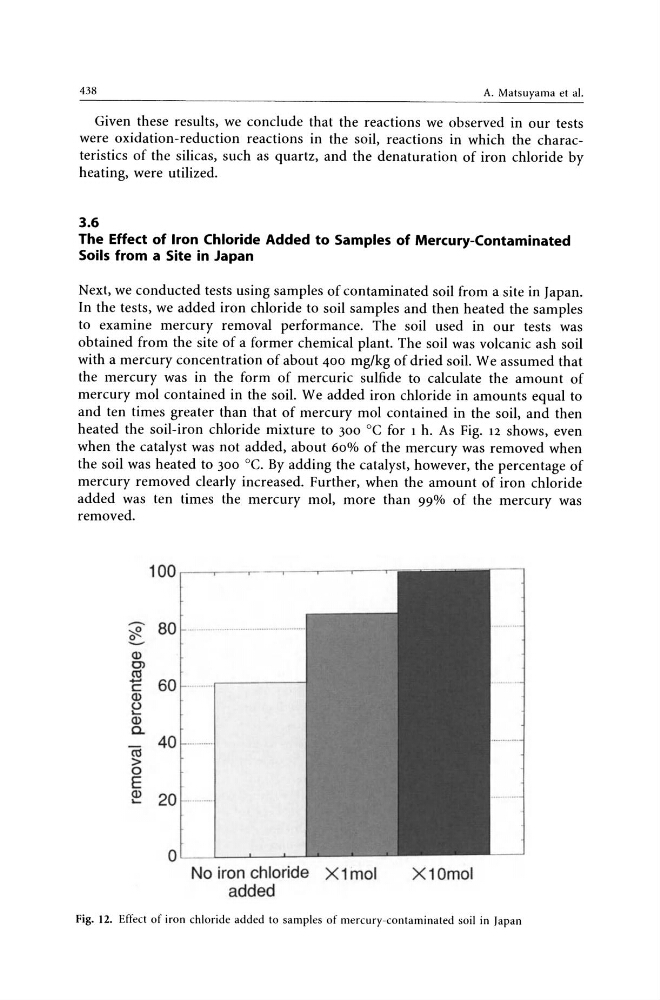
heated the soil-iron chloride mixture to 300°C for 1 h. As Fig. 12 shows, even
when the catalyst was not added, about 60% of the mercury was removed when
the soil was heated to 300 ° C. By adding the catalyst, however, the percentage of
mercury removed clearly increased. Further, when the amount of iron chloride
added was ten times the mercury mol, more than 99% of the mercury was
removed.
CD
0>
ro
~
c
CD
e
CD
a.
ro
>
o
E
CD
~
100 ~~--~-~-~--~--~
80
60
40
20
No iron chloride X 1 mol
added
X10mol
Fig. 12. Effect of iron chloride added to samples of mercury-contaminated soil in Japan
A. Matsuyama et al.
Given these results, we conclude that the reactions we observed in our tests
were oxidation-reduction reactions in the soil, reactions in which the characteristics of the silicas, such as quartz, and the denaturation of iron chloride by
heating, were utilized.
3.6
The Effect of Iron Chloride Added to Samples of Mercury-Contaminated
Soils from a Site in Japan
Next, we conducted tests using samples of contaminated soil from a site in Japan.
In the tests, we added iron chloride to soil samples and then heated the samples
to examine mercury removal performance. The soil used in our tests was
obtained from the site of a former chemical plant. The soil was volcanic ash soil
with a mercury concentration of about 400 mg/kg of dried soil. We assumed that
the mercury was in the form of mercuric sulfide to calculate the amount of
mercury mol contained in the soil. We added iron chloride in amounts equal to
and ten times greater than that of mercury mol contained in the soil, and then
heated the soil-iron chloride mixture to 300°C for 1 h. As Fig. 12 shows, even
when the catalyst was not added, about 60% of the mercury was removed when
the soil was heated to 300 ° C. By adding the catalyst, however, the percentage of
mercury removed clearly increased. Further, when the amount of iron chloride
added was ten times the mercury mol, more than 99% of the mercury was
removed.
CD
0>
ro
~
c
CD
e
CD
a.
ro
>
o
E
CD
~
100 ~~--~-~-~--~--~
80
60
40
20
No iron chloride X 1 mol
added
X10mol
Fig. 12. Effect of iron chloride added to samples of mercury-contaminated soil in Japan