

26
R. Ebinghaus et al.
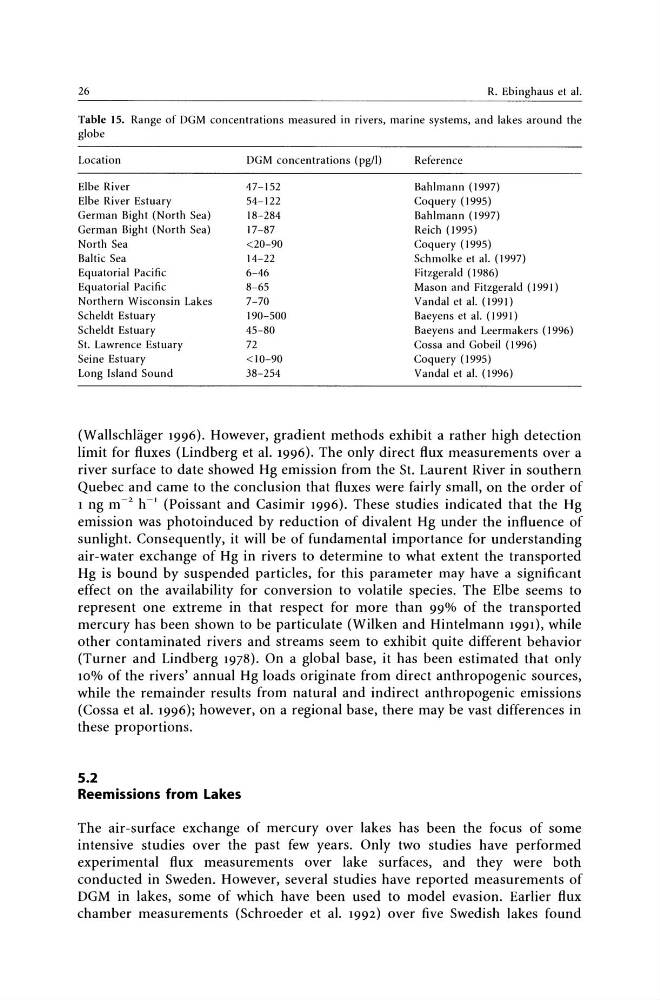
Table 15. Range of DGM concentrations measured in rivers, marine systems, and lakes around the
globe
Location
DGM concentrations (pgll)
Reference
Elbe River
47-152
Bahlmann (1997)
Elbe River Estuary
54-122
Coquery (1995)
German Bight (North Sea)
18-284
Bahlmann (1997)
German Bight (North Sea)
17-87
Reich (1995)
North Sea
<20-90
Coq uery (I 995)
Baltic Sea
14-22
Schmolke et al. (1997)
Equatorial Pacific
6-46
Fitzgerald (1986)
Equatorial Pacific
8-65
Mason and Fitzgerald (1991)
Northern Wisconsin Lakes
7-70
Vandal et al. (1991)
ScheIdt Estuary
190-500
Baeyens et al. (199 I)
ScheIdt Estuary
45-80
Baeyens and Leermakers (1996)
St. Lawrence Estuary
72
Cossa and Gobeil (1996)
Seine Estuary
<10-90
Coquery (1995)
Long Island Sound
38-254
Vandal et al. (1996)
(Wallschlager 1996). However, gradient methods exhibit a rather high detection
limit for fluxes (Lindberg et al. 1996). The only direct flux measurements over a
river surface to date showed Hg emission from the St. Laurent River in southern
Quebec and came to the conclusion that fluxes were fairly small, on the order of
1 ng m -2 h -, (Poissant and Casimir 1996). These studies indicated that the Hg
emission was photoinduced by reduction of divalent Hg under the influence of
sunlight. Consequently, it will be of fundamental importance for understanding
air-water exchange of Hg in rivers to determine to what extent the transported
Hg is bound by suspended particles, for this parameter may have a significant
effect on the availability for conversion to volatile species. The Elbe seems to
represent one extreme in iliat respect for more than 99% of the transported
mercury has been shown to be particulate (Wilken and Hintelmann 1991), while
other contaminated rivers and streams seem to exhibit quite different behavior
(Turner and Lindberg 1978). On a global base, it has been estimated that only
lO% of the rivers' annual Hg loads originate from direct anthropogenic sources,
while the remainder results from natural and indirect anthropogenic emissions
(Cossa et al. 1996); however, on a regional base, there may be vast differences in
these proportions.
5.2
Reemissions from Lakes
The air-surface exchange of mercury over lakes has been the focus of some
intensive studies over the past few years. Only two studies have performed
experimental flux measurements over lake surfaces, and they were both
conducted in Sweden. However, several studies have reported measurements of
DGM in lakes, some of which have been used to model evasion. Earlier flux
chamber measurements (Schroeder et al. 1992) over five Swedish lakes found
R. Ebinghaus et al.
Table 15. Range of DGM concentrations measured in rivers, marine systems, and lakes around the
globe
Location
DGM concentrations (pgll)
Reference
Elbe River
47-152
Bahlmann (1997)
Elbe River Estuary
54-122
Coquery (1995)
German Bight (North Sea)
18-284
Bahlmann (1997)
German Bight (North Sea)
17-87
Reich (1995)
North Sea
<20-90
Coq uery (I 995)
Baltic Sea
14-22
Schmolke et al. (1997)
Equatorial Pacific
6-46
Fitzgerald (1986)
Equatorial Pacific
8-65
Mason and Fitzgerald (1991)
Northern Wisconsin Lakes
7-70
Vandal et al. (1991)
ScheIdt Estuary
190-500
Baeyens et al. (199 I)
ScheIdt Estuary
45-80
Baeyens and Leermakers (1996)
St. Lawrence Estuary
72
Cossa and Gobeil (1996)
Seine Estuary
<10-90
Coquery (1995)
Long Island Sound
38-254
Vandal et al. (1996)
(Wallschlager 1996). However, gradient methods exhibit a rather high detection
limit for fluxes (Lindberg et al. 1996). The only direct flux measurements over a
river surface to date showed Hg emission from the St. Laurent River in southern
Quebec and came to the conclusion that fluxes were fairly small, on the order of
1 ng m -2 h -, (Poissant and Casimir 1996). These studies indicated that the Hg
emission was photoinduced by reduction of divalent Hg under the influence of
sunlight. Consequently, it will be of fundamental importance for understanding
air-water exchange of Hg in rivers to determine to what extent the transported
Hg is bound by suspended particles, for this parameter may have a significant
effect on the availability for conversion to volatile species. The Elbe seems to
represent one extreme in iliat respect for more than 99% of the transported
mercury has been shown to be particulate (Wilken and Hintelmann 1991), while
other contaminated rivers and streams seem to exhibit quite different behavior
(Turner and Lindberg 1978). On a global base, it has been estimated that only
lO% of the rivers' annual Hg loads originate from direct anthropogenic sources,
while the remainder results from natural and indirect anthropogenic emissions
(Cossa et al. 1996); however, on a regional base, there may be vast differences in
these proportions.
5.2
Reemissions from Lakes
The air-surface exchange of mercury over lakes has been the focus of some
intensive studies over the past few years. Only two studies have performed
experimental flux measurements over lake surfaces, and they were both
conducted in Sweden. However, several studies have reported measurements of
DGM in lakes, some of which have been used to model evasion. Earlier flux
chamber measurements (Schroeder et al. 1992) over five Swedish lakes found