

Removal of Mercury from Gases by Modified Zeolites in a Stationary Bed
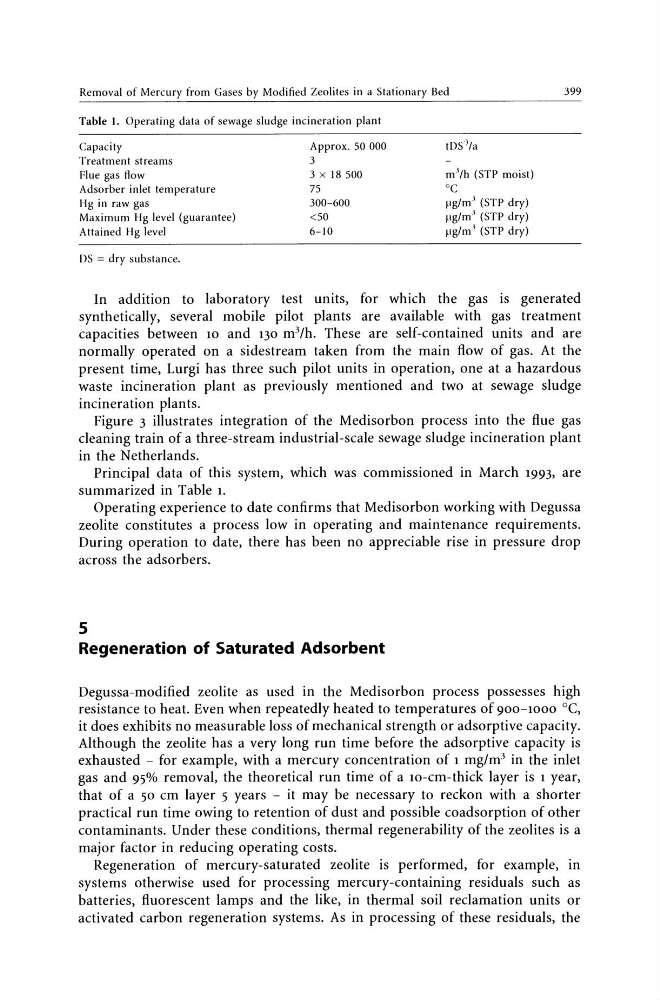
Table 1. Operating data of sewage sludge incineration plant
Capacity
Treatment streams
Flue gas flow
Adsorber inlet temperature
Hg in raw gas
Maximum Hg level (guarantee)
Attained Hg level
DS = dry substance.
Approx. 50000
3
3 x 18 500
75
300~600
<50
6~1O
m'/h (STP moist)
°C
pg/m' (STP dry)
pg/m"' (STP dry)
pg/m"' (STP dry)
399
In addition to laboratory test units, for which the gas is generated
synthetically, several mobile pilot plants are available with gas treatment
capacities between 10 and 130 m 3 /h. These are self-contained units and are
normally operated on a sidestream taken from the main flow of gas. At the
present time, Lurgi has three such pilot units in operation, one at a hazardous
waste incineration plant as previously mentioned and two at sewage sludge
incineration plants.
Figure 3 illustrates integration of the Medisorbon process into the flue gas
cleaning train of a three-stream industrial-scale sewage sludge incineration plant
in the Netherlands.
Principal data of this system, which was commissioned in March 1993, are
summarized in Table 1.
Operating experience to date confirms that Medisorbon working with Degussa
zeolite constitutes a process low in operating and maintenance requirements.
During operation to date, there has been no appreciable rise in pressure drop
across the adsorbers.
5
Regeneration of Saturated Adsorbent
Degussa-modified zeolite as used in the Medisorbon process possesses high
resistance to heat. Even when repeatedly heated to temperatures of 900-1000 DC,
it does exhibits no measurable loss of mechanical strength or adsorptive capacity.
Although the zeolite has a very long run time before the adsorptive capacity is
exhausted - for example, with a mercury concentration of 1 mg/m3 in the inlet
gas and 95% removal, the theoretical run time of a lO-cm-thick layer is 1 year,
that of a 50 cm layer 5 years - it may be necessary to reckon with a shorter
practical run time owing to retention of dust and possible co adsorption of other
contaminants. Under these conditions, thermal regenerability of the zeolites is a
major factor in reducing operating costs.
Regeneration of mercury-saturated zeolite is performed, for example, In
systems otherwise used for processing mercury-containing residuals such as
batteries, fluorescent lamps and the like, in thermal soil reclamation units or
activated carbon regeneration systems. As in processing of these residuals, the
Table 1. Operating data of sewage sludge incineration plant
Capacity
Treatment streams
Flue gas flow
Adsorber inlet temperature
Hg in raw gas
Maximum Hg level (guarantee)
Attained Hg level
DS = dry substance.
Approx. 50000
3
3 x 18 500
75
300~600
<50
6~1O
m'/h (STP moist)
°C
pg/m' (STP dry)
pg/m"' (STP dry)
pg/m"' (STP dry)
399
In addition to laboratory test units, for which the gas is generated
synthetically, several mobile pilot plants are available with gas treatment
capacities between 10 and 130 m 3 /h. These are self-contained units and are
normally operated on a sidestream taken from the main flow of gas. At the
present time, Lurgi has three such pilot units in operation, one at a hazardous
waste incineration plant as previously mentioned and two at sewage sludge
incineration plants.
Figure 3 illustrates integration of the Medisorbon process into the flue gas
cleaning train of a three-stream industrial-scale sewage sludge incineration plant
in the Netherlands.
Principal data of this system, which was commissioned in March 1993, are
summarized in Table 1.
Operating experience to date confirms that Medisorbon working with Degussa
zeolite constitutes a process low in operating and maintenance requirements.
During operation to date, there has been no appreciable rise in pressure drop
across the adsorbers.
5
Regeneration of Saturated Adsorbent
Degussa-modified zeolite as used in the Medisorbon process possesses high
resistance to heat. Even when repeatedly heated to temperatures of 900-1000 DC,
it does exhibits no measurable loss of mechanical strength or adsorptive capacity.
Although the zeolite has a very long run time before the adsorptive capacity is
exhausted - for example, with a mercury concentration of 1 mg/m3 in the inlet
gas and 95% removal, the theoretical run time of a lO-cm-thick layer is 1 year,
that of a 50 cm layer 5 years - it may be necessary to reckon with a shorter
practical run time owing to retention of dust and possible co adsorption of other
contaminants. Under these conditions, thermal regenerability of the zeolites is a
major factor in reducing operating costs.
Regeneration of mercury-saturated zeolite is performed, for example, In
systems otherwise used for processing mercury-containing residuals such as
batteries, fluorescent lamps and the like, in thermal soil reclamation units or
activated carbon regeneration systems. As in processing of these residuals, the