

Removal of Mercury from Gases by Modified Zeolites in a Stationary Bed
395
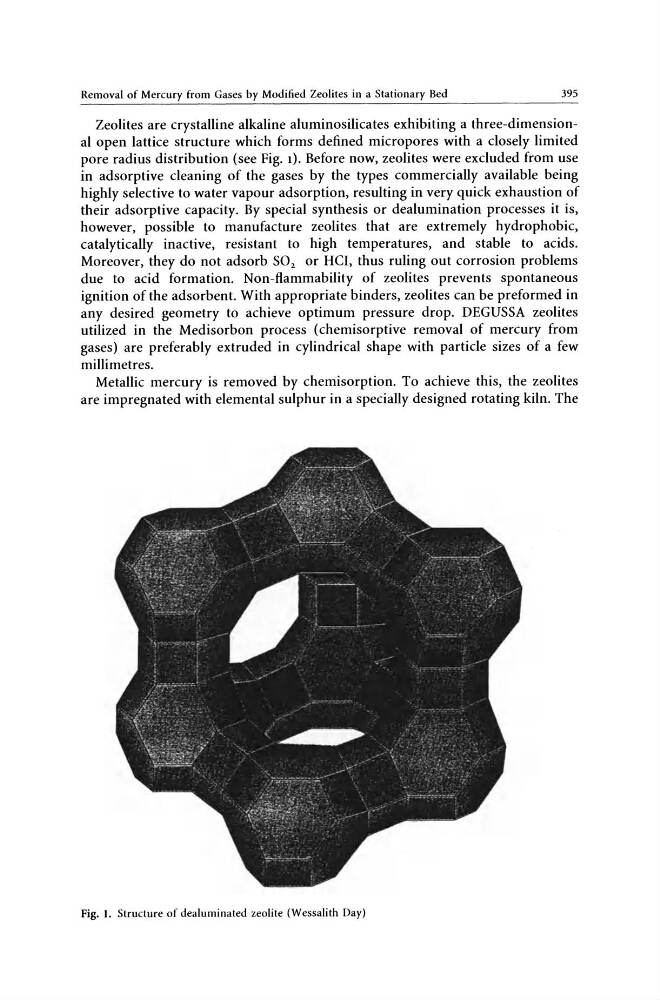
Zeolites are crystalline alkaline aluminosilicates exhibiting a three-dimensional open lattice structure which forms defined micropores with a closely limited
pore radius distribution (see Fig. 1). Before now, zeolites were excluded from use
in adsorptive cleaning of the gases by the types commercially available being
highly selective to water vapour adsorption, resulting in very quick exhaustion of
their adsorptive capacity. By special synthesis or dealumination processes it is,
however, possible to manufacture zeolites that are extremely hydrophobic,
catalytically inactive, resistant to high temperatures, and stable to acids.
Moreover, they do not adsorb S02 or HeI, thus ruling out corrosion problems
due to acid formation. Non-flammability of zeolites prevents spontaneous
ignition of the adsorbent. With appropriate binders, zeolites can be preformed in
any desired geometry to achieve optimum pressure drop. DEGUSSA zeolites
utilized in the Medisorbon process (chemisorptive removal of mercury from
gases) are preferably extruded in cylindrical shape with particle sizes of a few
millimetres.
Metallic mercury is removed by chemisorption. To achieve this, the zeolites
are impregnated with elemental sulphur in a specially designed rotating kiln. The
Fig. l. Structure of dealuminated zeolite (Wessalith Day)
395
Zeolites are crystalline alkaline aluminosilicates exhibiting a three-dimensional open lattice structure which forms defined micropores with a closely limited
pore radius distribution (see Fig. 1). Before now, zeolites were excluded from use
in adsorptive cleaning of the gases by the types commercially available being
highly selective to water vapour adsorption, resulting in very quick exhaustion of
their adsorptive capacity. By special synthesis or dealumination processes it is,
however, possible to manufacture zeolites that are extremely hydrophobic,
catalytically inactive, resistant to high temperatures, and stable to acids.
Moreover, they do not adsorb S02 or HeI, thus ruling out corrosion problems
due to acid formation. Non-flammability of zeolites prevents spontaneous
ignition of the adsorbent. With appropriate binders, zeolites can be preformed in
any desired geometry to achieve optimum pressure drop. DEGUSSA zeolites
utilized in the Medisorbon process (chemisorptive removal of mercury from
gases) are preferably extruded in cylindrical shape with particle sizes of a few
millimetres.
Metallic mercury is removed by chemisorption. To achieve this, the zeolites
are impregnated with elemental sulphur in a specially designed rotating kiln. The
Fig. l. Structure of dealuminated zeolite (Wessalith Day)