

Gold Mining in Siberia as a Source of Mercury Contamination of the Environment
4
Investigations on Estimation of Mercury Contamination
in Gold-Mining Areas in Siberia
361
There are few data in the literature on the results of investigations into mercury
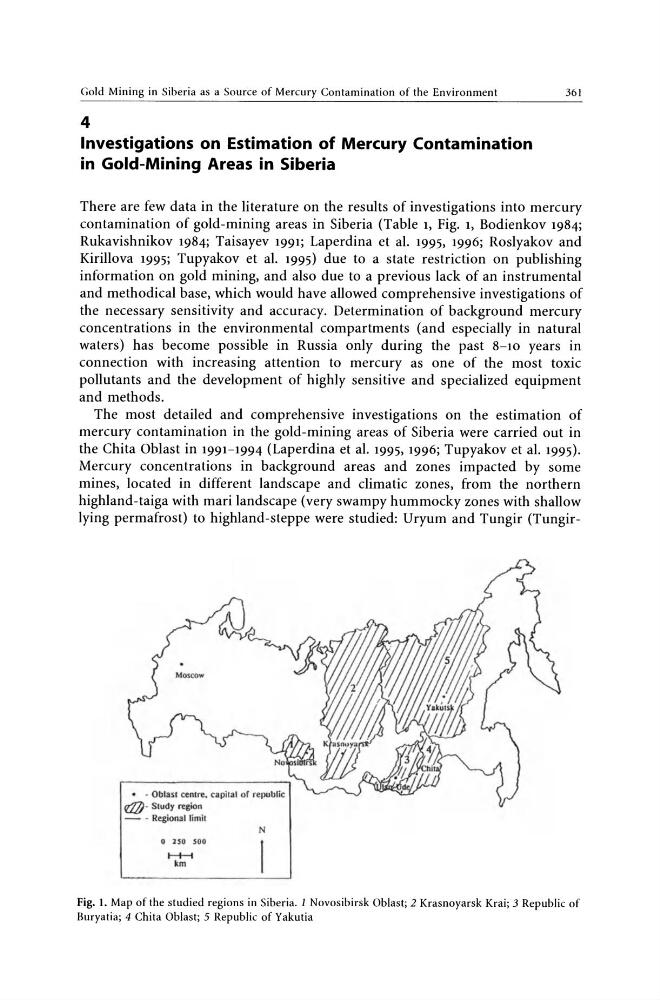
contamination of gold-mining areas in Siberia (Table 1, Fig. 1, Bodienkov 1984;
Rukavishnikov 1984; Taisayev 1991; Laperdina et al. 1995, 1996; Roslyakov and
Kirillova 1995; Tupyakov et al. 1995) due to a state restriction on publishing
information on gold mining, and also due to a previous lack of an instrumental
and methodical base, which would have allowed comprehensive investigations of
the necessary sensitivity and accuracy. Determination of background mercury
concentrations in the environmental compartments (and especially in natural
waters) has become possible in Russia only during the past 8-10 years in
connection with increasing attention to mercury as one of the most toxic
pollutants and the development of highly sensitive and specialized equipment
and methods.
The most detailed and comprehensive investigations on the estimation of
mercury contamination in the gold-mining areas of Siberia were carried out in
the Chita Oblast in 1991-1994 (Laperdina et al. 1995, 1996; Tupyakov et al. 1995).
Mercury concentrations in background areas and zones impacted by some
mines, located in different landscape and climatic zones, from the northern
highland-taiga with mari landscape (very swampy hummocky zones with shallow
lying permafrost) to highland-steppe were studied: Uryum and Tungir (Tungir• -Obla" cenlre. capilal of republic
rt:1J) - SlUdy region
-
- Regional limil
o 250 500
t-+-i
km
N
Fig. 1. Map of the studied regions in Siberia. 1 Novosibirsk Oblast; 2 Krasnoyarsk Krai; 3 Republic of
Buryatia; 4 Chita Oblasti 5 Republic of Yakutia
4
Investigations on Estimation of Mercury Contamination
in Gold-Mining Areas in Siberia
361
There are few data in the literature on the results of investigations into mercury
contamination of gold-mining areas in Siberia (Table 1, Fig. 1, Bodienkov 1984;
Rukavishnikov 1984; Taisayev 1991; Laperdina et al. 1995, 1996; Roslyakov and
Kirillova 1995; Tupyakov et al. 1995) due to a state restriction on publishing
information on gold mining, and also due to a previous lack of an instrumental
and methodical base, which would have allowed comprehensive investigations of
the necessary sensitivity and accuracy. Determination of background mercury
concentrations in the environmental compartments (and especially in natural
waters) has become possible in Russia only during the past 8-10 years in
connection with increasing attention to mercury as one of the most toxic
pollutants and the development of highly sensitive and specialized equipment
and methods.
The most detailed and comprehensive investigations on the estimation of
mercury contamination in the gold-mining areas of Siberia were carried out in
the Chita Oblast in 1991-1994 (Laperdina et al. 1995, 1996; Tupyakov et al. 1995).
Mercury concentrations in background areas and zones impacted by some
mines, located in different landscape and climatic zones, from the northern
highland-taiga with mari landscape (very swampy hummocky zones with shallow
lying permafrost) to highland-steppe were studied: Uryum and Tungir (Tungir• -Obla" cenlre. capilal of republic
rt:1J) - SlUdy region
-
- Regional limil
o 250 500
t-+-i
km
N
Fig. 1. Map of the studied regions in Siberia. 1 Novosibirsk Oblast; 2 Krasnoyarsk Krai; 3 Republic of
Buryatia; 4 Chita Oblasti 5 Republic of Yakutia