

282
A. Gnamus and M. Horvat
emissions. Moreover, approximately two-thirds of the total world's current yield
of Hg has been produced in the past century (Andren and Nriagu 1979). In recent
years, worldwide fossil-fuel combustion fluxes with global effect, and a few mines
and smelters with very distinctive local effects produced the majority, i.e. about
60%, of the current annual Hg input to the atmosphere (Nriagu and Pacyna 1988;
Baeyens et al. 1996). Ultimately, various transport and scavenging processes
return the majority of airborne Hg to the terrestrial environment close to the
pollution source (Lindberg et al. 1979; Baeyens et al. 1996). Deposition of the
element in surface soils and its reemission induce elevated levels on and in
plants, which subsequently results in accumulation of the metal in herbivorous
and further in carnivorous animals or man.
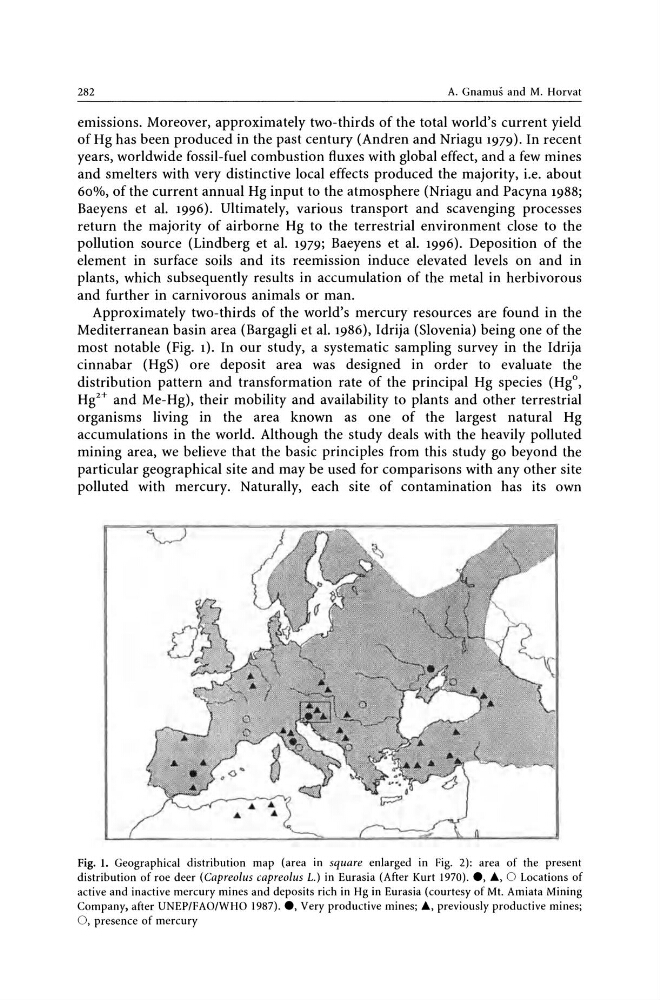
Approximately two-thirds of the world's mercury resources are found in the
Mediterranean basin area (Bargagli et al. 1986), Idrija (Slovenia) being one of the
most notable (Fig. 1). In our study, a systematic sampling survey in the Idrija
cinnabar (HgS) ore deposit area was designed in order to evaluate the
distribution pattern and transformation rate of the principal Hg species (HgO,
HgH and Me-Hg), their mobility and availability to plants and other terrestrial
organisms living in the area known as one of the largest natural Hg
accumulations in the world. Although the study deals with the heavily polluted
mining area, we believe that the basic principles from this study go beyond the
particular geographical site and may be used for comparisons with any other site
polluted with mercury. Naturally, each site of contamination has its own
Fig. J. Geographical distribution map (area in square enlarged in Fig. 2): area of the present
distribution of roe deer (Capreolus capreolus L.) in Eurasia (After Kurt 1970) .•• A. 0 Locations of
active and inactive mercury mines and deposits rich in Hg in Eurasia (courtesy of Mt. Amiata Mining
Company, after UNEP/FAO/WHO 1987) .•• Very productive mines; A. previously productive mines;
O. presence of mercury
A. Gnamus and M. Horvat
emissions. Moreover, approximately two-thirds of the total world's current yield
of Hg has been produced in the past century (Andren and Nriagu 1979). In recent
years, worldwide fossil-fuel combustion fluxes with global effect, and a few mines
and smelters with very distinctive local effects produced the majority, i.e. about
60%, of the current annual Hg input to the atmosphere (Nriagu and Pacyna 1988;
Baeyens et al. 1996). Ultimately, various transport and scavenging processes
return the majority of airborne Hg to the terrestrial environment close to the
pollution source (Lindberg et al. 1979; Baeyens et al. 1996). Deposition of the
element in surface soils and its reemission induce elevated levels on and in
plants, which subsequently results in accumulation of the metal in herbivorous
and further in carnivorous animals or man.
Approximately two-thirds of the world's mercury resources are found in the
Mediterranean basin area (Bargagli et al. 1986), Idrija (Slovenia) being one of the
most notable (Fig. 1). In our study, a systematic sampling survey in the Idrija
cinnabar (HgS) ore deposit area was designed in order to evaluate the
distribution pattern and transformation rate of the principal Hg species (HgO,
HgH and Me-Hg), their mobility and availability to plants and other terrestrial
organisms living in the area known as one of the largest natural Hg
accumulations in the world. Although the study deals with the heavily polluted
mining area, we believe that the basic principles from this study go beyond the
particular geographical site and may be used for comparisons with any other site
polluted with mercury. Naturally, each site of contamination has its own
Fig. J. Geographical distribution map (area in square enlarged in Fig. 2): area of the present
distribution of roe deer (Capreolus capreolus L.) in Eurasia (After Kurt 1970) .•• A. 0 Locations of
active and inactive mercury mines and deposits rich in Hg in Eurasia (courtesy of Mt. Amiata Mining
Company, after UNEP/FAO/WHO 1987) .•• Very productive mines; A. previously productive mines;
O. presence of mercury