

12
R. Ebinghaus et al.
revival of the use of amalgamation in gold panning has spread rapidly in tropical
areas and roughly 10 million people were estimated to be engaged in this activity
(Ramel 1996). The gold/mercury amalgam is usually caught in a sluice box and
then heated in a pan where the mercury evaporates into the air and the raw gold
remains. In Brazil alone, gold production comprises about 2000 sites ("garimpos") of which about 80% are located in the Amazonas. It is mostly smallscale activity in remote villages and the amount of mercury released to the
environment is about 1.3 kg mercury for each kg of gold or an overall estimated
emission of 180 t year1
(Ramel 1996). It has been estimated that about 2 million
people in Brazil alone are directly or indirectly dependent on gold extraction
(Branches et al. 1993). In Tanzania, 250000 people live in gold-mining villages
along riverbeds (Ikingura and Mutakyahwa 1995). Official statistics concerning
gold production and use of mercury are often underreported because of illegal
use and widespread smuggling of both mercury and gold. The current and total
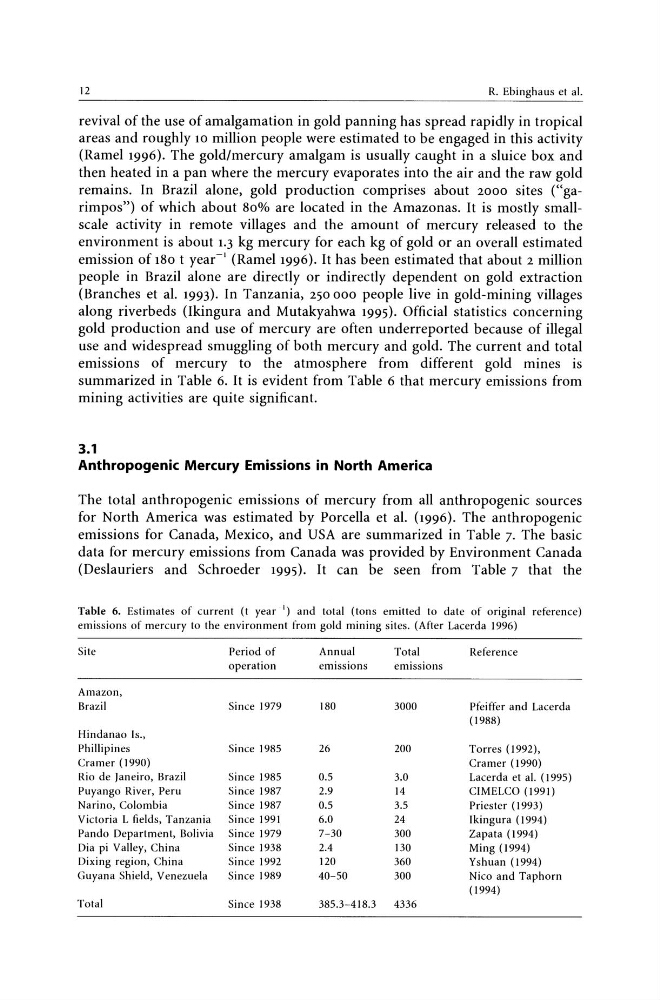
emissions of mercury to the atmosphere from different gold mines is
summarized in Table 6. It is evident from Table 6 that mercury emissions from
mining activities are quite significant.
3.1
Anthropogenic Mercury Emissions in North America
The total anthropogenic emissions of mercury from all anthropogenic sources
for North America was estimated by Porcella et al. (1996). The anthropogenic
emissions for Canada, Mexico, and USA are summarized in Table 7. The basic
data for mercury emissions from Canada was provided by Environment Canada
(Deslauriers and Schroeder 1995). It can be seen from Table 7 that the
Table 6. Estimates of current (t year I) and total (tons emitted to date of original reference)
emissions of mercury to the environment from gold mining sites. (After Lacerda 1996)
Site
Period of
Annual
Total
Reference
operation
enlissions
emissions
Amazon,
Brazil
Since 1979
180
3000
Pfeiffer and Lacerda
(1988)
Hindanao Is.,
Phillipines
Since 1985
26
200
Torres (1992),
Cramer (1990)
Cramer (1990)
Rio de Janeiro, Brazil
Since 1985
0.5
3.0
Lacerda et al. (1995)
Puyango River, Peru
Since 1987
2.9
14
CIMELCO (1991)
Narino, Colombia
Since 1987
0.5
3.5
Priester (1993)
Victoria L fields, Tanzania
Since 1991
6.0
24
Ikingura (1994)
Pando Department, Bolivia Since 1979
7-30
300
Zapata (1994)
Dia pi Valley, China
Since 1938
2.4
130
Ming (1994)
Dixing region, China
Since 1992
120
360
Yshuan (1994)
Guyana Shield, Venezuela
Since 1989
40-50
300
Nico and Taphorn
(1994)
Total
Since 1938
385.3-418.3
4336
R. Ebinghaus et al.
revival of the use of amalgamation in gold panning has spread rapidly in tropical
areas and roughly 10 million people were estimated to be engaged in this activity
(Ramel 1996). The gold/mercury amalgam is usually caught in a sluice box and
then heated in a pan where the mercury evaporates into the air and the raw gold
remains. In Brazil alone, gold production comprises about 2000 sites ("garimpos") of which about 80% are located in the Amazonas. It is mostly smallscale activity in remote villages and the amount of mercury released to the
environment is about 1.3 kg mercury for each kg of gold or an overall estimated
emission of 180 t year1
(Ramel 1996). It has been estimated that about 2 million
people in Brazil alone are directly or indirectly dependent on gold extraction
(Branches et al. 1993). In Tanzania, 250000 people live in gold-mining villages
along riverbeds (Ikingura and Mutakyahwa 1995). Official statistics concerning
gold production and use of mercury are often underreported because of illegal
use and widespread smuggling of both mercury and gold. The current and total
emissions of mercury to the atmosphere from different gold mines is
summarized in Table 6. It is evident from Table 6 that mercury emissions from
mining activities are quite significant.
3.1
Anthropogenic Mercury Emissions in North America
The total anthropogenic emissions of mercury from all anthropogenic sources
for North America was estimated by Porcella et al. (1996). The anthropogenic
emissions for Canada, Mexico, and USA are summarized in Table 7. The basic
data for mercury emissions from Canada was provided by Environment Canada
(Deslauriers and Schroeder 1995). It can be seen from Table 7 that the
Table 6. Estimates of current (t year I) and total (tons emitted to date of original reference)
emissions of mercury to the environment from gold mining sites. (After Lacerda 1996)
Site
Period of
Annual
Total
Reference
operation
enlissions
emissions
Amazon,
Brazil
Since 1979
180
3000
Pfeiffer and Lacerda
(1988)
Hindanao Is.,
Phillipines
Since 1985
26
200
Torres (1992),
Cramer (1990)
Cramer (1990)
Rio de Janeiro, Brazil
Since 1985
0.5
3.0
Lacerda et al. (1995)
Puyango River, Peru
Since 1987
2.9
14
CIMELCO (1991)
Narino, Colombia
Since 1987
0.5
3.5
Priester (1993)
Victoria L fields, Tanzania
Since 1991
6.0
24
Ikingura (1994)
Pando Department, Bolivia Since 1979
7-30
300
Zapata (1994)
Dia pi Valley, China
Since 1938
2.4
130
Ming (1994)
Dixing region, China
Since 1992
120
360
Yshuan (1994)
Guyana Shield, Venezuela
Since 1989
40-50
300
Nico and Taphorn
(1994)
Total
Since 1938
385.3-418.3
4336