

Mercury in the Town of Idrija (Slovenia) After 500 Years of Mining and Smelting
261
operation of the mine and smeltery. The gases emitted through the main exhaust
stack continuously contaminated the air with Hg. According to some measurements and estimates, approximately 20 kg of Hg were emitted into the
atmosphere daily in the form of vapor or aerosols (Kosta et al. 1974). Hg
concentrations in air measured in the 1970S ranged from 0.1 to 10 ~Ig Hg m -3 of
air; the highest concentration in the air, found in the immediate vicinity of the
smeltery, was 8.5 ~lg Hg m- 3 of air. The Hg concentration in the town centre was
0.6 ~lg Hg m -3 of air and was 6 hundred times higher than at the reference
locations (Kranj, Ljubljana), whereas Hg concentrations in uncontaminated
locations did not exceed 0.001 ~lg Hg m- 3 of air.
This type of pollution resulted in increased Hg values in plants and animal
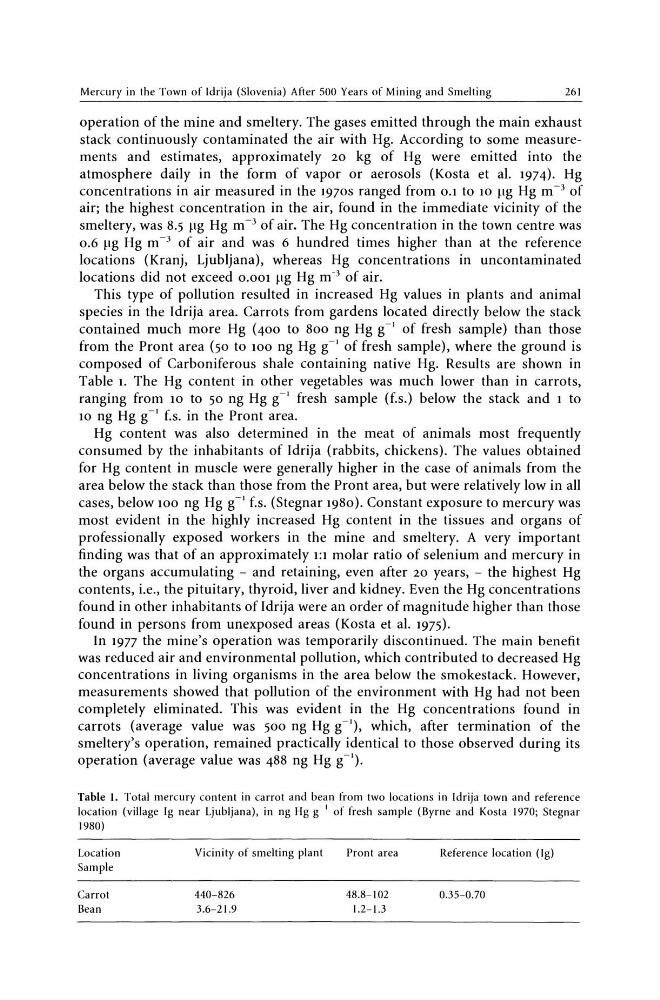
species in the Idrija area. Carrots from gardens located directly below the stack
contained much more Hg (400 to 800 ng Hg g-' of fresh sample) than those
from the Pront area (50 to 100 ng Hg g-' of fresh sample), where the ground is
composed of Carboniferous shale containing native Hg. Results are shown in
Table 1. The Hg content in other vegetables was much lower than in carrots,
ranging from 10 to 50 ng Hg g-' fresh sample (f.s.) below the stack and 1 to
10 ng Hg g -, f.s. in the Pront area.
Hg content was also determined in the meat of animals most frequently
consumed by the inhabitants of Idrija (rabbits, chickens). The values obtained
for Hg content in muscle were generally higher in the case of animals from the
area below the stack than those from the Pront area, but were relatively low in all
cases, below 100 ng Hg g-' f.s. (Stegnar 1980). Constant exposure to mercury was
most evident in the highly increased Hg content in the tissues and organs of
professionally exposed workers in the mine and smeltery. A very important
finding was that of an approximately 1:1 molar ratio of selenium and mercury in
the organs accumulating - and retaining, even after 20 years, - the highest Hg
contents, i.e., the pituitary, thyroid, liver and kidney. Even the Hg concentrations
found in other inhabitants of Idrija were an order of magnitude higher than those
found in persons from unexposed areas (Kosta et al. 1975).
In 1977 the mine's operation was temporarily discontinued. The main benefit
was reduced air and environmental pollution, which contributed to decreased Hg
concentrations in living organisms in the area below the smokestack. However,
measurements showed that pollution of the environment with Hg had not been
completely eliminated. This was evident in the Hg concentrations found in
carrots (average value was 500 ng Hg g-'), which, after termination of the
smeltery's operation, remained practically identical to those observed during its
operation (average value was 488 ng Hg g-').
Table 1. Total mercury content in carrot and bean from two locations in Idrija town and reference
location (village Ig near Ljubljana), in ng Hg g' of fresh sample (Byrne and Kosta 1970; Stegnar
1980)
Location
Sample
Carrot
Bean
Vicinity of smelting plant
440-826
3.6-21.9
Pront area
48.8-102
1.2-1.3
Reference location (Ig)
0.35-0.70
261
operation of the mine and smeltery. The gases emitted through the main exhaust
stack continuously contaminated the air with Hg. According to some measurements and estimates, approximately 20 kg of Hg were emitted into the
atmosphere daily in the form of vapor or aerosols (Kosta et al. 1974). Hg
concentrations in air measured in the 1970S ranged from 0.1 to 10 ~Ig Hg m -3 of
air; the highest concentration in the air, found in the immediate vicinity of the
smeltery, was 8.5 ~lg Hg m- 3 of air. The Hg concentration in the town centre was
0.6 ~lg Hg m -3 of air and was 6 hundred times higher than at the reference
locations (Kranj, Ljubljana), whereas Hg concentrations in uncontaminated
locations did not exceed 0.001 ~lg Hg m- 3 of air.
This type of pollution resulted in increased Hg values in plants and animal
species in the Idrija area. Carrots from gardens located directly below the stack
contained much more Hg (400 to 800 ng Hg g-' of fresh sample) than those
from the Pront area (50 to 100 ng Hg g-' of fresh sample), where the ground is
composed of Carboniferous shale containing native Hg. Results are shown in
Table 1. The Hg content in other vegetables was much lower than in carrots,
ranging from 10 to 50 ng Hg g-' fresh sample (f.s.) below the stack and 1 to
10 ng Hg g -, f.s. in the Pront area.
Hg content was also determined in the meat of animals most frequently
consumed by the inhabitants of Idrija (rabbits, chickens). The values obtained
for Hg content in muscle were generally higher in the case of animals from the
area below the stack than those from the Pront area, but were relatively low in all
cases, below 100 ng Hg g-' f.s. (Stegnar 1980). Constant exposure to mercury was
most evident in the highly increased Hg content in the tissues and organs of
professionally exposed workers in the mine and smeltery. A very important
finding was that of an approximately 1:1 molar ratio of selenium and mercury in
the organs accumulating - and retaining, even after 20 years, - the highest Hg
contents, i.e., the pituitary, thyroid, liver and kidney. Even the Hg concentrations
found in other inhabitants of Idrija were an order of magnitude higher than those
found in persons from unexposed areas (Kosta et al. 1975).
In 1977 the mine's operation was temporarily discontinued. The main benefit
was reduced air and environmental pollution, which contributed to decreased Hg
concentrations in living organisms in the area below the smokestack. However,
measurements showed that pollution of the environment with Hg had not been
completely eliminated. This was evident in the Hg concentrations found in
carrots (average value was 500 ng Hg g-'), which, after termination of the
smeltery's operation, remained practically identical to those observed during its
operation (average value was 488 ng Hg g-').
Table 1. Total mercury content in carrot and bean from two locations in Idrija town and reference
location (village Ig near Ljubljana), in ng Hg g' of fresh sample (Byrne and Kosta 1970; Stegnar
1980)
Location
Sample
Carrot
Bean
Vicinity of smelting plant
440-826
3.6-21.9
Pront area
48.8-102
1.2-1.3
Reference location (Ig)
0.35-0.70