

8
R. Ebinghaus et al.
background and will be significantly deposited only after atmospheric transformation processes or through plant surface interactions such as stomatal uptake
at elevated concentrations (Hanson et al. 1995). However, particulate-phase
mercury (Hgpart ) and reactive gaseous mercury (RGM) will deposit more rapidly
on a local or regional scale (Lindberg et al. 1992). Estimates made by Slemr et al.
(1985) based on the relations between vapor pressure and the ratio of particulate
concentrations to gaseous concentrations of different species in the atmosphere
(Junge 1977) suggest that inorganic gaseous mercury species will be predominantly found on aerosols and thus will share their atmospheric fate, i.e., will have
a residence time of about 5 days (Prospero et al. 1983) and cannot be transported
over large distances. According to Junge, another consequence is that concentrations of Hg(II) should not be too different from particulate phase concentrations of mercury because the particulates encompass Hg(II). However, recent
measurements of RGM using newly designed techniques including treated filters,
denuders, and refluxing mist chambers all show that RGM generally exceeds
Hgparl at a variety of sites (Stratton and Lindberg 1995; Xiao et al. 1997; S.E.
Lindberg and Stratton 1998; Ebinghaus et al. 1998)
Measurements of operationally defined Total Gaseous Mercury (TGM) are
being made on a routine basis at a number of sites in Europe and North America.
A recently conducted field intercomparison of measurements of atmospheric
mercury species shows good comparability of the commonly accepted methods
for TGM, but less so for RGM and HgP (Ebinghaus et al. 1998). Long-term studies
suggest that atmospheric TGM concentrations were increasing on a hemispheric
or a global scale until the early 1990S; a decrease has been suggested for the
period 1990-1994 (Slemr and Langer 1992; Fitzgerald 1995; Slemr 1996).
Fewer data are available for particulate-phase mercury or inorganic gaseous
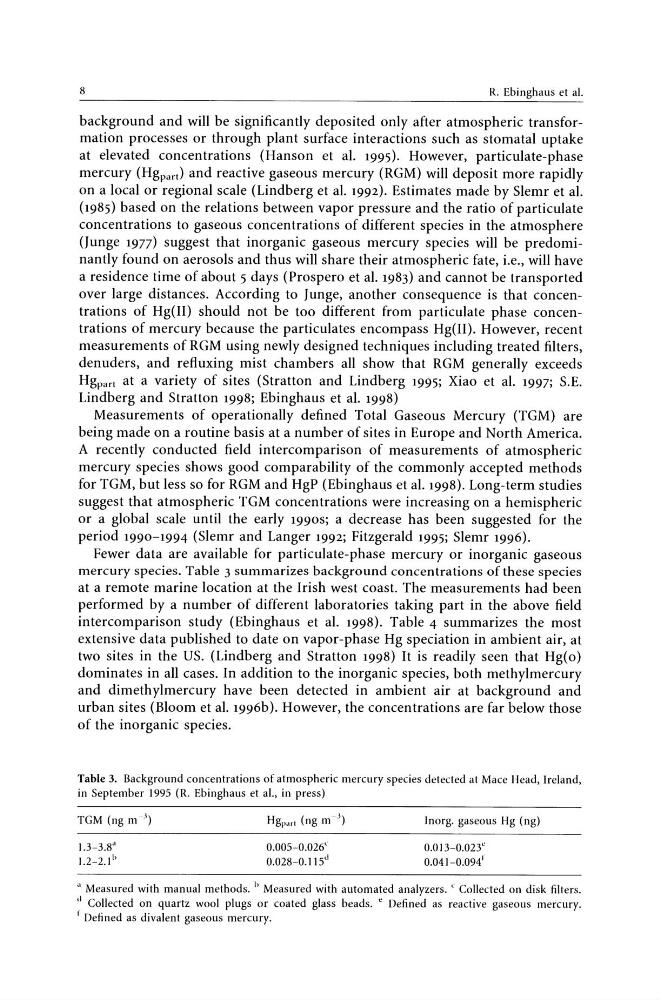
mercury species. Table 3 summarizes background concentrations of these species
at a remote marine location at the Irish west coast. The measurements had been
performed by a number of different laboratories taking part in the above field
intercomparison study (Ebinghaus et al. 1998). Table 4 summarizes the most
extensive data published to date on vapor-phase Hg speciation in ambient air, at
two sites in the US. (Lindberg and Stratton 1998) It is readily seen that Hg( 0)
dominates in all cases. In addition to the inorganic species, both methylmercury
and dimethylmercury have been detected in ambient air at background and
urban sites (Bloom et al. 1996b). However, the concentrations are far below those
of the inorganic species.
Table 3. Background concentrations of atmospheric mercury species detected at Mace Head, Ireland,
in September 1995 (R. Ebinghaus et aI., in press)
TGM (ng m')
1.3-3.8"
1.2-2.1 h
0.005-0.026'
0.028-0. 11 Sci
Inorg. gaseous Hg (ng)
0.0 I 3-0.023"
0.04 I -0.094'
" Measured with manual methods. h Measured with automated analyzers. " Collected on disk filters.
cI Collected on quartz wool plugs or coated glass beads. e Defined as reactive gaseous mercury.
, Defined as divalent gaseous mercury.
R. Ebinghaus et al.
background and will be significantly deposited only after atmospheric transformation processes or through plant surface interactions such as stomatal uptake
at elevated concentrations (Hanson et al. 1995). However, particulate-phase
mercury (Hgpart ) and reactive gaseous mercury (RGM) will deposit more rapidly
on a local or regional scale (Lindberg et al. 1992). Estimates made by Slemr et al.
(1985) based on the relations between vapor pressure and the ratio of particulate
concentrations to gaseous concentrations of different species in the atmosphere
(Junge 1977) suggest that inorganic gaseous mercury species will be predominantly found on aerosols and thus will share their atmospheric fate, i.e., will have
a residence time of about 5 days (Prospero et al. 1983) and cannot be transported
over large distances. According to Junge, another consequence is that concentrations of Hg(II) should not be too different from particulate phase concentrations of mercury because the particulates encompass Hg(II). However, recent
measurements of RGM using newly designed techniques including treated filters,
denuders, and refluxing mist chambers all show that RGM generally exceeds
Hgparl at a variety of sites (Stratton and Lindberg 1995; Xiao et al. 1997; S.E.
Lindberg and Stratton 1998; Ebinghaus et al. 1998)
Measurements of operationally defined Total Gaseous Mercury (TGM) are
being made on a routine basis at a number of sites in Europe and North America.
A recently conducted field intercomparison of measurements of atmospheric
mercury species shows good comparability of the commonly accepted methods
for TGM, but less so for RGM and HgP (Ebinghaus et al. 1998). Long-term studies
suggest that atmospheric TGM concentrations were increasing on a hemispheric
or a global scale until the early 1990S; a decrease has been suggested for the
period 1990-1994 (Slemr and Langer 1992; Fitzgerald 1995; Slemr 1996).
Fewer data are available for particulate-phase mercury or inorganic gaseous
mercury species. Table 3 summarizes background concentrations of these species
at a remote marine location at the Irish west coast. The measurements had been
performed by a number of different laboratories taking part in the above field
intercomparison study (Ebinghaus et al. 1998). Table 4 summarizes the most
extensive data published to date on vapor-phase Hg speciation in ambient air, at
two sites in the US. (Lindberg and Stratton 1998) It is readily seen that Hg( 0)
dominates in all cases. In addition to the inorganic species, both methylmercury
and dimethylmercury have been detected in ambient air at background and
urban sites (Bloom et al. 1996b). However, the concentrations are far below those
of the inorganic species.
Table 3. Background concentrations of atmospheric mercury species detected at Mace Head, Ireland,
in September 1995 (R. Ebinghaus et aI., in press)
TGM (ng m')
1.3-3.8"
1.2-2.1 h
0.005-0.026'
0.028-0. 11 Sci
Inorg. gaseous Hg (ng)
0.0 I 3-0.023"
0.04 I -0.094'
" Measured with manual methods. h Measured with automated analyzers. " Collected on disk filters.
cI Collected on quartz wool plugs or coated glass beads. e Defined as reactive gaseous mercury.
, Defined as divalent gaseous mercury.