

Monitoring and Assessment of Mercury Pollution
223
100 mg of mercury, then 200 t/a of mercury is used for the production of this
quantity. This is the maximum quantity of mercury which may potentially reach
the environment (under the condition that all lamps produced in the course of
1 year are disposed of and that the mercury they contain becomes part of the
geochemical cycle). It should also be noted that lamp recycling is widespread in
some countries. Thus, the actual quantity of mercury involved in the production
and use of these lamps that may potentially be disseminated in the environment
must be considerably less and not exceed 140-150 t on a global scale.
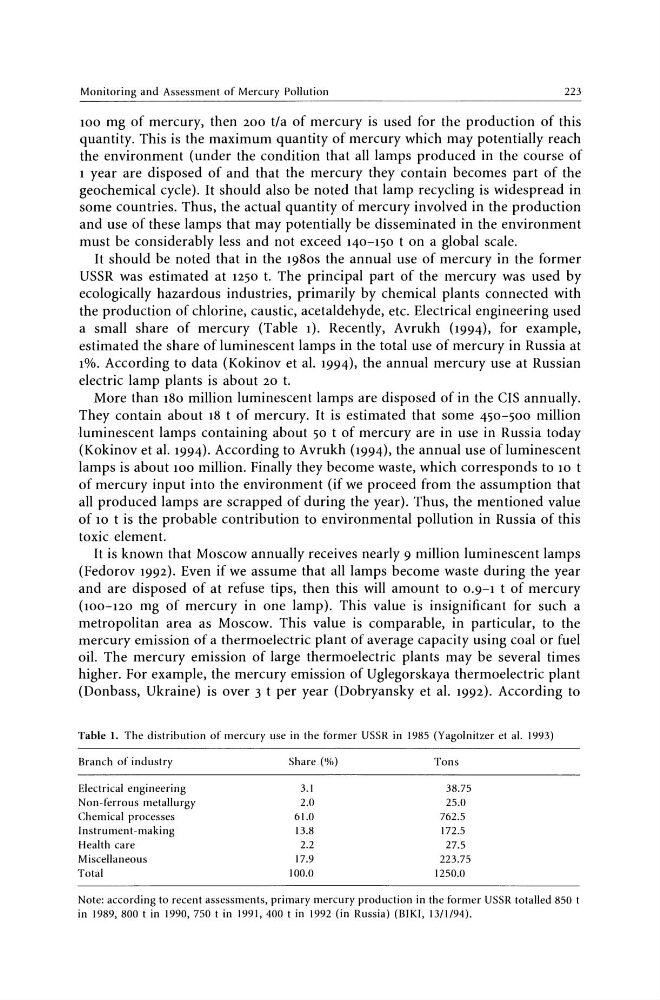
It should be noted that in the 1980s the annual use of mercury in the former
USSR was estimated at l250 t. The principal part of the mercury was used by
ecologically hazardous industries, primarily by chemical plants connected with
the production of chlorine, caustic, acetaldehyde, etc. Electrical engineering used
a small share of mercury (Table 1). Recently, Avrukh (1994), for example,
estimated the share of luminescent lamps in the total use of mercury in Russia at
1%. According to data (Kokinov et al. 1994), the annual mercury use at Russian
electric lamp plants is about 20 t.
More than 180 million luminescent lamps are disposed of in the CIS annually.
They contain about 18 t of mercury. It is estimated that some 450-500 million
luminescent lamps containing about 50 t of mercury are in use in Russia today
(Kokinov et al. 1994). According to Avrukh (1994), the annual use ofluminescent
lamps is about 100 million. Finally tlIey become waste, which corresponds to 10 t
of mercury input into the environment (if we proceed from the assumption that
all produced lamps are scrapped of during the year). Thus, the mentioned value
of 10 t is the probable contribution to environmental pollution in Russia of this
toxic element.
It is known that Moscow annually receives nearly 9 million luminescent lamps
(Fedorov 1992). Even if we assume that all lamps become waste during the year
and are disposed of at refuse tips, then this will amount to 0.9-1 t of mercury
(100-l20 mg of mercury in one lamp). This value is insignificant for such a
metropolitan area as Moscow. This value is comparable, in particular, to the
mercury emission of a thermoelectric plant of average capacity using coal or fuel
oil. The mercury emission of large thermoelectric plants may be several times
higher. For example, the mercury emission of Uglegorskaya thermoelectric plant
(Donbass, Ukraine) is over 3 t per year (Dobryansky et al. 1992). According to
Table 1. The distribution of mercury use in the former USSR in 1985 (Yagolnitzer et al. 1993)
Branch of industry
Share (%)
Tons
Electrical engineering
3.1
38.75
Non-ferrous metallurgy
2.0
25.0
Chemical processes
61.0
762.5
Instrument-making
13.8
172.5
Health care
2.2
27.5
Miscellaneous
17.9
223.75
Total
100.0
1250.0
Note: according to recent assessments, primary mercury production in the former USSR totalled 850 t
in 1989,800 t in 1990,750 t in 1991,400 t in 1992 (in Russia) (BIKI, 1311/94).
223
100 mg of mercury, then 200 t/a of mercury is used for the production of this
quantity. This is the maximum quantity of mercury which may potentially reach
the environment (under the condition that all lamps produced in the course of
1 year are disposed of and that the mercury they contain becomes part of the
geochemical cycle). It should also be noted that lamp recycling is widespread in
some countries. Thus, the actual quantity of mercury involved in the production
and use of these lamps that may potentially be disseminated in the environment
must be considerably less and not exceed 140-150 t on a global scale.
It should be noted that in the 1980s the annual use of mercury in the former
USSR was estimated at l250 t. The principal part of the mercury was used by
ecologically hazardous industries, primarily by chemical plants connected with
the production of chlorine, caustic, acetaldehyde, etc. Electrical engineering used
a small share of mercury (Table 1). Recently, Avrukh (1994), for example,
estimated the share of luminescent lamps in the total use of mercury in Russia at
1%. According to data (Kokinov et al. 1994), the annual mercury use at Russian
electric lamp plants is about 20 t.
More than 180 million luminescent lamps are disposed of in the CIS annually.
They contain about 18 t of mercury. It is estimated that some 450-500 million
luminescent lamps containing about 50 t of mercury are in use in Russia today
(Kokinov et al. 1994). According to Avrukh (1994), the annual use ofluminescent
lamps is about 100 million. Finally tlIey become waste, which corresponds to 10 t
of mercury input into the environment (if we proceed from the assumption that
all produced lamps are scrapped of during the year). Thus, the mentioned value
of 10 t is the probable contribution to environmental pollution in Russia of this
toxic element.
It is known that Moscow annually receives nearly 9 million luminescent lamps
(Fedorov 1992). Even if we assume that all lamps become waste during the year
and are disposed of at refuse tips, then this will amount to 0.9-1 t of mercury
(100-l20 mg of mercury in one lamp). This value is insignificant for such a
metropolitan area as Moscow. This value is comparable, in particular, to the
mercury emission of a thermoelectric plant of average capacity using coal or fuel
oil. The mercury emission of large thermoelectric plants may be several times
higher. For example, the mercury emission of Uglegorskaya thermoelectric plant
(Donbass, Ukraine) is over 3 t per year (Dobryansky et al. 1992). According to
Table 1. The distribution of mercury use in the former USSR in 1985 (Yagolnitzer et al. 1993)
Branch of industry
Share (%)
Tons
Electrical engineering
3.1
38.75
Non-ferrous metallurgy
2.0
25.0
Chemical processes
61.0
762.5
Instrument-making
13.8
172.5
Health care
2.2
27.5
Miscellaneous
17.9
223.75
Total
100.0
1250.0
Note: according to recent assessments, primary mercury production in the former USSR totalled 850 t
in 1989,800 t in 1990,750 t in 1991,400 t in 1992 (in Russia) (BIKI, 1311/94).