

192
T. Sch6ndorf et al.
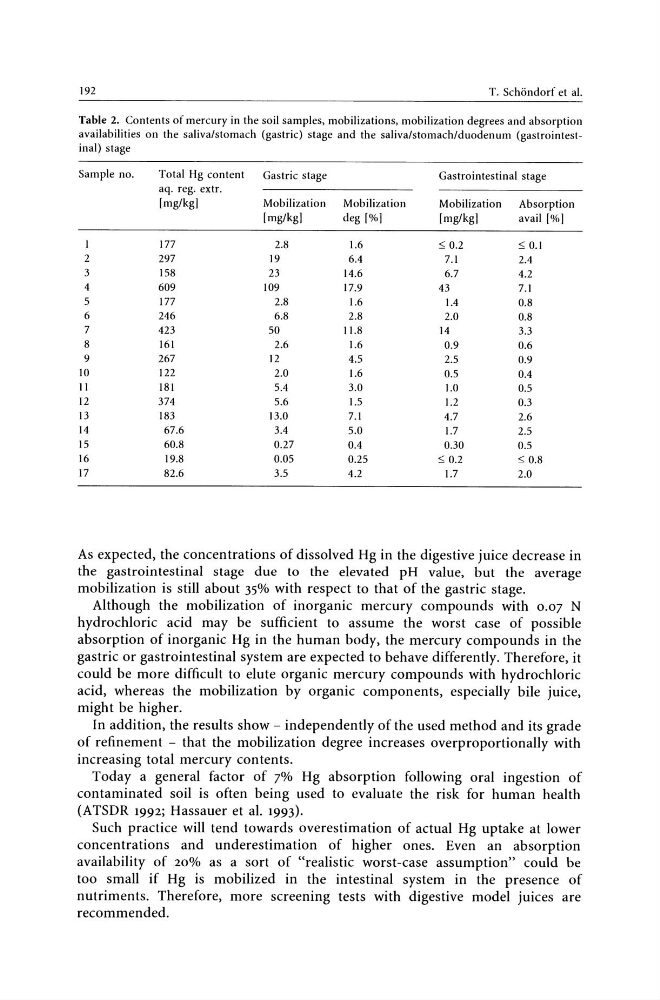
Table 2. Contents of mercury in the soil samples, mobilizations, mobilization degrees and absorption
availabilities on the saliva/stomach (gastric) stage and the saliva/stomach/duodenum (gastrointestinal) stage
Sample no.
Total Hg content
Gastric stage
Gastrointestinal stage
aq. reg. extr.
[mg/kg[
Mobilization
Mobilization
Mobilization
Absorption
[mg/kg[
deg [%[
[mg/kg]
avail [%J
177
2.8
1.6
<; 0.2
<; 0.1
2
297
19
6.4
7.1
2.4
3
158
23
14.6
6.7
4.2
4
609
109
17.9
43
7.1
5
177
2.8
1.6
1.4
0.8
6
246
6.8
2.8
2.0
0.8
7
423
50
11.8
14
3.3
8
161
2.6
1.6
0.9
0.6
9
267
12
4.5
2.5
0.9
10
122
2.0
1.6
0.5
0.4
II
181
5.4
3.0
1.0
0.5
12
374
5.6
1.5
1.2
0.3
13
183
13.0
7.1
4.7
2.6
14
67.6
3.4
5.0
1.7
2.5
15
60.8
0.27
0.4
0.30
0.5
16
19.8
0.05
0.25
<; 0.2
<; 0.8
17
82.6
3.5
4.2
1.7
2.0
As expected, the concentrations of dissolved Hg in the digestive juice decrease in
the gastrointestinal stage due to the elevated pH value, but the average
mobilization is still about 35% with respect to that of the gastric stage.
Although the mobilization of inorganic mercury compounds with 0.07 N
hydrochloric acid may be sufficient to assume the worst case of possible
absorption of inorganic Hg in the human body, the mercury compounds in the
gastric or gastrointestinal system are expected to behave differently. Therefore, it
could be more difficult to elute organic mercury compounds with hydrochloric
acid, whereas the mobilization by organic components, especially bile juice,
might be higher.
In addition, the results show - independently of the used method and its grade
of refinement - that the mobilization degree increases overproportionally with
increasing total mercury contents.
Today a general factor of 7% Hg absorption following oral ingestion of
contaminated soil is often being used to evaluate the risk for human health
(ATSDR 1992; Hassauer et al. 1993).
Such practice will tend towards overestimation of actual Hg uptake at lower
concentrations and underestimation of higher ones. Even an absorption
availability of 20% as a sort of "realistic worst-case assumption" could be
too small if Hg is mobilized in the intestinal system in the presence of
nutriments. Therefore, more screening tests with digestive model juices are
recommended.
T. Sch6ndorf et al.
Table 2. Contents of mercury in the soil samples, mobilizations, mobilization degrees and absorption
availabilities on the saliva/stomach (gastric) stage and the saliva/stomach/duodenum (gastrointestinal) stage
Sample no.
Total Hg content
Gastric stage
Gastrointestinal stage
aq. reg. extr.
[mg/kg[
Mobilization
Mobilization
Mobilization
Absorption
[mg/kg[
deg [%[
[mg/kg]
avail [%J
177
2.8
1.6
<; 0.2
<; 0.1
2
297
19
6.4
7.1
2.4
3
158
23
14.6
6.7
4.2
4
609
109
17.9
43
7.1
5
177
2.8
1.6
1.4
0.8
6
246
6.8
2.8
2.0
0.8
7
423
50
11.8
14
3.3
8
161
2.6
1.6
0.9
0.6
9
267
12
4.5
2.5
0.9
10
122
2.0
1.6
0.5
0.4
II
181
5.4
3.0
1.0
0.5
12
374
5.6
1.5
1.2
0.3
13
183
13.0
7.1
4.7
2.6
14
67.6
3.4
5.0
1.7
2.5
15
60.8
0.27
0.4
0.30
0.5
16
19.8
0.05
0.25
<; 0.2
<; 0.8
17
82.6
3.5
4.2
1.7
2.0
As expected, the concentrations of dissolved Hg in the digestive juice decrease in
the gastrointestinal stage due to the elevated pH value, but the average
mobilization is still about 35% with respect to that of the gastric stage.
Although the mobilization of inorganic mercury compounds with 0.07 N
hydrochloric acid may be sufficient to assume the worst case of possible
absorption of inorganic Hg in the human body, the mercury compounds in the
gastric or gastrointestinal system are expected to behave differently. Therefore, it
could be more difficult to elute organic mercury compounds with hydrochloric
acid, whereas the mobilization by organic components, especially bile juice,
might be higher.
In addition, the results show - independently of the used method and its grade
of refinement - that the mobilization degree increases overproportionally with
increasing total mercury contents.
Today a general factor of 7% Hg absorption following oral ingestion of
contaminated soil is often being used to evaluate the risk for human health
(ATSDR 1992; Hassauer et al. 1993).
Such practice will tend towards overestimation of actual Hg uptake at lower
concentrations and underestimation of higher ones. Even an absorption
availability of 20% as a sort of "realistic worst-case assumption" could be
too small if Hg is mobilized in the intestinal system in the presence of
nutriments. Therefore, more screening tests with digestive model juices are
recommended.