

Remediation Techniques for Hg- Contaminated Sites
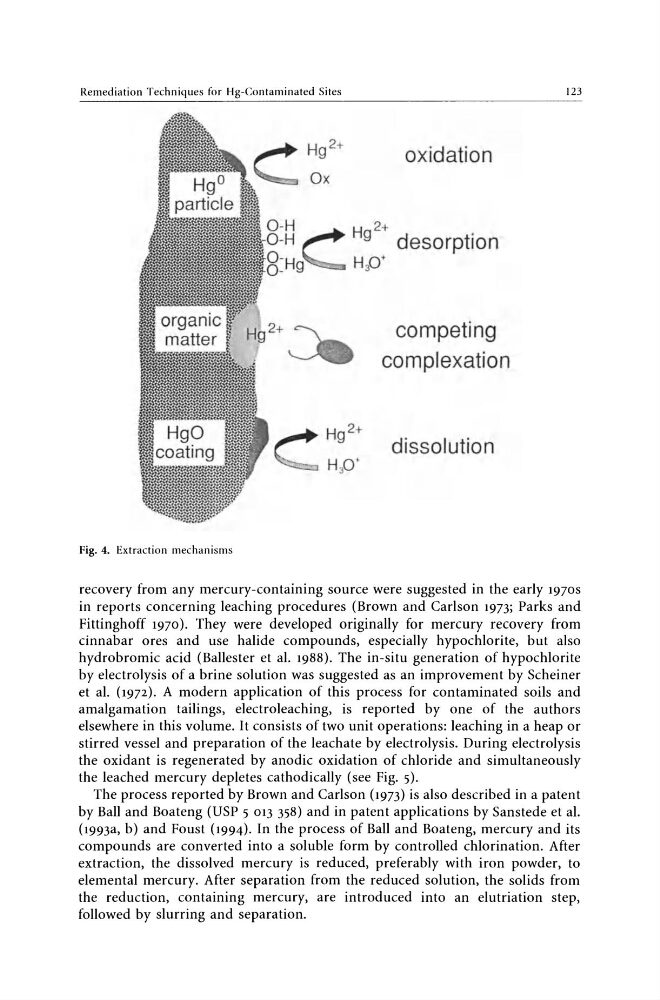
Fig. 4. Extraction mechanisms
oxidation
desorption
competing
complexation
dissolution
123
recovery from any mercury-containing source were suggested in the early 1970S
in reports concerning leaching procedures (Brown and Carlson 1973; Parks and
Fittinghoff 1970). They were developed originally for mercury recovery from
cinnabar ores and use halide compounds, especially hypochlorite, but also
hydrobromic acid (Ballester et al. 1988). The in-situ generation of hypochlorite
by electrolysis of a brine solution was suggested as an improvement by Scheiner
et al. (1972) . A modern application of this process for contaminated soils and
amalgamation tailings, electro leaching, is reported by one of the authors
elsewhere in this volume. It consists of two unit operations: leaching in a heap or
stirred vessel and preparation of the leachate by electrolysis. During electrolysis
the oxidant is regenerated by anodic oxidation of chloride and simultaneously
the leached mercury depletes cathodically (see Fig. 5).
The process reported by Brown and Carlson (1973) is also described in a patent
by Ball and Boateng (USP 5 013 358) and in patent applications by Sanstede et al.
(1993a, b) and Foust (1994). In the process of Ball and Boateng, mercury and its
compounds are converted into a soluble form by controlled chlorination. After
extraction, the dissolved mercury is reduced, preferably with iron powder, to
elemental mercury. After separation from the reduced solution, the solids from
the reduction, containing mercury, are introduced into an elutriation step,
followed by slurring and separation.
Fig. 4. Extraction mechanisms
oxidation
desorption
competing
complexation
dissolution
123
recovery from any mercury-containing source were suggested in the early 1970S
in reports concerning leaching procedures (Brown and Carlson 1973; Parks and
Fittinghoff 1970). They were developed originally for mercury recovery from
cinnabar ores and use halide compounds, especially hypochlorite, but also
hydrobromic acid (Ballester et al. 1988). The in-situ generation of hypochlorite
by electrolysis of a brine solution was suggested as an improvement by Scheiner
et al. (1972) . A modern application of this process for contaminated soils and
amalgamation tailings, electro leaching, is reported by one of the authors
elsewhere in this volume. It consists of two unit operations: leaching in a heap or
stirred vessel and preparation of the leachate by electrolysis. During electrolysis
the oxidant is regenerated by anodic oxidation of chloride and simultaneously
the leached mercury depletes cathodically (see Fig. 5).
The process reported by Brown and Carlson (1973) is also described in a patent
by Ball and Boateng (USP 5 013 358) and in patent applications by Sanstede et al.
(1993a, b) and Foust (1994). In the process of Ball and Boateng, mercury and its
compounds are converted into a soluble form by controlled chlorination. After
extraction, the dissolved mercury is reduced, preferably with iron powder, to
elemental mercury. After separation from the reduced solution, the solids from
the reduction, containing mercury, are introduced into an elutriation step,
followed by slurring and separation.