

Remediation Techniques for Hg-Contaminated Sites
121
Good results were obtained in a 6000-t project: the feed contained between 3000
and 7000 mg Hg/kg, the cleaned soil between 0.44 and 1.9 mg Hg/kg.
A combination of high vacuum (50 mm mercury) and "low» temperature
(600 °C) infrared radiation is described by Dagidian and Stolz (1996). The aim of
the vacuum-low temperature combination is to depress the boiling points of the
Hg compounds. The compounds are desorbed by energy-efficient infrared
radiation. In bench scale tests, a feed with a mercury contamination of 0.5 to
615 mg Hg/kg was reduced to <0.002 to 0.03 mg Hg/kg.
Navetta (1996) describes a continuous processing technique where the material
is transported in an internally fired, hollow screw de sorber, which operates under
vacuum levels of 5 x 10 4 N/ml at temperatures between 175 and 650 °C.
4.2
Hydrometallurgical Extraction (Cleanup) Processes
Because of their similarity, all extraction processes that make use of aqueous
solutions can be grouped under the general term hydrometallurgical extraction
processes. The term hydrometallurgy originates from the field of extractive
metallurgy, which involves the treatment of metallic ores. It covers all wet metal
extraction and separation processes, operating at low temperatures such as
leaching, electrochemical reduction and ion exchange. Wet extraction involves
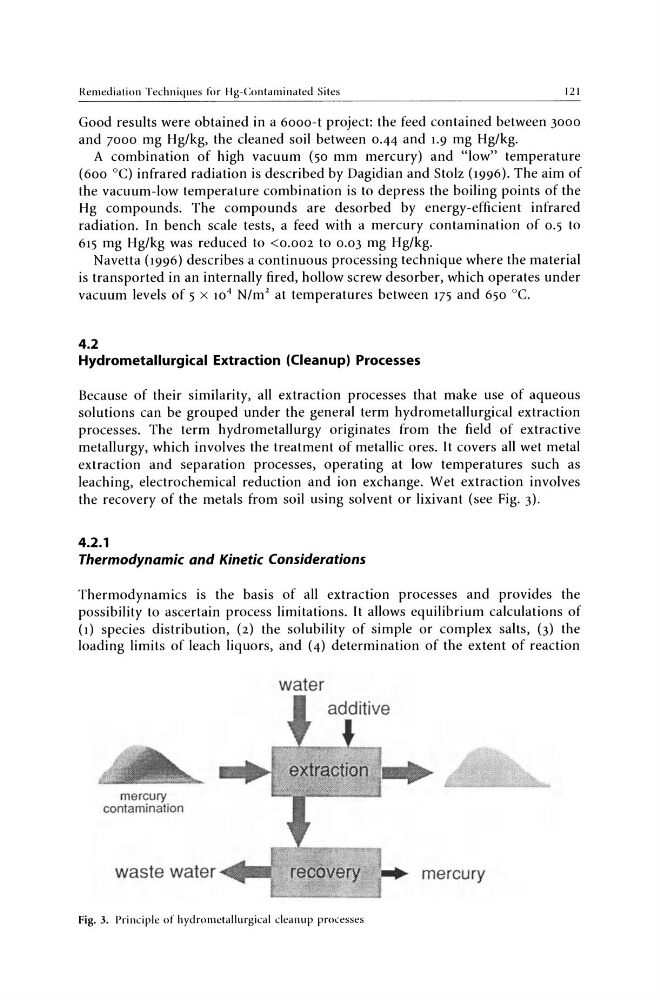
the recovery of the metals from soil using solvent or lixivant (see Fig. 3).
4.2.1
Thermodynamic and Kinetic Considerations
Thermodynamics is the basis of all extraction processes and provides the
possibility to ascertain process limitations. It allows equilibrium calculations of
(1) species distribution, (2) the solubility of simple or complex salts, (3) the
loading limits of leach liquors, and (4) determination of the extent of reaction
mercury
contamination
waste water __ _
water
additive
Fig. 3. Principle of hydroJlletallurgical cleanup processes
mercury
121
Good results were obtained in a 6000-t project: the feed contained between 3000
and 7000 mg Hg/kg, the cleaned soil between 0.44 and 1.9 mg Hg/kg.
A combination of high vacuum (50 mm mercury) and "low» temperature
(600 °C) infrared radiation is described by Dagidian and Stolz (1996). The aim of
the vacuum-low temperature combination is to depress the boiling points of the
Hg compounds. The compounds are desorbed by energy-efficient infrared
radiation. In bench scale tests, a feed with a mercury contamination of 0.5 to
615 mg Hg/kg was reduced to <0.002 to 0.03 mg Hg/kg.
Navetta (1996) describes a continuous processing technique where the material
is transported in an internally fired, hollow screw de sorber, which operates under
vacuum levels of 5 x 10 4 N/ml at temperatures between 175 and 650 °C.
4.2
Hydrometallurgical Extraction (Cleanup) Processes
Because of their similarity, all extraction processes that make use of aqueous
solutions can be grouped under the general term hydrometallurgical extraction
processes. The term hydrometallurgy originates from the field of extractive
metallurgy, which involves the treatment of metallic ores. It covers all wet metal
extraction and separation processes, operating at low temperatures such as
leaching, electrochemical reduction and ion exchange. Wet extraction involves
the recovery of the metals from soil using solvent or lixivant (see Fig. 3).
4.2.1
Thermodynamic and Kinetic Considerations
Thermodynamics is the basis of all extraction processes and provides the
possibility to ascertain process limitations. It allows equilibrium calculations of
(1) species distribution, (2) the solubility of simple or complex salts, (3) the
loading limits of leach liquors, and (4) determination of the extent of reaction
mercury
contamination
waste water __ _
water
additive
Fig. 3. Principle of hydroJlletallurgical cleanup processes
mercury