

106
R.R. Turner and G.R. Southworth
a few known examples where river sediments (e.g., Saltville) were dredged to
remove mercury from aquatic environments.
A limited number of sites are currently pumping and treating Hg-contaminated groundwater (GW). In addition to the groundwater treatment at Oak Ridge
and Lavaca Bay already described above, treatment is underway, or soon will be
at a number of other sites. For example, two spatially well-defined Hgcontaminated GW plumes (up to 40 pg 1-1) were found in Centreville, Mississippi, beneath a landfarm for refinery wastewater sludges. The nature of the Hg
sources was never identified and could not be unequivocably related to the
landfarming activity. Nonetheless, GW recovery systems were installed to capture
the plumes. A combination of capture wells and trenching was used to intercept
GW greater than the Maximum Concentration Limit (MCL) of 2 ~lg 1-1 for
mercury. To date, more than 70 million gallons of GW have been treated
successfully with activated carbon at this site. In another case Hg-contaminated
groundwater beneath a former chloralkali plant site in McIntosh, Alabama, is
being extracted using several wells with a combined pumping rate of 2000 to
2500 LPM. Treatment entails adsorption on activated carbon columns which
have not needed to be changed in 3 years [Influent (Hg) = 20 to 50 ~lg 1-1;
effluent (Hg) = < 0.2 ~Lg 1-1]. This equates to an effective carbon adsorption
capacity of approximately 0.18 kg of mercury per 45 kg of carbon (40 0 0 pg g-I).
This experience and the one described above suggest that activated carbon is an
effective sorbent for mercury, at least for water containing ~lg 1-1 levels of
mercury. Although activated carbon seems to be the most common sorbent used
to remove mercury, at least one former chloralkali plant site (Squamish, British
Columbia) is performing batch treatment of groundwater with precipitants
followed by filtration. Influent concentrations at this site are typically 400 ~Lg 1-1
and greater than 99% mercury removal is achieved.
As noted elsewhere in this Volume (Hempel and Thoeming), many remediation technologies have been proposed and evaluated at the laboratory or pilot
scale but, thus far, few have been demonstrated in North America.
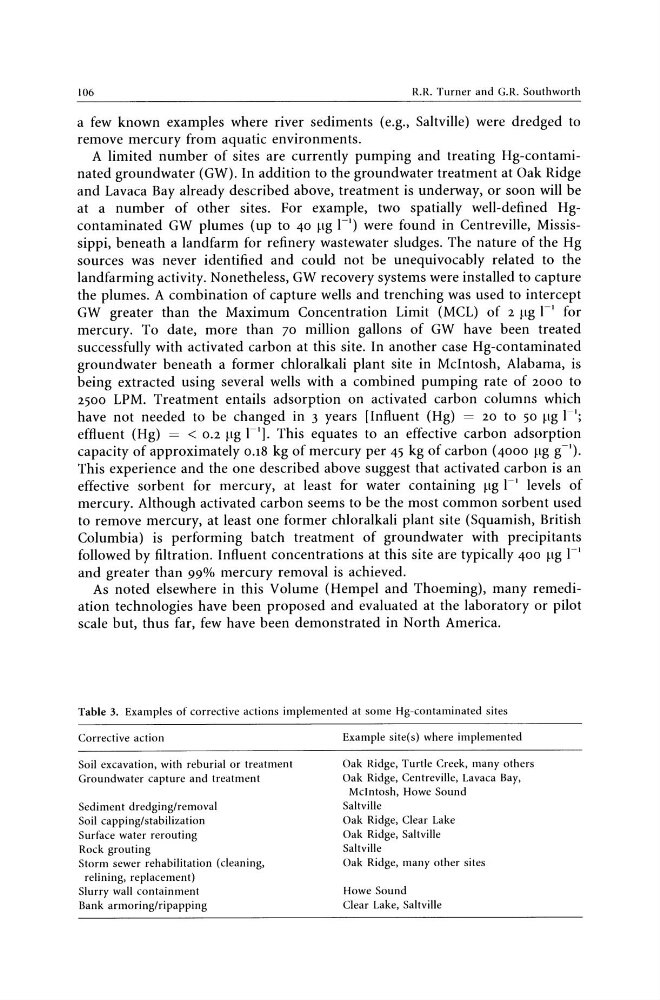
Table 3. Examples of corrective actions implemented at some Hg-contaminated sites
Corrective action
Soil excavation, with reburial or treatment
Groundwater capture and treatment
Sediment dredginglremoval
Soil capping/stabilization
Surface water rerouting
Rock grouting
Storm sewer rehabilitation (cleaning,
relining, replacement)
Slurry wall containment
Bank armoring/ripapping
Example site(s) where implemented
Oak Ridge, Turtle Creek, many others
Oak Ridge, Centreville, Lavaca Bay,
McIntosh, Howe Sound
Saltville
Oak Ridge, Clear Lake
Oak Ridge, Saltville
Saltville
Oak Ridge, many other sites
Howe Sound
Clear Lake, Saltville
R.R. Turner and G.R. Southworth
a few known examples where river sediments (e.g., Saltville) were dredged to
remove mercury from aquatic environments.
A limited number of sites are currently pumping and treating Hg-contaminated groundwater (GW). In addition to the groundwater treatment at Oak Ridge
and Lavaca Bay already described above, treatment is underway, or soon will be
at a number of other sites. For example, two spatially well-defined Hgcontaminated GW plumes (up to 40 pg 1-1) were found in Centreville, Mississippi, beneath a landfarm for refinery wastewater sludges. The nature of the Hg
sources was never identified and could not be unequivocably related to the
landfarming activity. Nonetheless, GW recovery systems were installed to capture
the plumes. A combination of capture wells and trenching was used to intercept
GW greater than the Maximum Concentration Limit (MCL) of 2 ~lg 1-1 for
mercury. To date, more than 70 million gallons of GW have been treated
successfully with activated carbon at this site. In another case Hg-contaminated
groundwater beneath a former chloralkali plant site in McIntosh, Alabama, is
being extracted using several wells with a combined pumping rate of 2000 to
2500 LPM. Treatment entails adsorption on activated carbon columns which
have not needed to be changed in 3 years [Influent (Hg) = 20 to 50 ~lg 1-1;
effluent (Hg) = < 0.2 ~Lg 1-1]. This equates to an effective carbon adsorption
capacity of approximately 0.18 kg of mercury per 45 kg of carbon (40 0 0 pg g-I).
This experience and the one described above suggest that activated carbon is an
effective sorbent for mercury, at least for water containing ~lg 1-1 levels of
mercury. Although activated carbon seems to be the most common sorbent used
to remove mercury, at least one former chloralkali plant site (Squamish, British
Columbia) is performing batch treatment of groundwater with precipitants
followed by filtration. Influent concentrations at this site are typically 400 ~Lg 1-1
and greater than 99% mercury removal is achieved.
As noted elsewhere in this Volume (Hempel and Thoeming), many remediation technologies have been proposed and evaluated at the laboratory or pilot
scale but, thus far, few have been demonstrated in North America.
Table 3. Examples of corrective actions implemented at some Hg-contaminated sites
Corrective action
Soil excavation, with reburial or treatment
Groundwater capture and treatment
Sediment dredginglremoval
Soil capping/stabilization
Surface water rerouting
Rock grouting
Storm sewer rehabilitation (cleaning,
relining, replacement)
Slurry wall containment
Bank armoring/ripapping
Example site(s) where implemented
Oak Ridge, Turtle Creek, many others
Oak Ridge, Centreville, Lavaca Bay,
McIntosh, Howe Sound
Saltville
Oak Ridge, Clear Lake
Oak Ridge, Saltville
Saltville
Oak Ridge, many other sites
Howe Sound
Clear Lake, Saltville