

36°45
0 51″N, 2°50
0 38″E) in the western part of Djamila
Bay. This port is characterized by the presence of small
fishing boats throughout the year, which use hydrocarbons as fuel and cause pollution from careening operations (painting, gasoline, detergent). Sediment and
seawater samples were collected aseptically in March 2016
from Sidi Fredj harbour. About 1 litter of seawater was
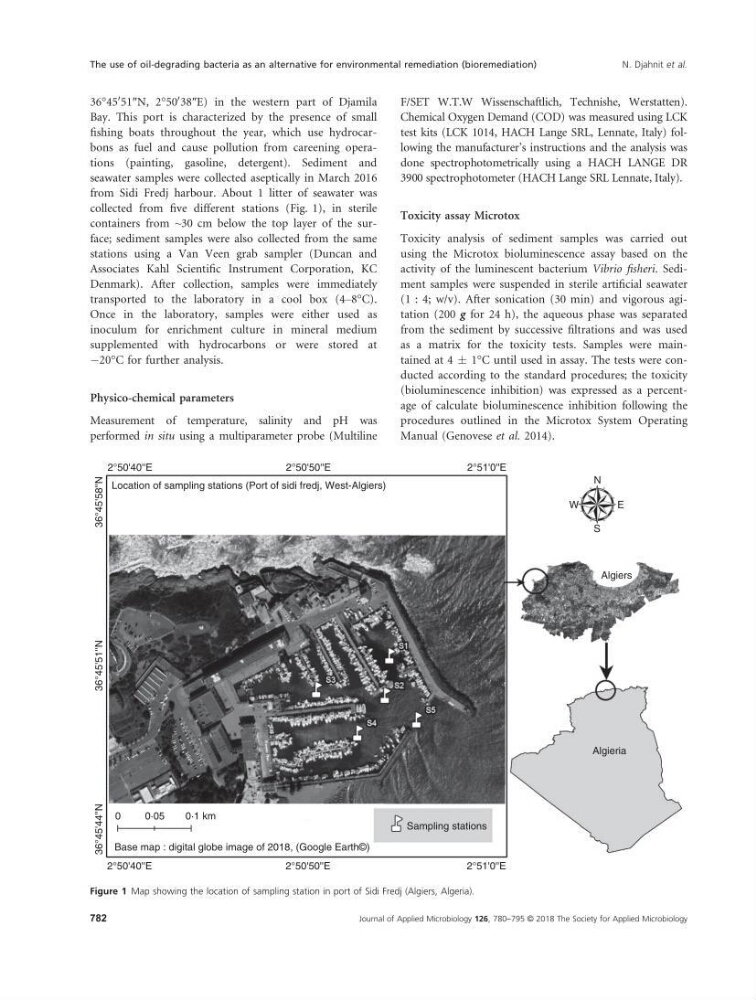
collected from five different stations (Fig. 1), in sterile
containers from ~30 cm below the top layer of the surface; sediment samples were also collected from the same
stations using a Van Veen grab sampler (Duncan and
Associates Kahl Scientific Instrument Corporation, KC
Denmark). After collection, samples were immediately
transported to the laboratory in a cool box (4–8°C).
Once in the laboratory, samples were either used as
inoculum for enrichment culture in mineral medium
supplemented with hydrocarbons or were stored at
À20°C for further analysis.
Physico-chemical parameters
Measurement of temperature, salinity and pH was
performed in situ using a multiparameter probe (Multiline
F/SET W.T.W Wissenschaftlich, Technishe, Werstatten).
Chemical Oxygen Demand (COD) was measured using LCK
test kits (LCK 1014, HACH Lange SRL, Lennate, Italy) following the manufacturer’s instructions and the analysis was
done spectrophotometrically using a HACH LANGE DR
3900 spectrophotometer (HACH Lange SRL Lennate, Italy).
Toxicity assay Microtox
Toxicity analysis of sediment samples was carried out
using the Microtox bioluminescence assay based on the
activity of the luminescent bacterium Vibrio fisheri. Sediment samples were suspended in sterile artificial seawater
(1 : 4; w/v). After sonication (30 min) and vigorous agitation (200 g for 24 h), the aqueous phase was separated
from the sediment by successive filtrations and was used
as a matrix for the toxicity tests. Samples were maintained at 4 Æ 1°C until used in assay. The tests were conducted according to the standard procedures; the toxicity
(bioluminescence inhibition) was expressed as a percentage of calculate bioluminescence inhibition following the
procedures outlined in the Microtox System Operating
Manual (Genovese et al. 2014).
Location of sampling stations (Port of sidi fredj, West-Algiers)
2°50'40''E
2°50'50''E
2°51'0''E
N
S
E
W
Algiers
Algieria
2°50'40''E
0
0·05
0·1 km
Base map : digital globe image of 2018, (Google Earth©)
36°45'44''N
36°45'51''N
36°45'58''N
2°50'50''E
Sampling stations
2°51'0''E
Figure 1 Map showing the location of sampling station in port of Sidi Fredj (Algiers, Algeria).
Journal of Applied Microbiology 126, 780--795 © 2018 The Society for Applied Microbiology
782
The use of oil-degrading bacteria as an alternative for environmental remediation (bioremediation)
N. Djahnit et al.
0 51″N, 2°50
0 38″E) in the western part of Djamila
Bay. This port is characterized by the presence of small
fishing boats throughout the year, which use hydrocarbons as fuel and cause pollution from careening operations (painting, gasoline, detergent). Sediment and
seawater samples were collected aseptically in March 2016
from Sidi Fredj harbour. About 1 litter of seawater was
collected from five different stations (Fig. 1), in sterile
containers from ~30 cm below the top layer of the surface; sediment samples were also collected from the same
stations using a Van Veen grab sampler (Duncan and
Associates Kahl Scientific Instrument Corporation, KC
Denmark). After collection, samples were immediately
transported to the laboratory in a cool box (4–8°C).
Once in the laboratory, samples were either used as
inoculum for enrichment culture in mineral medium
supplemented with hydrocarbons or were stored at
À20°C for further analysis.
Physico-chemical parameters
Measurement of temperature, salinity and pH was
performed in situ using a multiparameter probe (Multiline
F/SET W.T.W Wissenschaftlich, Technishe, Werstatten).
Chemical Oxygen Demand (COD) was measured using LCK
test kits (LCK 1014, HACH Lange SRL, Lennate, Italy) following the manufacturer’s instructions and the analysis was
done spectrophotometrically using a HACH LANGE DR
3900 spectrophotometer (HACH Lange SRL Lennate, Italy).
Toxicity assay Microtox
Toxicity analysis of sediment samples was carried out
using the Microtox bioluminescence assay based on the
activity of the luminescent bacterium Vibrio fisheri. Sediment samples were suspended in sterile artificial seawater
(1 : 4; w/v). After sonication (30 min) and vigorous agitation (200 g for 24 h), the aqueous phase was separated
from the sediment by successive filtrations and was used
as a matrix for the toxicity tests. Samples were maintained at 4 Æ 1°C until used in assay. The tests were conducted according to the standard procedures; the toxicity
(bioluminescence inhibition) was expressed as a percentage of calculate bioluminescence inhibition following the
procedures outlined in the Microtox System Operating
Manual (Genovese et al. 2014).
Location of sampling stations (Port of sidi fredj, West-Algiers)
2°50'40''E
2°50'50''E
2°51'0''E
N
S
E
W
Algiers
Algieria
2°50'40''E
0
0·05
0·1 km
Base map : digital globe image of 2018, (Google Earth©)
36°45'44''N
36°45'51''N
36°45'58''N
2°50'50''E
Sampling stations
2°51'0''E
Figure 1 Map showing the location of sampling station in port of Sidi Fredj (Algiers, Algeria).
Journal of Applied Microbiology 126, 780--795 © 2018 The Society for Applied Microbiology
782
The use of oil-degrading bacteria as an alternative for environmental remediation (bioremediation)
N. Djahnit et al.