

Références
bibliographiques
171
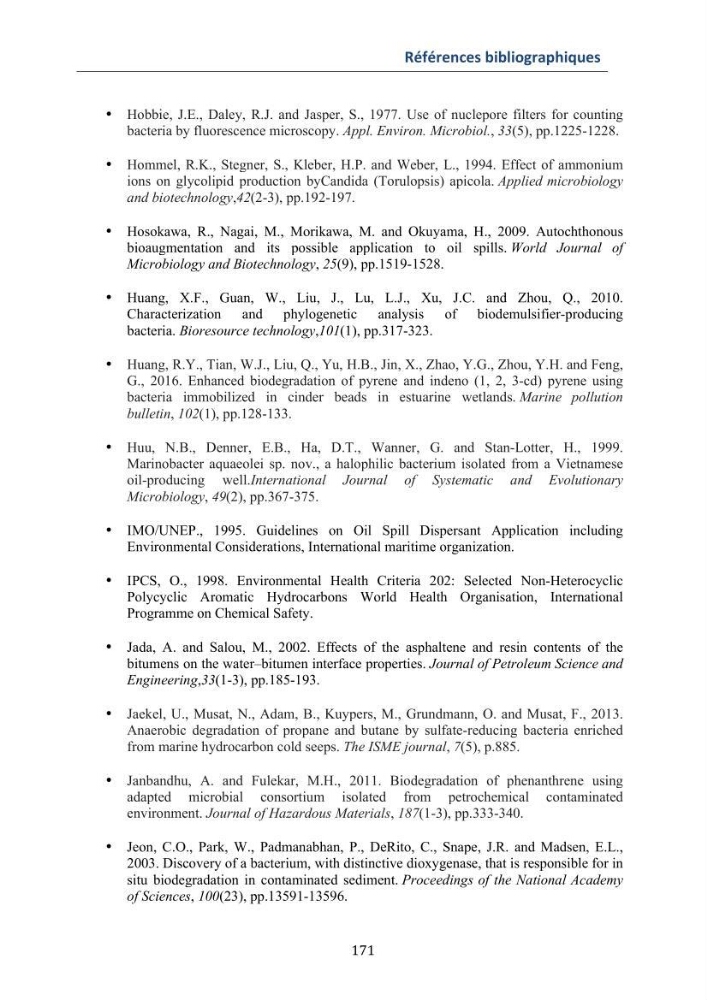
• Hobbie, J.E., Daley, R.J. and Jasper, S., 1977. Use of nuclepore filters for counting
bacteria by fluorescence microscopy. Appl. Environ. Microbiol., 33(5), pp.1225-1228.
• Hommel, R.K., Stegner, S., Kleber, H.P. and Weber, L., 1994. Effect of ammonium
ions on glycolipid production byCandida (Torulopsis) apicola. Applied microbiology
and biotechnology,42(2-3), pp.192-197.
• Hosokawa, R., Nagai, M., Morikawa, M. and Okuyama, H., 2009. Autochthonous
bioaugmentation and its possible application to oil spills. World Journal of
Microbiology and Biotechnology, 25(9), pp.1519-1528.
• Huang, X.F., Guan, W., Liu, J., Lu, L.J., Xu, J.C. and Zhou, Q., 2010.
Characterization and phylogenetic analysis of biodemulsifier-producing
bacteria. Bioresource technology,101(1), pp.317-323.
• Huang, R.Y., Tian, W.J., Liu, Q., Yu, H.B., Jin, X., Zhao, Y.G., Zhou, Y.H. and Feng,
G., 2016. Enhanced biodegradation of pyrene and indeno (1, 2, 3-cd) pyrene using
bacteria immobilized in cinder beads in estuarine wetlands. Marine pollution
bulletin, 102(1), pp.128-133.
• Huu, N.B., Denner, E.B., Ha, D.T., Wanner, G. and Stan-Lotter, H., 1999.
Marinobacter aquaeolei sp. nov., a halophilic bacterium isolated from a Vietnamese
oil-producing well.International Journal of Systematic and Evolutionary
Microbiology, 49(2), pp.367-375.
• IMO/UNEP., 1995. Guidelines on Oil Spill Dispersant Application including
Environmental Considerations, International maritime organization.
• IPCS, O., 1998. Environmental Health Criteria 202: Selected Non-Heterocyclic
Polycyclic Aromatic Hydrocarbons World Health Organisation, International
Programme on Chemical Safety.
• Jada, A. and Salou, M., 2002. Effects of the asphaltene and resin contents of the
bitumens on the water–bitumen interface properties. Journal of Petroleum Science and
Engineering,33(1-3), pp.185-193.
• Jaekel, U., Musat, N., Adam, B., Kuypers, M., Grundmann, O. and Musat, F., 2013.
Anaerobic degradation of propane and butane by sulfate-reducing bacteria enriched
from marine hydrocarbon cold seeps. The ISME journal, 7(5), p.885.
• Janbandhu, A. and Fulekar, M.H., 2011. Biodegradation of phenanthrene using
adapted microbial consortium isolated from petrochemical contaminated
environment. Journal of Hazardous Materials, 187(1-3), pp.333-340.
• Jeon, C.O., Park, W., Padmanabhan, P., DeRito, C., Snape, J.R. and Madsen, E.L.,
2003. Discovery of a bacterium, with distinctive dioxygenase, that is responsible for in
situ biodegradation in contaminated sediment. Proceedings of the National Academy
of Sciences, 100(23), pp.13591-13596.
bibliographiques
171
• Hobbie, J.E., Daley, R.J. and Jasper, S., 1977. Use of nuclepore filters for counting
bacteria by fluorescence microscopy. Appl. Environ. Microbiol., 33(5), pp.1225-1228.
• Hommel, R.K., Stegner, S., Kleber, H.P. and Weber, L., 1994. Effect of ammonium
ions on glycolipid production byCandida (Torulopsis) apicola. Applied microbiology
and biotechnology,42(2-3), pp.192-197.
• Hosokawa, R., Nagai, M., Morikawa, M. and Okuyama, H., 2009. Autochthonous
bioaugmentation and its possible application to oil spills. World Journal of
Microbiology and Biotechnology, 25(9), pp.1519-1528.
• Huang, X.F., Guan, W., Liu, J., Lu, L.J., Xu, J.C. and Zhou, Q., 2010.
Characterization and phylogenetic analysis of biodemulsifier-producing
bacteria. Bioresource technology,101(1), pp.317-323.
• Huang, R.Y., Tian, W.J., Liu, Q., Yu, H.B., Jin, X., Zhao, Y.G., Zhou, Y.H. and Feng,
G., 2016. Enhanced biodegradation of pyrene and indeno (1, 2, 3-cd) pyrene using
bacteria immobilized in cinder beads in estuarine wetlands. Marine pollution
bulletin, 102(1), pp.128-133.
• Huu, N.B., Denner, E.B., Ha, D.T., Wanner, G. and Stan-Lotter, H., 1999.
Marinobacter aquaeolei sp. nov., a halophilic bacterium isolated from a Vietnamese
oil-producing well.International Journal of Systematic and Evolutionary
Microbiology, 49(2), pp.367-375.
• IMO/UNEP., 1995. Guidelines on Oil Spill Dispersant Application including
Environmental Considerations, International maritime organization.
• IPCS, O., 1998. Environmental Health Criteria 202: Selected Non-Heterocyclic
Polycyclic Aromatic Hydrocarbons World Health Organisation, International
Programme on Chemical Safety.
• Jada, A. and Salou, M., 2002. Effects of the asphaltene and resin contents of the
bitumens on the water–bitumen interface properties. Journal of Petroleum Science and
Engineering,33(1-3), pp.185-193.
• Jaekel, U., Musat, N., Adam, B., Kuypers, M., Grundmann, O. and Musat, F., 2013.
Anaerobic degradation of propane and butane by sulfate-reducing bacteria enriched
from marine hydrocarbon cold seeps. The ISME journal, 7(5), p.885.
• Janbandhu, A. and Fulekar, M.H., 2011. Biodegradation of phenanthrene using
adapted microbial consortium isolated from petrochemical contaminated
environment. Journal of Hazardous Materials, 187(1-3), pp.333-340.
• Jeon, C.O., Park, W., Padmanabhan, P., DeRito, C., Snape, J.R. and Madsen, E.L.,
2003. Discovery of a bacterium, with distinctive dioxygenase, that is responsible for in
situ biodegradation in contaminated sediment. Proceedings of the National Academy
of Sciences, 100(23), pp.13591-13596.