

A New Approach in E. coli Identification
75
Scheme I
Scheme 2
Not exposed to
* E. coli
Exposed to
bacteriophages
0
A. aerogenes
bacteriophages
Θ Others
Identification of E. coli by bacteriophages
and quantitative estimation of coliforms
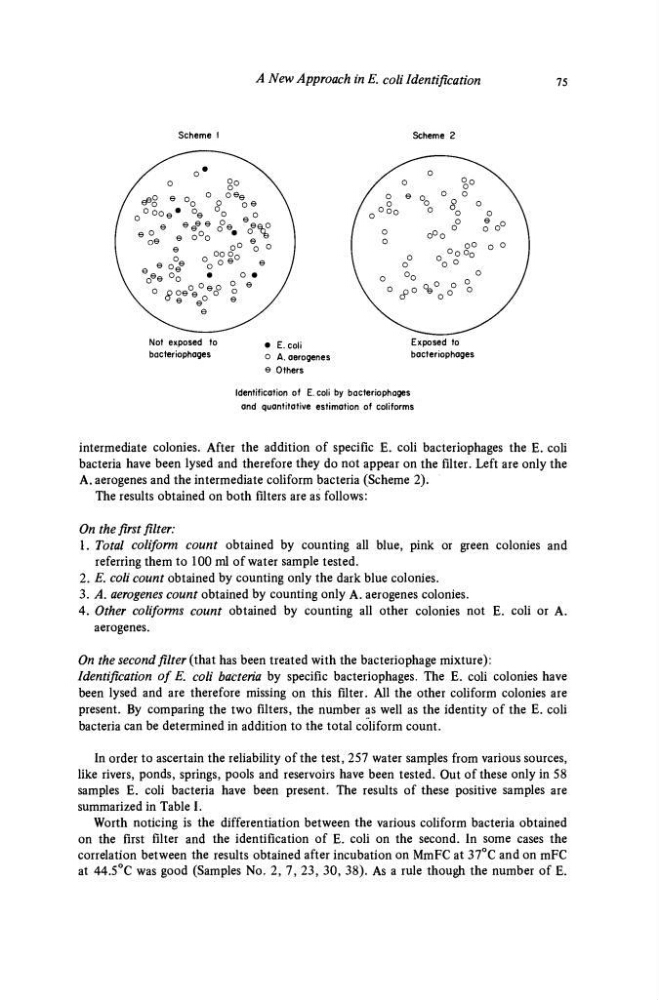
intermediate colonies. After the addition of specific E. coli bacteriophages the E. coli
bacteria have been lysed and therefore they do not appear on the filter. Left are only the
A. aerogenes and the intermediate coliform bacteria (Scheme 2).
The results obtained on both filters are as follows:
On the first filter:
1. Total coliform count obtained by counting all blue, pink or green colonies and
referring them to 100 ml of water sample tested.
2. E. coli count obtained by counting only the dark blue colonies.
3. A. aerogenes count obtained by counting only A. aerogenes colonies.
4. Other coliforms count obtained by counting all other colonies not E. coli or A.
aerogenes.
On the second filter (that has been treated with the bacteriophage mixture):
Identification of E. coli bacteria by specific bacteriophages. The E. coli colonies have
been lysed and are therefore missing on this filter. All the other coliform colonies are
present. By comparing the two filters, the number as well as the identity of the E. coli
bacteria can be determined in addition to the total coliform count.
In order to ascertain the reliability of the test, 257 water samples from various sources,
like rivers, ponds, springs, pools and reservoirs have been tested. Out of these only in 58
samples E. coli bacteria have been present. The results of these positive samples are
summarized in Table I.
Worth noticing is the differentiation between the various coliform bacteria obtained
on the first filter and the identification of E. coli on the second. In some cases the
correlation between the results obtained after incubation on MmFC at 37°C and on mFC
at 44.5°C was good (Samples No. 2, 7, 23, 30, 38). As a rule though the number of E.
75
Scheme I
Scheme 2
Not exposed to
* E. coli
Exposed to
bacteriophages
0
A. aerogenes
bacteriophages
Θ Others
Identification of E. coli by bacteriophages
and quantitative estimation of coliforms
intermediate colonies. After the addition of specific E. coli bacteriophages the E. coli
bacteria have been lysed and therefore they do not appear on the filter. Left are only the
A. aerogenes and the intermediate coliform bacteria (Scheme 2).
The results obtained on both filters are as follows:
On the first filter:
1. Total coliform count obtained by counting all blue, pink or green colonies and
referring them to 100 ml of water sample tested.
2. E. coli count obtained by counting only the dark blue colonies.
3. A. aerogenes count obtained by counting only A. aerogenes colonies.
4. Other coliforms count obtained by counting all other colonies not E. coli or A.
aerogenes.
On the second filter (that has been treated with the bacteriophage mixture):
Identification of E. coli bacteria by specific bacteriophages. The E. coli colonies have
been lysed and are therefore missing on this filter. All the other coliform colonies are
present. By comparing the two filters, the number as well as the identity of the E. coli
bacteria can be determined in addition to the total coliform count.
In order to ascertain the reliability of the test, 257 water samples from various sources,
like rivers, ponds, springs, pools and reservoirs have been tested. Out of these only in 58
samples E. coli bacteria have been present. The results of these positive samples are
summarized in Table I.
Worth noticing is the differentiation between the various coliform bacteria obtained
on the first filter and the identification of E. coli on the second. In some cases the
correlation between the results obtained after incubation on MmFC at 37°C and on mFC
at 44.5°C was good (Samples No. 2, 7, 23, 30, 38). As a rule though the number of E.