

D I S C U S S I O N
J.E. Keil, USA
This paper identifies dosimeters of pollution inferring that there is an inverse relationship between
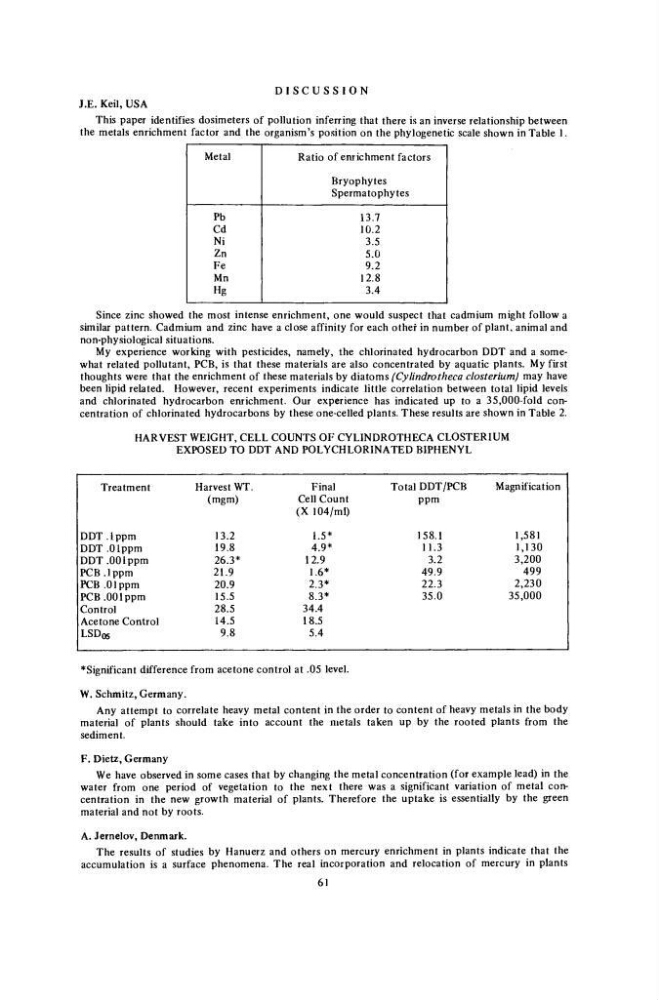
the metals enrichment factor and the organism's position on the phylogenetic scale shown in Table 1.
Metal
Pb
Cd
Ni
Zn
Fe
Mn
Hg
Ratio of enrichment factors
Bryophytes
Spermatophytes
13.7
10.2
3.5
5.0
9.2
12.8
3.4
Since zinc showed the most intense enrichment, one would suspect that cadmium might follow a
similar pattern. Cadmium and zinc have a close affinity for each other in number of plant, animal and
non-physiological situations.
My experience working with pesticides, namely, the chlorinated hydrocarbon DDT and a somewhat related pollutant, PCB, is that these materials are also concentrated by aquatic plants. My first
thoughts were that the enrichment of these materials by diatoms (Cylindrotheca closterium) may have
been lipid related. However, recent experiments indicate little correlation between total lipid levels
and chlorinated hydrocarbon enrichment. Our experience has indicated up to a 35,000-fold concentration of chlorinated hydrocarbons by these one-celled plants. These results are shown in Table 2.
HARVEST WEIGHT, CELL COUNTS OF CYLINDROTHECA CLOSTERIUM
EXPOSED TO DDT AND POLYCHLORINATED BIPHENYL
Treatment
DDT.lppm
DDT.Olppm
DDT.OOlppm
PCB.lppm
PCB .Olppm
PCB.OOlppm
Control
Acetone Control
LSDQS
Harvest WT.
(mgm)
13.2
19.8
26.3*
21.9
20.9
15.5
28.5
14.5
9.8
Final
Cell Count
(X 104/ml)
1.5*
4.9*
12.9
1.6*
2.3*
8.3*
34.4
18.5
5.4
Total DDT/PCB
ppm
158.1
11.3
3.2
49.9
22.3
35.0
Magnification
1,581
1,130
3,200
499
2,230
35,000
*Significant difference from acetone control at .05 level.
W. Schmitz, Germany.
Any attempt to correlate heavy metal content in the order to content of heavy metals in the body
material of plants should take into account the metals taken up by the rooted plants from the
sediment.
F. Dietz, Germany
We have observed in some cases that by changing the metal concentration (for example lead) in the
water from one period of vegetation to the next there was a significant variation of metal concentration in the new growth material of plants. Therefore the uptake is essentially by the green
material and not by roots.
A. Jernelov, Denmark.
The results of studies by Hanuerz and others on mercury enrichment in plants indicate that the
accumulation is a surface phenomena. The real incorporation and relocation of mercury in plants
61
J.E. Keil, USA
This paper identifies dosimeters of pollution inferring that there is an inverse relationship between
the metals enrichment factor and the organism's position on the phylogenetic scale shown in Table 1.
Metal
Pb
Cd
Ni
Zn
Fe
Mn
Hg
Ratio of enrichment factors
Bryophytes
Spermatophytes
13.7
10.2
3.5
5.0
9.2
12.8
3.4
Since zinc showed the most intense enrichment, one would suspect that cadmium might follow a
similar pattern. Cadmium and zinc have a close affinity for each other in number of plant, animal and
non-physiological situations.
My experience working with pesticides, namely, the chlorinated hydrocarbon DDT and a somewhat related pollutant, PCB, is that these materials are also concentrated by aquatic plants. My first
thoughts were that the enrichment of these materials by diatoms (Cylindrotheca closterium) may have
been lipid related. However, recent experiments indicate little correlation between total lipid levels
and chlorinated hydrocarbon enrichment. Our experience has indicated up to a 35,000-fold concentration of chlorinated hydrocarbons by these one-celled plants. These results are shown in Table 2.
HARVEST WEIGHT, CELL COUNTS OF CYLINDROTHECA CLOSTERIUM
EXPOSED TO DDT AND POLYCHLORINATED BIPHENYL
Treatment
DDT.lppm
DDT.Olppm
DDT.OOlppm
PCB.lppm
PCB .Olppm
PCB.OOlppm
Control
Acetone Control
LSDQS
Harvest WT.
(mgm)
13.2
19.8
26.3*
21.9
20.9
15.5
28.5
14.5
9.8
Final
Cell Count
(X 104/ml)
1.5*
4.9*
12.9
1.6*
2.3*
8.3*
34.4
18.5
5.4
Total DDT/PCB
ppm
158.1
11.3
3.2
49.9
22.3
35.0
Magnification
1,581
1,130
3,200
499
2,230
35,000
*Significant difference from acetone control at .05 level.
W. Schmitz, Germany.
Any attempt to correlate heavy metal content in the order to content of heavy metals in the body
material of plants should take into account the metals taken up by the rooted plants from the
sediment.
F. Dietz, Germany
We have observed in some cases that by changing the metal concentration (for example lead) in the
water from one period of vegetation to the next there was a significant variation of metal concentration in the new growth material of plants. Therefore the uptake is essentially by the green
material and not by roots.
A. Jernelov, Denmark.
The results of studies by Hanuerz and others on mercury enrichment in plants indicate that the
accumulation is a surface phenomena. The real incorporation and relocation of mercury in plants
61