

THE ENRICHMENT OF HEAVY METALS
IN SUBMERGED PLANTS
F. DIETZ
Ruhrverband, D-4300 Essen, Kronprinzenstr. 37, F.R.G.
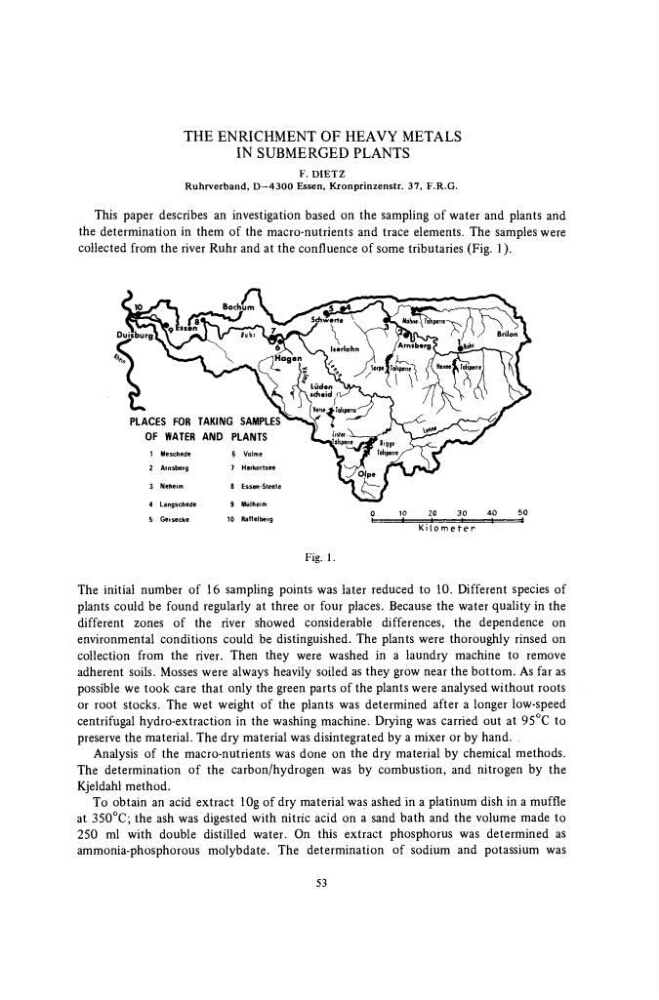
This paper describes an investigation based on the sampling of water and plants and
the determination in them of the macro-nutrients and trace elements. The samples were
collected from the river Ruhr and at the confluence of some tributaries (Fig. 1).
K i l o m e t e r
Fig. 1.
The initial number of 16 sampling points was later reduced to 10. Different species of
plants could be found regularly at three or four places. Because the water quality in the
different zones of the river showed considerable differences, the dependence on
environmental conditions could be distinguished. The plants were thoroughly rinsed on
collection from the river. Then they were washed in a laundry machine to remove
adherent soils. Mosses were always heavily soiled as they grow near the bottom. As far as
possible we took care that only the green parts of the plants were analysed without roots
or root stocks. The wet weight of the plants was determined after a longer low-speed
centrifugal hydro-extraction in the washing machine. Drying was carried out at 95°C to
preserve the material. The dry material was disintegrated by a mixer or by hand. .
Analysis of the macro-nutrients was done on the dry material by chemical methods.
The determination of the carbon/hydrogen was by combustion, and nitrogen by the
Kjeldahl method.
To obtain an acid extract 10g of dry material was ashed in a platinum dish in a muffle
at 350°C; the ash was digested with nitric acid on a sand bath and the volume made to
250 ml with double distilled water. On this extract phosphorus was determined as
ammonia-phosphorous molybdate. The determination of sodium and potassium was
53
IN SUBMERGED PLANTS
F. DIETZ
Ruhrverband, D-4300 Essen, Kronprinzenstr. 37, F.R.G.
This paper describes an investigation based on the sampling of water and plants and
the determination in them of the macro-nutrients and trace elements. The samples were
collected from the river Ruhr and at the confluence of some tributaries (Fig. 1).
K i l o m e t e r
Fig. 1.
The initial number of 16 sampling points was later reduced to 10. Different species of
plants could be found regularly at three or four places. Because the water quality in the
different zones of the river showed considerable differences, the dependence on
environmental conditions could be distinguished. The plants were thoroughly rinsed on
collection from the river. Then they were washed in a laundry machine to remove
adherent soils. Mosses were always heavily soiled as they grow near the bottom. As far as
possible we took care that only the green parts of the plants were analysed without roots
or root stocks. The wet weight of the plants was determined after a longer low-speed
centrifugal hydro-extraction in the washing machine. Drying was carried out at 95°C to
preserve the material. The dry material was disintegrated by a mixer or by hand. .
Analysis of the macro-nutrients was done on the dry material by chemical methods.
The determination of the carbon/hydrogen was by combustion, and nitrogen by the
Kjeldahl method.
To obtain an acid extract 10g of dry material was ashed in a platinum dish in a muffle
at 350°C; the ash was digested with nitric acid on a sand bath and the volume made to
250 ml with double distilled water. On this extract phosphorus was determined as
ammonia-phosphorous molybdate. The determination of sodium and potassium was
53