

632
L.R.J. van Vuuren, J.W. Funke and L. Smith
aeration efficiency depended on the levels of the water in the aeration vessel. Since then
this level is automatically maintained at about one third of the vessel's capacity and no
further difficulties have been experienced.
The reclaimed water was of such a quality that it could, after sand filtration, be used
in all sections of the pulp and paper mill without deleterious effects on the quality of the
J6600go l
ALO M 7 0 rnq/ l
IsOOOgo l I
NoO
H
I
I
t
φ ©
SAMPLING POINTS
m"
ιβ"
f
Mc COM B ANCO R
Sawog t Work s
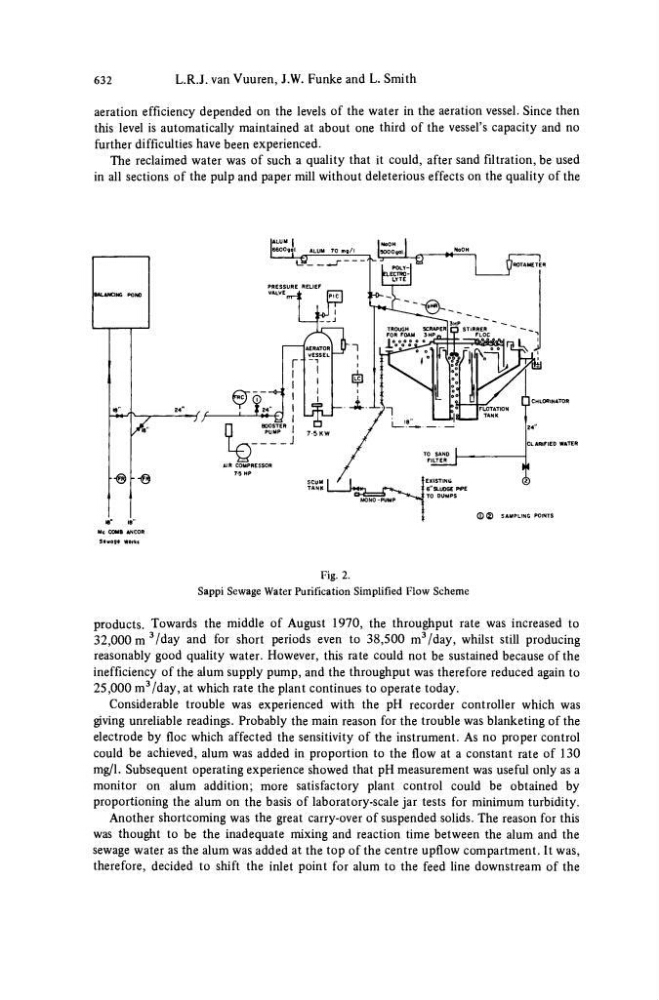
Fig. 2.
Sappi Sewage Water Purification Simplified Flow Scheme
products. Towards the middle of August 1970, the throughput rate was increased to
32,000 m
3 /day and for short periods even to 38,500 m
3 /day, whilst still producing
reasonably good quality water. However, this rate could not be sustained because of the
inefficiency of the alum supply pump, and the throughput was therefore reduced again to
25,000 m
3 /day, at which rate the plant continues to operate today.
Considerable trouble was experienced with the pH recorder controller which was
giving unreliable readings. Probably the main reason for the trouble was blanketing of the
electrode by floe which affected the sensitivity of the instrument. As no proper control
could be achieved, alum was added in proportion to the flow at a constant rate of 130
mg/1. Subsequent operating experience showed that pH measurement was useful only as a
monitor on alum addition; more satisfactory plant control could be obtained by
proportioning the alum on the basis of laboratory-scale jar tests for minimum turbidity.
Another shortcoming was the great carry-over of suspended solids. The reason for this
was thought to be the inadequate mixing and reaction time between the alum and the
sewage water as the alum was added at the top of the centre upflow compartment. It was,
therefore, decided to shift the inlet point for alum to the feed line downstream of the